Independently Owned, Locally Grown, Community Loved

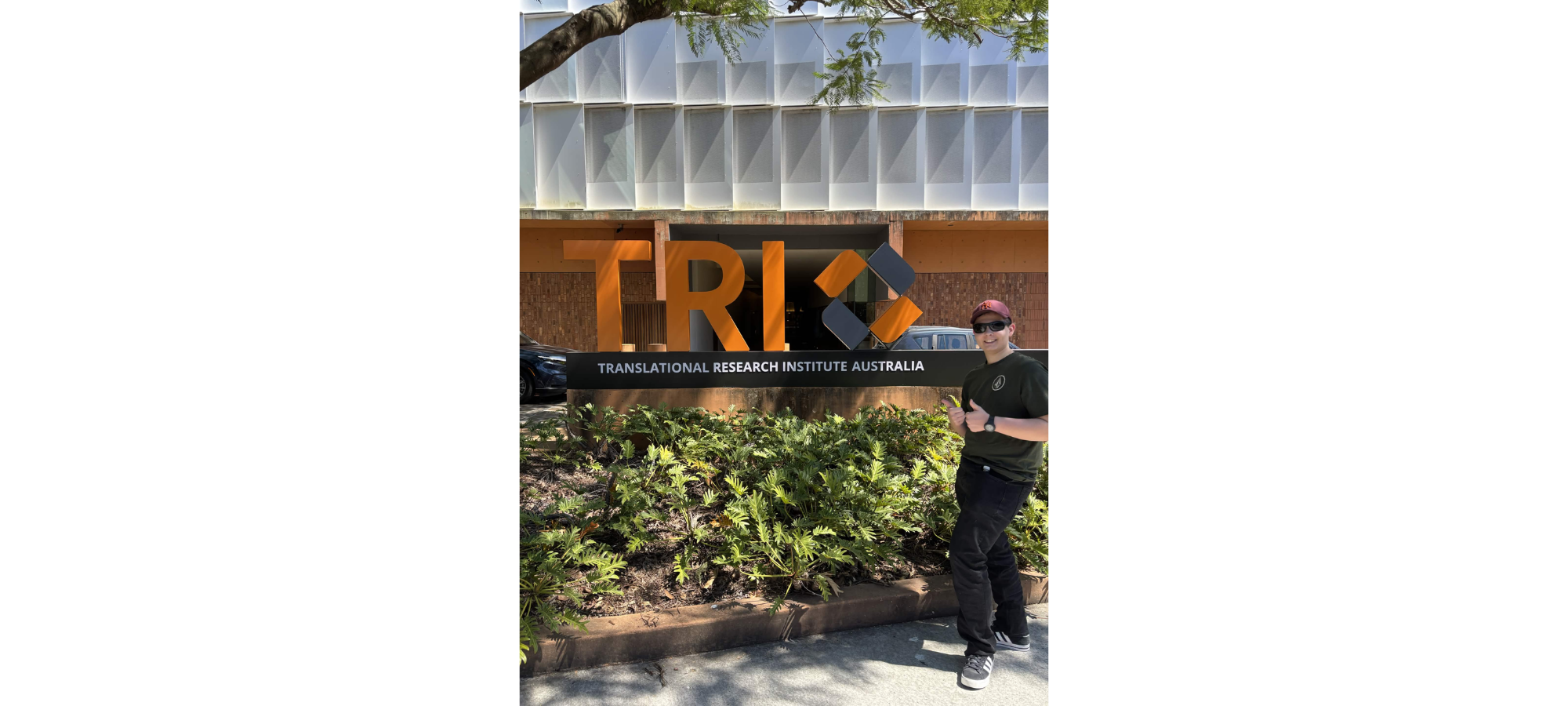
Year 12 student Brayden Becke was chosen from 150 applicants to participate in the SPARQ-ed Senior Research Immersion Program at Brisbane’s Translational Research Institute. Photo supplied
An Ayr State High School student was one of just 20 across Queensland selected to investigate cancer treatments in a prestigious biomedical research program.
Year 12 student Brayden Becke was chosen from 150 applicants to participate in the SPARQ-ed Senior Research Immersion Program at Brisbane’s Translational Research Institute.
Across the five-day program, Brayden worked alongside teachers and research scientists in TRI’s purpose-built PC2 laboratory, using specialist equipment to conduct experiments, analyse results and develop his research and communication skills.
Intrigued by scientific research since primary school, he called the opportunity “amazing”, albeit somewhat unexpected.
“Getting selected felt like a fever dream … It felt like I had truly earned my place among the best and the brightest,” he said.
“Living in such a small town, it can be hard to be passionate about my career when there is so little opportunity to express that passion. But being in Brisbane surrounded by people who are all equally as driven by their love of biomedical science as I was? It was amazing.”
The first three days of the program saw students complete two experiments. The research focused on oxidative damage caused by certain cancer treatments, examining whether two laboratory assays could kill HeLa cancer cells while leaving HEK293T cells largely unharmed.
Brayden worked with laboratory samples and chemicals, using pipettes and microscopes to assess the effects of the treatments on the cells before presenting findings to Professor Brian Gabrielli.
With limited laboratory experience before the program, he said the opportunity gave him an unprecedented look into the field he hopes to pursue professionally.
“One of my biggest takeaways from the programme is that science takes time,” he said.
“But it was also great to see just what needs to be done to do even the simplest toss in a lab. The cleaning, the preparing, the safety checks, you need to leave as little room for error to get the best possible results.”
Brayden said he applied for the program to gain a better understanding of what a career in health sciences could look like after high school, encouraged by his school’s head of science.
Already accepted into James Cook University’s Bachelor of Biomedical Science/Bachelor of Laboratory Medicine, Brayden hopes to one day research DNA and genes to develop treatments for genetic disorders.
Publishers Indemnity. Any individual or entity that places advertising, supplies copy material, or submits editorial content to Core Life Publishing agrees and undertakes to ensure that all such material:- Does not infringe upon any copyright, trademark, or other intellectual property rights;- Is free from any content that could be considered defamatory, libelous, or slanderous;- Does not infringe upon any rights related to privacy or breach of confidence;- Contains no obscene, indecent, or otherwise unlawful material;- Complies fully with the Trade Practices Act and all other applicable laws, regulations, or statutes.Furthermore, by submitting or placing such material, these individuals or entities agree to indemnify and hold harmless the publisher, Core Publishing and Events Pty Ltd, and/or its agents from and against any and all investigations, claims, demands, liabilities, damages, costs, or judgments arising out of or in connection with the material provided. All material is believed to be accurate at the time of printing and remains the copyright of Core Publishing and Events Pty Ltd.
© 2026 Life Publishing Group Pty Ltd.