
Independently Owned, Locally Grown, Community Loved

By Chelsea Ravizza What began as a passion project for Home Hill's Jonathan Caspanello has evolved into a successful fashion and lifestyle brand, with the 23-year-old entrepreneur crediting his regional upbringing for helping shape both the business and the person behind it. “It [Home Hill] was the kind of community where everyone got around each other, supported one another and celebrated each other's successes, and those values have stayed with me throughout my life and continue to influence both who I am and the way I approach business today,” he said. Since launching Caspa Collective at just 21-years-old, Jono has grown the label into a recognised brand with a strong social media presence, loyal customer base and a growing community of supporters. After moving to Brisbane to complete a Bachelor of Education (Primary) at Australian Catholic University, following in the footsteps of his mother, Kavette, Jono discovered a passion for fashion, branding and content creation while working as a teacher aide. “I’ve always enjoyed creating things. Whether it was ideas, projects or content, I liked bringing something from imagination into reality,” he said. His entrepreneurial journey began close to home, inspired by watching his father, Warren, build a successful business from the ground up. Combined with a fascination for social media and the ability of brands to connect with people through storytelling, design and culture, it sparked a desire to create something of his own. While Caspa Collective now operates primarily from Brisbane, the Burdekin remains at the heart of the brand's identity. Even its name carries a personal connection, with "Caspa" derived from Caspanello. “I wanted a name that reflected who I am, where I come from and the journey, I'm on. The word ‘Collective’ was equally important because the brand has never been just about me. It's about the people who support it, wear it, model it and help bring ideas to life.” Over the years, Jono has learned that building a successful clothing brand involves far more than designing apparel. Through a largely self-taught journey into entrepreneurship, he has developed skills across content creation, branding, social media, website development, manufacturer liaison and campaign production. “One of the biggest lessons I've learned is that consistency matters more than perfection,” Jono reflected. “When you're starting out, it's easy to think everything needs to be perfect before you launch something. The reality is that you learn by doing. Every collection, photoshoot, campaign and product release teaches you something new.” Another lesson has been the importance of building genuine connections. “People connect with stories, personalities and communities far more than they connect with products alone,” he said. That support network starts close to home, with his sisters Rylee, Elly and Deni, along with his father and extended family, all playing a role in helping the brand grow. “When you're building something from the ground up, it's often the people closest to you who become your biggest supporters. Their encouragement, willingness to help and belief in what I'm building have been invaluable,” he said. “Every person who wears a Caspa Collective piece, shares a post or recommends the brand to someone else contributes to its growth. That's why community remains at the heart of everything we do.” Looking to the future, Jono believes Caspa Collective is only just getting started. More than a clothing brand, it has become a reflection of his journey, his Burdekin upbringing and the community that helped shape him; a reminder that with hard work, persistence and a willingness to take a chance, even the simplest idea can evolve into something far greater. “If I could offer one piece of advice to other young people from regional communities who have an idea they're passionate about, it would be this: don't let where you come from limit what you believe is possible,” he said. “Growing up in a small town can sometimes make opportunities feel further away, but technology has changed that. Today, you can build a business, launch a brand and connect with people all over the world from almost anywhere. You don't need all the answers before you begin, and you certainly don't need everything to be perfect. “The biggest regret is often not trying at all. Start before you're ready, stay patient, keep learning and trust the process. Small steps taken consistently over time can create opportunities you never imagined possible.” CAPTION: Jono Caspanello and his father, Warren Caspanello. Photo supplied
Read the full story
It is show season and we should start seeing it all come together over the next week as the party comes to town. The show society has been doing a great job over the years and each year they seem to find a way to keep it fresh and entertaining. Whilst my boys are all grown up and not making me buy show bags anymore. We do still like to go along and check it out. The water festival had its launch last Friday and I’m told it was a great night. Wonderful to see so many entrants participating and getting involved. I look forward to many months of activities and fun things to do. I got myself down to groper creek briefly last week and it was great to see all the nomads in town and set up to enjoy our beautiful weather. The area looked absolutely spectacular and I can see why so many regulars come back every year. Welcome back and thanks for coming to join us again. The crushing is underway and this a timely reminder to use your train brain. I spoke to one farmer this week who got a bit closer to a cane fire than he liked, so I’ll take this opportunity to remind all of us in the industry to where your PPE and take care. It’s very easy to get complacent, especially when everyone is in a rush. Take care everyone.
Read the full story
Supplied by the Office of Federal Member for Dawson, Andrew Willcox Tax, the three-letter word Labor loves most, goes hand in hand with the other three-letter word Labor does best—lie. It would be mission impossible to count the number of times the Prime Minister, the Treasurer and senior Labor ministers promised there would be “no changes” to Capital Gains Tax or negative gearing. They said ‘no changes’ before the election, after the election and even earlier this year. Literally hundreds of times, they gave Australians the same assurance. Repeatedly challenged by the media, they doubled down every single time. Then, on Budget night, only a few weeks ago, the government announced that the changes would be brought in. These tax changes are not “intergenerational fairness”. They are nothing more than a tax grab designed to fund Labor’s wasteful spending and economic incompetence. And the people who will pay the highest price are young Australians with aspiration. Under Labor’s changes, existing investments will be grandfathered. Those already in the market keep the current rules, while younger Australians looking to build wealth through investment face higher taxes and fewer opportunities. A young couple hoping to invest in a rental property will no longer receive the same negative gearing benefits. A young worker wanting to build a share portfolio, trade crypto, or invest in a small business will face a higher Capital Gains Tax burden than previous generations. Labor claims to stand for fairness, but there is nothing fair about pulling the ladder up behind you. Taxing aspiration is profoundly un-Australian. The economic consequences will also be severe. Labor itself admits these changes will place upward pressure on rents, although it claims the impact will only be around $2 a week. This is the same government that promised households would be $275 better off on their power bills. So, if the government’s own modelling is pointing to increased costs, the reality will be a disaster for renters. With interest rates again marching north and home ownership becoming harder, more Australians, especially younger Australians, are relying on the rental market. Yet Labor is actively discouraging property investment. The economics are simple. Fewer investors mean fewer rental properties, tighter vacancy rates and higher rents. That hurts every Australian renter. These changes will also discourage people from moving investment capital into more productive opportunities. Investors who remain under the existing rules will be reluctant to sell assets because any new investment will fall under Labor’s new tax regime. Flipping houses will become a thing of the past, meaning less stock returning to the market for prospective homeowners. Instead of encouraging economic activity and investment, Labor is creating uncertainty and stagnation. The Coalition opposes these damaging new taxes and will repeal them in government. Australia should be a country that rewards hard work, encourages investment and supports aspiration, not one that punishes people for trying to get ahead and set up their future. Stop the lies – Reverse the Tax. CAPTION: “It would be mission impossible to count the number of times the Prime Minister, the Treasurer and senior Labor ministers promised there would be “no changes” to Capital Gains Tax or negative gearing.” Photo source: Website/Andrew Willcox MP
Read the full story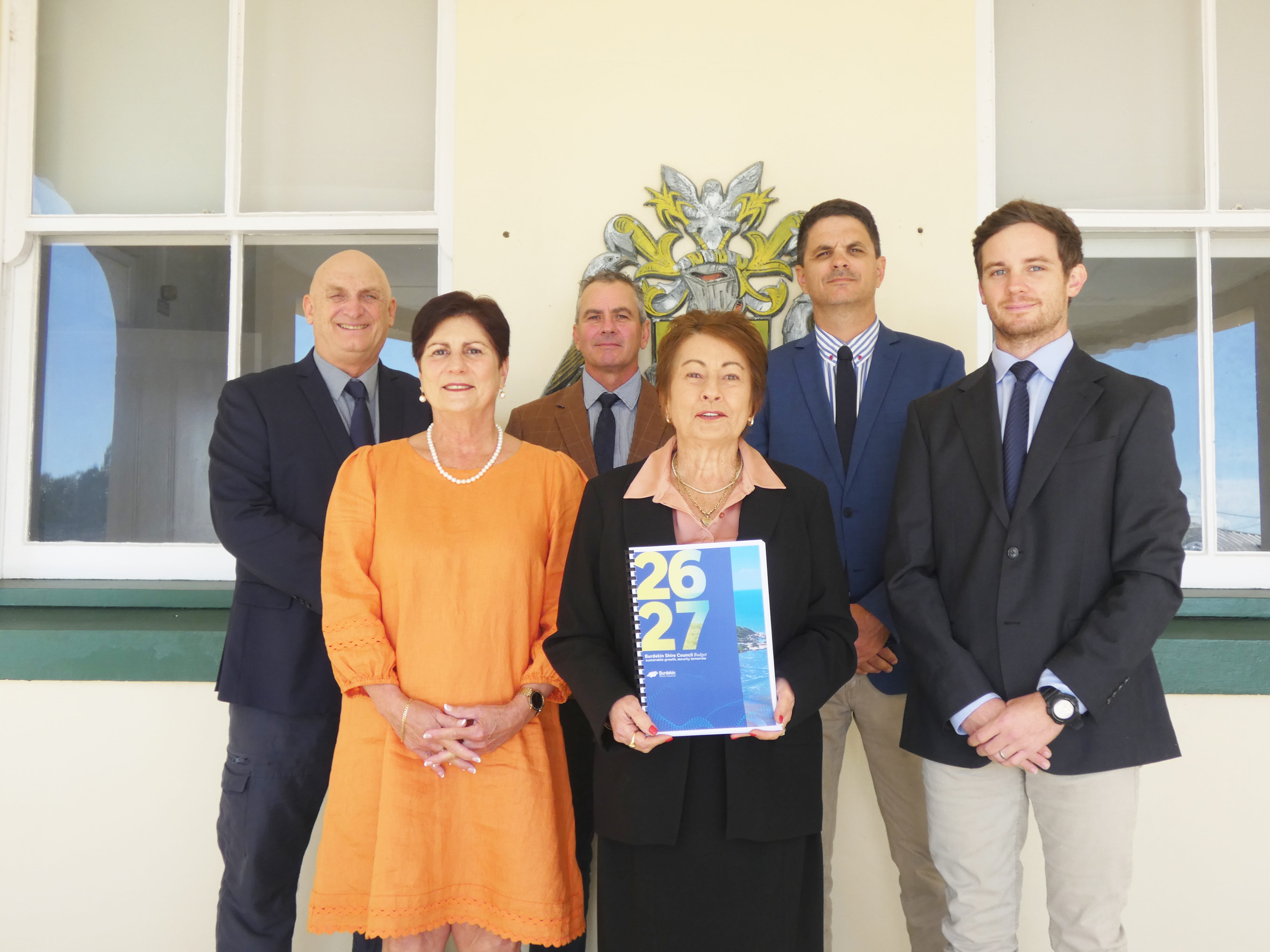
Burdekin Shire Council has handed down a $106.9 million budget for 2026/27, introducing a 1.5 per cent general rate rise to fund major upgrades to roads, drainage, and water infrastructure. The “Sustainable Growth, Security Tomorrow” budget allocates $36.2 million for capital works and $70.7 million for operational activities. While waste services rates will remain steady, residents face a 3 per cent increase in water access charges and a 6 per cent hike in sewerage charges to fund the ongoing delivery of high-quality services. Mayor Pierina Dalle Cort said the budget adopts a practical, forward-looking approach that balances financial pressures on households with the need to maintain essential services. “Sustainable Growth, Security Tomorrow is about investing in the infrastructure our community needs now while preparing for the future,” Mayor Dalle Cort said. “We understand the financial pressures many households are facing, and this Budget has been carefully planned to balance those pressures with the need to continue delivering essential services.” More than $24.6 million will flow directly into the region's transport and flood mitigation networks. Key projects include a $5 million road and kerb reconstruction at the Ayr Industrial Estate, a $2.8 million upgrade to Upper Haughton Road, and a $1.15 million sealing project on Thompson Road. The drainage network will also receive a major boost in the form of $3.6 million Ayr Town Drain improvements and a $1.6 million drainage upgrade at Wickham Street Anzac Park. Mayor Dalle Cort said strengthening these networks is critical to the local economy and agricultural productivity. “Our road and drainage networks are essential to the functioning of our community and economy,” she said. “This year’s program focuses on strengthening infrastructure, improving flood resilience and supporting future growth across the Shire, while also supporting local industry and agricultural productivity through improved access and freight reliability.” Essential water and sewer services comprise another major pillar of the budget. Council has allocated $1.96 million specifically for sewerage infrastructure upgrades alongside significant drinking water investments. Major water utility projects include the $1.5 million South Ayr Water Treatment upgrade, a $1.2 million pipeline augmentation in Home Hill, and a $1 million sewer relining and manhole rehabilitation project. “While often out of sight, these services play a vital role in our community, from supporting public health to protecting the environment and ensuring everything runs safely and reliably,” Mayor Dalle Cort said. Community liveability and lifestyle projects will progress under the budget, backed by state and federal funding programs. Notable allocations include $1.2 million for the Home Hill Swimming Pool upgrades, $500,000 for the Burdekin Be-Active Trail, and $440,000 for the Plantation Park Nature Based Play Area carpark. CAPTION: Burdekin Shire Councillors John Furnell (back-left), Max Musumeci (back-centre), Callan Oar (back-right), Fina Vasta (front-left) and Michael Detenon (front-right) with Mayor Dalle Cort (front-centre) at the conclusion of the 2026/27 budget meeting. Missing: Councillor Amanda Hall. Photo credit: Jacob Casha
Read the full story
.jpg)
FriendlyCare Pharmacy offers a Medication Packing Service designed to take the stress out of your daily routine, so you can focus on what matters most: your health. Photo supplied
Managing multiple medications every day is no small task. For many Australians, keeping track of what to take, when to take it, and whether a dose has already been taken can quickly become overwhelming, and the consequences of getting it wrong can be serious.
That's why FriendlyCare Pharmacy offers a Medication Packing Service designed to take the stress out of your daily routine, so you can focus on what matters most: your health.
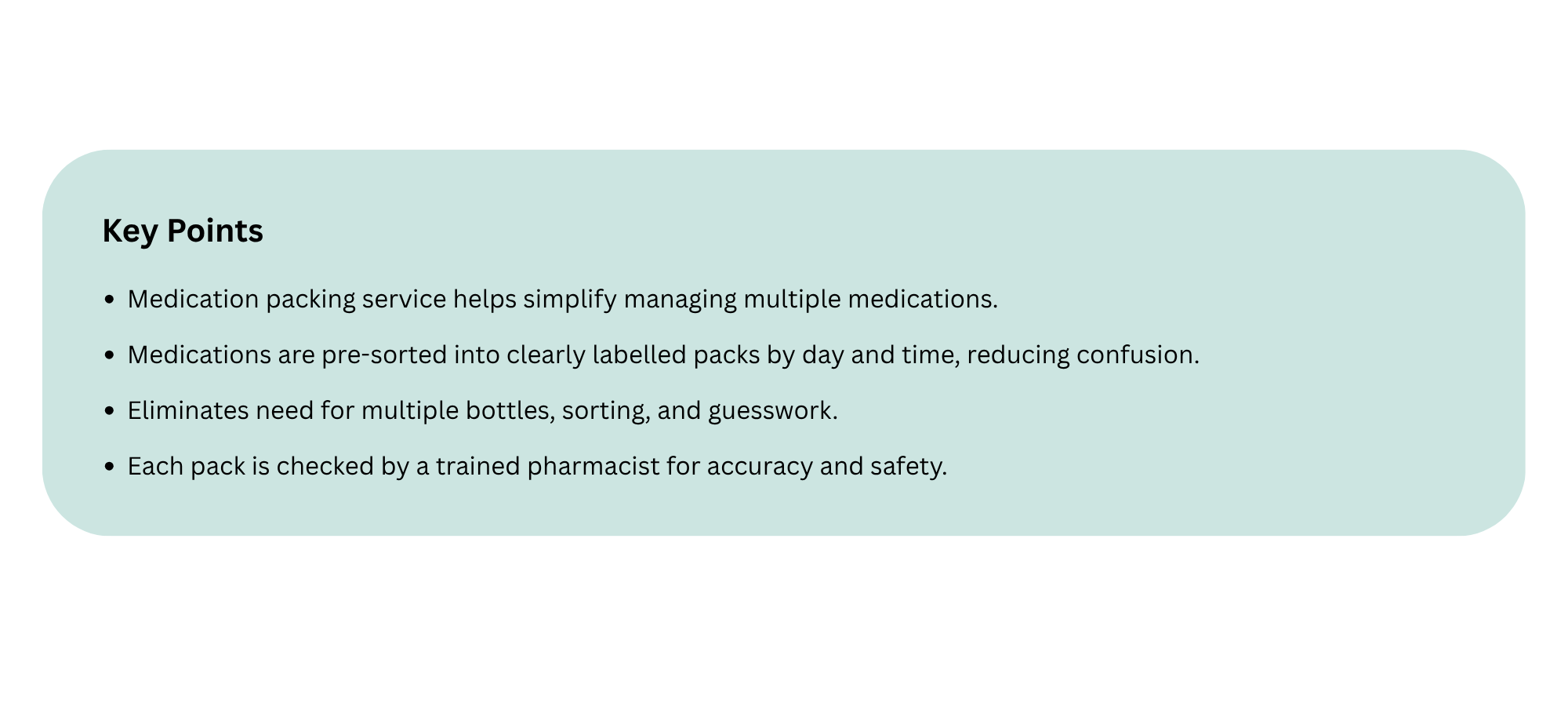
Medication packing, often referred to as blister packing, is a service where your pharmacist sorts and pre-packages your medications into clearly labelled packs organised by day and time. Instead of managing multiple bottles and boxes, you simply open the correct pack for that day and time. No sorting, no guesswork, no worry.
Each pack is carefully checked by a trained FriendlyCare pharmacist before it reaches your hands, giving you confidence that every dose is exactly right.
Medication packing is particularly valuable for anyone who takes three or more medications, manages a chronic condition, cares for an elderly or unwell family member, or simply wants peace of mind that their routine is correct. It is equally helpful for busy individuals who travel regularly, as a pre-packed supply is easy to take on the go without the risk of forgetting or misplacing individual medications.
"We see so many patients who come in feeling overwhelmed by their medications," says Lorenza, pharmacist at FriendlyCare Pharmacy.
"Medication packing makes such a practical difference. When everything is sorted and labelled for you, it removes the daily pressure and helps people feel more confident and in control of their health."
Beyond the practical benefits, medication packing can genuinely improve health outcomes. Missed doses and medication errors are among the most common, and most preventable, health issues in Australia. Having medications pre-packed by day and time significantly reduces the risk of missed doses, double-dosing, and confusion between similar-looking tablets.
FriendlyCare also offers free one-on-one Medication Reviews, where your pharmacist reviews all of your prescriptions, over-the-counter products and supplements together. This helps identify any potential interactions, expired or duplicated medications, or unnecessary side effects that may be affecting your wellbeing.
To find out if medication packing is right for you, simply pop into FriendlyCare Pharmacy Ayr for a chat. There is no obligation, and the conversation is relaxed, confidential and completely personalised to your needs.
You can also download the free MedAdvisor app to manage your digital prescriptions, set medication reminders and request repeats from home, keeping you connected to your FriendlyCare pharmacist wherever you are.
Scan the QR code in this advertisement to download your free Medication Management eBook or visit FriendlyCare Pharmacy Ayr to book your free Medication Review today.
This article provides general health information only. Always consult with a qualified healthcare provider before starting, stopping or changing any medication.
Contributed with thanks to FriendlyCare Pharmacy
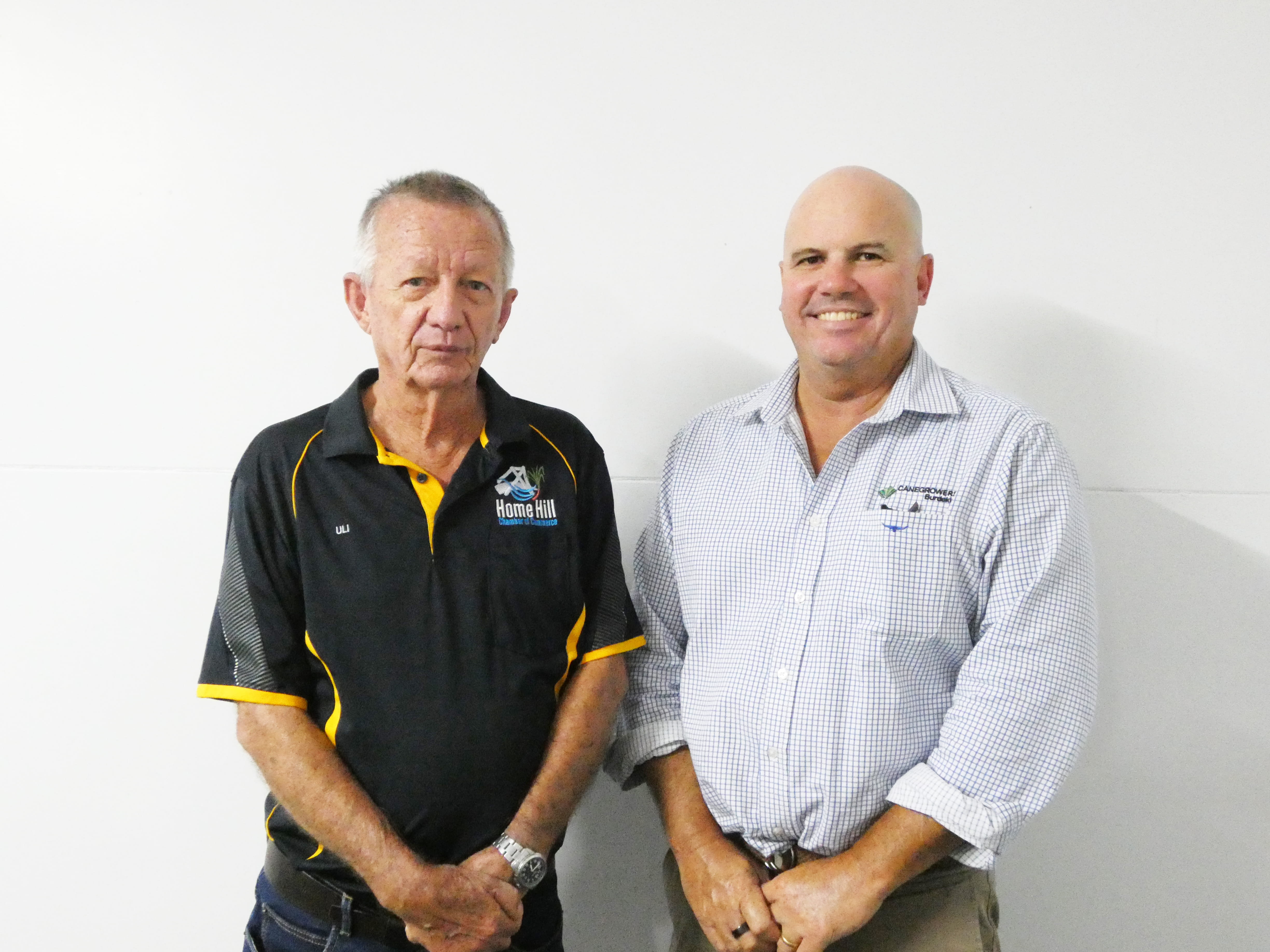
Home Hill Chamber of Commerce President Uli Liessmann alongside director of CANEGROWERS Burdekin Limited and President of the World Association of Beet and Cane Growers (WABCG), Owen Menkens. Photo supplied
Owen Menkens, director of CANEGROWERS Burdekin Limited and President of the World Association of Beet and Cane Growers (WABCG), said the Burdekin sugar industry is stable with room for growth, speaking to the Home Hill Chamber of Commerce last Wednesday.
The evening’s keynote speaker, Menkens addressed a modest crowd of locals at the Home Hill Community Sports Club, touching on the local sugar industry picture and future forecasts.
He said that while sugar prices are in something of a lull, the situation is not unprecedented. He backed current Burdekin sugar farming infrastructure to weather the storm, calling it “one of the best in the world.”
Menkens said that key to the Burdekin’s sugar farming future would be the next generation, and that CANEGROWERS initiatives targeted at the younger generations have yielded success.
“We’ve done a lot of educational work with future generations,” he said.
“The look on these kids faces… when they see what you can do in the industry and the opportunity, they were just blown away. They couldn’t believe it.”
He remains optimistic of a successful passing of the torch.
“We’re not an ageing industry in the Burdekin,” Menkens said.
“We’ve got a lot of young growers coming into the industry fresh from other districts, and a lot locally coming onto their farms and taking them on.”
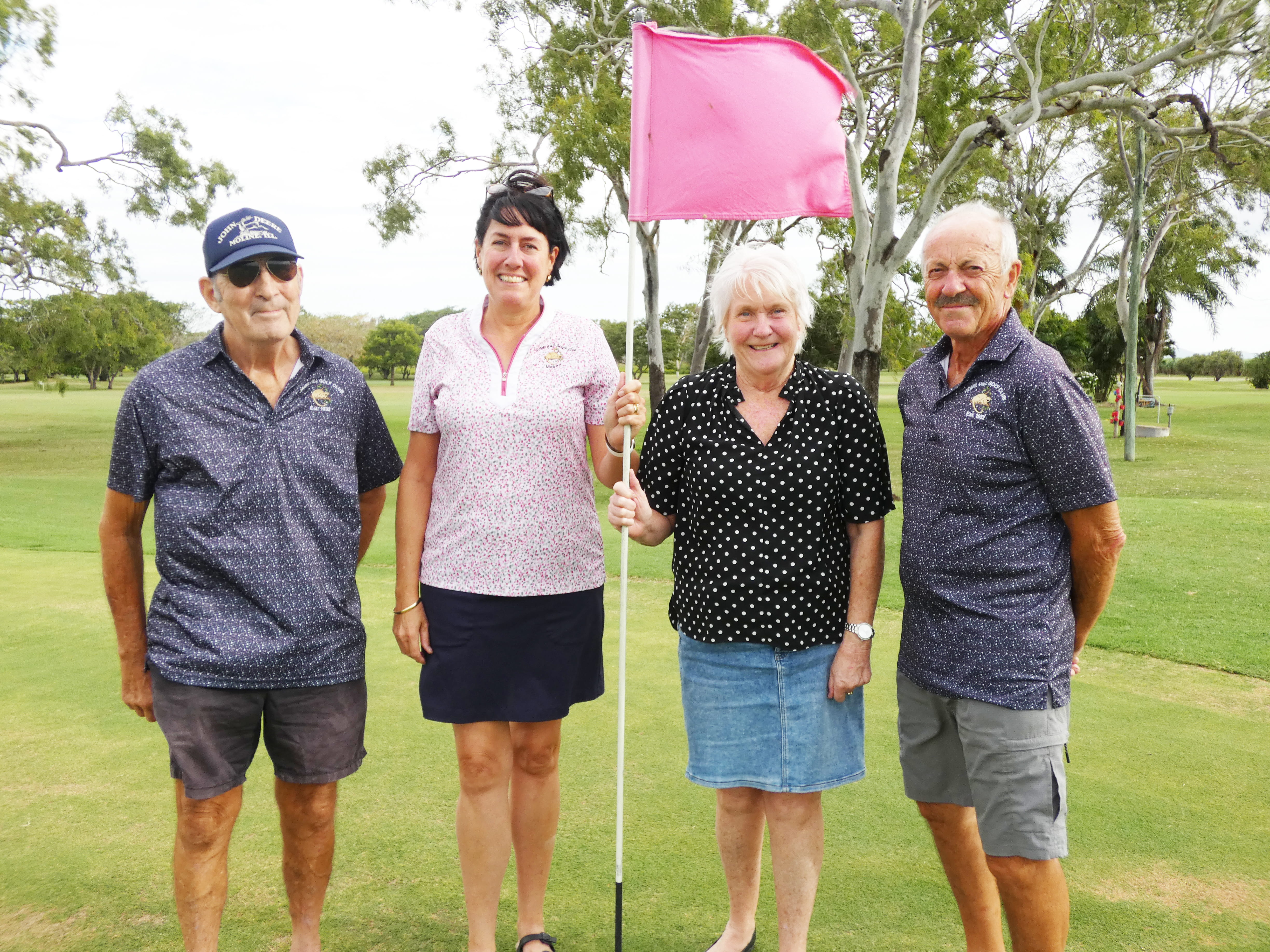
Home Hill Golf Club has received a welcome boost, securing $13,629 in funding through the latest round of Gambling Community Benefit Fund (GCBF) grants. Photo credit: Jacob Casha
Home Hill Golf Club has received a welcome boost, securing $13,629 in funding through the latest round of Gambling Community Benefit Fund (GCBF) grants.
The round saw the Crisafulli Government distribute about $19.5 million to nearly 800 community groups across Queensland, with grants of up to $35,000 supporting projects ranging from facility upgrades to equipment purchases and community programs.
Club Secretary Megan Barbagallo said the news was met with excitement and relief, particularly after several unsuccessful applications in previous rounds.
“We were absolutely thrilled to receive the call from Burdekin MP Dale Last,” Mrs Barbagallo said.
“After missing out before, this grant means a great deal to our club and shows that persistence really does pay off.”
The funding will go towards replacing the roof of the club’s machinery shed, which has significantly deteriorated over time.
“Our shed roof is in very poor condition and has been leaking, putting important equipment at risk,” she said.
“This upgrade will ensure our machinery is properly protected and can continue to be used to maintain the course.”
Mrs Barbagallo said projects like this would be extremely difficult for a small community club to fund on its own.
“Clubs like ours rely heavily on grant funding to complete essential infrastructure upgrades. Without this support, many of these projects simply wouldn’t be possible,” she said.
The need for the upgrade was driven by ongoing wear and tear, with the roof reaching a point where replacement could no longer be delayed.
While the improvement may not be immediately visible to visitors, Mrs Barbagallo said it would have a lasting impact on the overall club experience.
“By protecting our equipment, we can ensure the course remains in great condition for our members, guests, and visitors,” she said.
“It all contributes to maintaining a high standard across the club.”
Home Hill Golf Club has undertaken a number of improvements in recent years, many made possible through successful grant applications, reinforcing its commitment to providing quality facilities for the local community.

Nominations for the Queensland Landcare Awards will close on Friday, 31 July. Photo source: Pexels
Nominations are now open for the 2026 Queensland Landcare Awards, recognising the everyday Queenslanders making a difference in their local environments.
The biennial awards celebrate individuals, groups and organisations dedicated to restoring bushland, protecting waterways, improving soil health, caring for coastlines and supporting sustainable environmental practices across the state.
From volunteer groups regenerating creeks to farming families trialling innovative approaches, schools introducing students to landcare, and First Nations organisations caring for Country, the awards highlight the wide range of contributions being made at a grassroots level.
Nominations are free and open to everyone, including self-nominations, with entries closing on Friday, 31 July, 2026.
Award categories span a diverse range of areas, including innovation, sustainable agriculture and community partnerships, reflecting the many ways Queenslanders are working to protect and enhance the natural environment.
The Queensland Landcare Awards are considered a prestigious state program, shining a spotlight on those driving real, on-the-ground change in their communities — not in distant locations, but right across regional and rural Queensland.
Winners in selected categories will progress as finalists to the 2027 National Landcare Awards, to be held in Adelaide, South Australia, providing an opportunity for local efforts to gain national recognition.
Community members are encouraged to nominate individuals or groups making a positive impact, or to put forward their own work.
For more information or to submit a nomination, visit the Landcare Australia website at www.landcareaustralia.org.au/awards.

Image from Pexels
Australian farmers are set to benefit from faster access to fertiliser following new measures introduced by the Government to streamline import processes without compromising biosecurity.
Announced on 16 April 2026, the changes aim to reduce delays at ports, cut costs and ease administrative burdens, while maintaining Australia’s strict biosecurity standards.
The Government said the move comes amid ongoing global pressure on fertiliser supply, particularly due to conflict in the Middle East, which has impacted availability and delivery times.
Under the updated system, imported fertiliser will undergo improved offshore certification processes, ensuring goods are free from biosecurity risk material before arriving in Australia. Importers using higher-risk pathways will also be required to provide samples for inspection, while registration and compliance processes will be simplified.
Despite the streamlined approach, strict safeguards remain in place, including the requirement that all imported inorganic fertiliser be free from contaminants.
The announcement builds on a range of existing measures designed to support the agriculture sector, including the establishment of a Fertiliser Supply Working Group, collaboration with alternative suppliers, and legislative changes to support private sector purchasing.
Minister for Agriculture, Fisheries and Forestry Julie Collins said the changes strike a balance between efficiency and safety.
“We understand how important fertiliser is for Australian farmers and our food production system,” she said.
“That’s why the Government is working day and night with industry to support fertiliser getting to Australian farmers. We have engaged closely with industry to establish these changes, and appreciate Fertilizer Australia’s commitment to practical collaboration and problem solving.
“The Government will never compromise on biosecurity, but this is a sensible way to streamline the robust systems in place to help get the fertiliser we need faster.”
Fertilizer Australia Chief Executive Officer Stephen Annells welcomed the announcement, highlighting the importance of collaboration between industry and government.
“Fertilizer Australia is committed to working alongside the government, ensuring that our collaborative efforts lead to sound biosecurity systems and timely access to fertiliser for Australian farmers,” he said.
“This partnership not only emphasises the importance of practical solutions but also reinforces our shared dedication to maintaining rigorous biosecurity standards, protecting Australia's farming ecosystems and export markets.”

Over early morning coffees at Chill Café, the Burdekin Chamber of Commerce wasn’t just ticking through an agenda, it was quietly mapping out how to keep the region’s small businesses moving in a tightening economic climate.
With Small Business Month around the corner, the Chamber is leaning into practical support, announcing hands-on “Canva Made Simple” workshops aimed at helping local operators sharpen their branding and social media presence. The sessions promise something rare for time-poor business owners, walking away with content ready to use.
But beneath the surface, there’s a stronger message: spend local, and spend it now.
With around 800 Burdekin Gift Cards still in circulation ahead of a platform transition, members were urged to actively use and promote the cards. The recent purchase of more than $2,000 worth of cards by the Burdekin Eisteddfod was highlighted as a win, but also a reminder of what’s at stake.
There’s also creativity brewing, with plans for a “Burdekin Bingo” initiative designed to gamify local spending and draw customers into Chamber businesses in a fresh, interactive way.
Beyond business promotion, broader pressures were also in focus. Rising fuel costs and upcoming wage changes are adding strain, with updates shared on available ATO relief measures for affected businesses.
Meanwhile, Mayor Pierina Dalle Cort flagged ongoing housing challenges in the region, hinting that potential development announcements could be on the horizon.
From digital skills to economic survival, the message from the Chamber was clear: in the Burdekin, small business success will depend on community support, and a willingness to adapt.

The Coalition has launched the Australian Values Migration Plan, a decisive package aimed at restoring integrity to a migration system it claims has been left in "chaos" under the Albanese Government.
Federal Member for Dawson, Andrew Willcox, said the plan is designed to ensure those seeking to call Australia home share the nation's core values, laws, and freedoms.
“Since Labor took office, the migration program has lacked direction: numbers have soared while standards have plummeted,” Mr Willcox said.
“The Coalition’s plan will restore integrity and ensure our migration system serves the national interest. Living in Australia is a privilege, not a right: those who come here must respect our laws, share our values, and contribute to our nation.”
The first stage of the plan includes three key pillars:
Compliance with the Australian Values Statement will become a universal, binding visa condition. This allows for visas to be refused or cancelled where individuals fail to uphold these values. Breaches will be codified as grounds for failing the Character Test under the Migration Act 1958, leading to removal.
To deter unfounded claims, a "Safe Country List" will be introduced to fast-track refusals from places deemed safe. The Coalition also intends to restore Temporary Protection Visas and provide additional funding to deport the 65,000 unlawful non-citizens currently in Australia.
Vetting will be strengthened through a new Enhanced Screening Coordination Centre, making social media screening a standard feature. Real-time, risk-based vetting will aim to identify and block individuals who pose a security threat.
Mr Willcox said Australia has the right to be selective.
“If you share our values and want to strengthen our nation, you are welcome; however, if you reject the rule of law, parliamentary democracy, or individual freedoms like freedom of speech and religion, you will be happier elsewhere,” he said.
“To protect our way of life and restore Australians’ standard of living, we must reduce immigration numbers and lift migration standards.”
Contributed with thanks to the office of Member for Dawson, Andrew Willcox

Rod, Joe, Phil and Raman pitched in to install the new signing at Groper Creek Caravan Park. Photo source: Groper Creek Caravan Park
The Home Hill Boat Club has taken another step towards cementing Groper Creek Caravan Park’s reputation as “the best place to visit, fish, relax and make lasting memories,” with the recent installation of new directional signage.
In the wake of last year’s flood event, the club took the opportunity to reassess the park and its facilities, concluding that a refresh and a series of improvements were needed to maintain its appeal for both loyal visitors and new travellers.
“Groper Creek isn’t just a stopover,” said Home Hill Boat Club Secretary Sue Malaponte.
“It’s a place where locals gather for family outings, fishing, camping, and school holiday fun. With that in mind, the committee set out to create a more welcoming, vibrant and enjoyable environment for everyone who uses the park.”
A range of upgrades is set to roll out over the coming years, with Ms Malaponte confirming the committee has been actively pursuing funding and grants to support the projects, particularly following a period of limited improvements.
“Fresh ideas are always being explored, and one long-term vision is the development of a dedicated clubhouse for the Home Hill Boat Club and its members,” she said.
With a history spanning more than eight decades, the club has long been a valued part of the Burdekin Shire community, despite never having a clubhouse of its own. Many believe a purpose-built facility would strengthen the club’s long-term sustainability while enhancing the experience for caravan park visitors.
“While the clubhouse remains a future goal, several shorter-term projects are already underway, helping to steadily improve the park and create a more welcoming environment for everyone,” Ms Malaponte added.
Over the years, the club has been supported by a strong base of dedicated members. The committee recently acknowledged the passing of Life Member and long-serving Treasurer Alf Shand, whose contribution was deeply valued, while long-time Commodore, Life Member and patron John Fahey remains an active and supportive presence.
Ms Malaponte said the club continues to benefit from the commitment of both long-standing and newer members, along with strong local support.
“Members like Rod, Joe, Phil and Raman have played a key role in recent improvements,” she said.
“Without their time, skills and willingness to pitch in, many of these projects simply wouldn’t have been possible.”
Their efforts, alongside many others, continue to drive improvements across the park, ensuring Groper Creek remains a welcoming and enjoyable destination for residents, visitors and caravan guests alike, offering a relaxed coastal setting with opportunities for fishing, crabbing and boating.
Over the Easter break and school holidays, the park was buzzing with activity, with children enjoying the Easter egg hunt, families gathering along the jetty, and visitors chatting, laughing and heading out for a fish.
Feedback on the recent upgrades has been overwhelmingly positive, with many visitors commenting on how well the park is looking, the clarity of the new signage, and how much easier it is to navigate the caravan sites.
“The Home Hill Boat Club and Groper Creek Caravan Park look forward to welcoming many familiar caravanner faces, along with plenty of new visitors, throughout the coming season and well into the future,” Ms Malaponte said.
“Visitors will be welcomed by Gail and Raman, the Caravan Park Managers, along with the Home Hill Boat Club committee and members.”
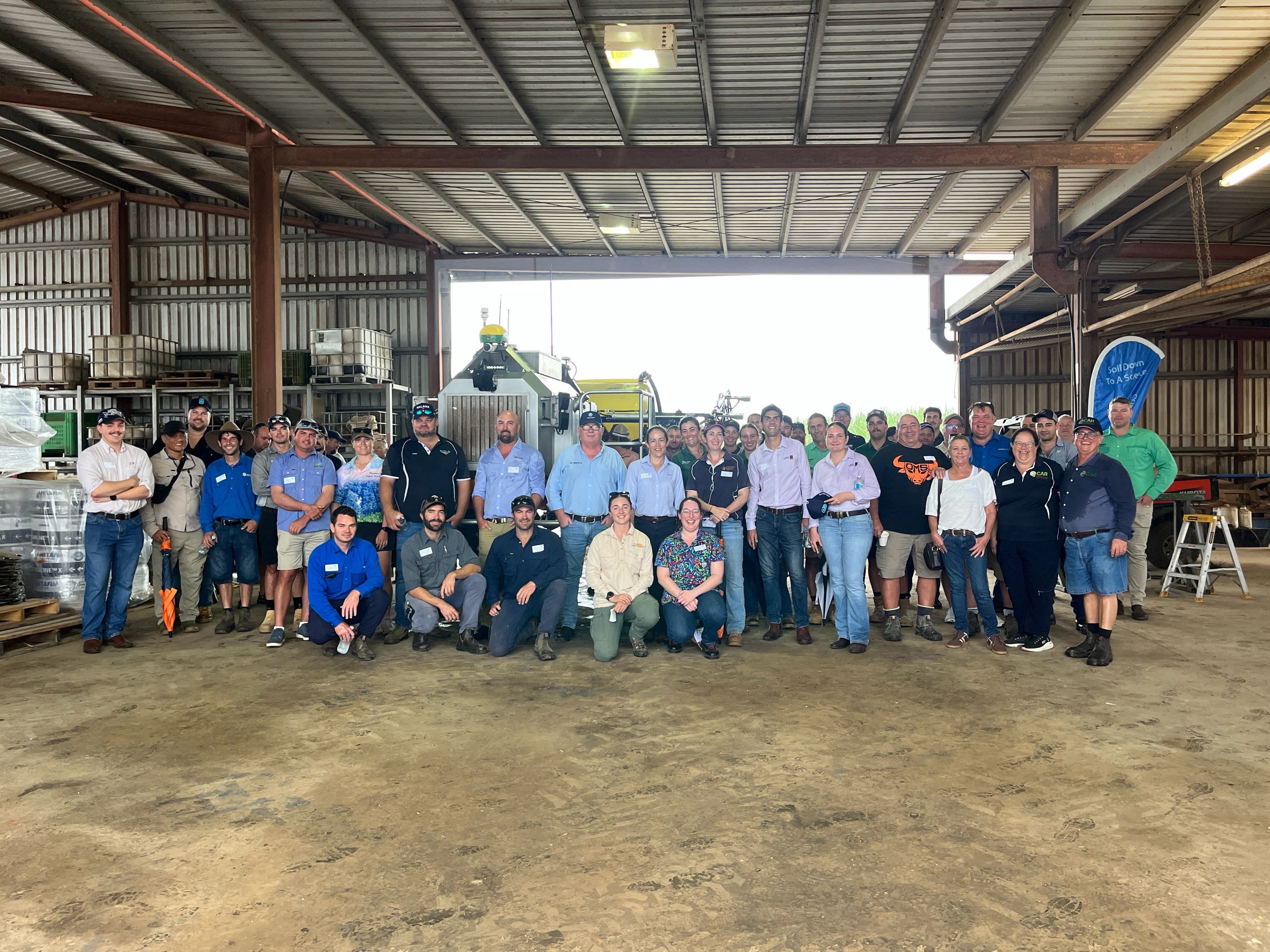
The inaugural Next Gen Cane Forum has wrapped up after two energetic days across the Herbert and Burdekin regions, bringing growers and industry together to explore the future of cane farming.
Day one in Ingham delivered a strong turnout, with participants engaging in discussions around innovation, productivity and sustainability. The program featured cutting-edge technology including drones, the use of AI in agriculture, GPS tractor technologies, alongside valuable networking opportunities.
The forum then moved to the Burdekin for day two, with a start at the Burdekin Theatre. Attendees experienced live demonstrations at Mulgowie Farms, showcasing automated machinery and irrigation in real paddock conditions, before touring the iconic Burdekin Rum Distillery.
The event concluded with a forum dinner at the Queens Hotel, rounding out a packed program of learning and connection.
Organised by Queensland Cane Agriculture and Renewables and Aglantis, the forum highlighted emerging technologies, funding opportunities and the importance of collaboration across the industry.
With strong attendance and plenty of ideas shared, organisers say the success of the first Next Gen Cane Forum has set a solid foundation for future events.
See more photos from the day here: https://www.burdekinlife.com/social-pics/next-gen-cane-forum-wraps-up-across-herbert-and-burdekin

For many years, access between Ayr and Home Hill during flood events has been a significant concern for our community.
I am pleased to share that the Department of Transport and Main Roads has commenced a geotechnical investigation of State-controlled infrastructure on the Bruce Highway at Plantation Creek. This important work will inform future connectivity planning, not only between Ayr and Home Hill, but for North and Far North Queensland and western regions. These investigations are funded through the Commonwealth–State Disaster Recovery Funding Arrangements and is proposed to be constructed after the 2027 wet season.
As we approach Anzac Day, the Burdekin is preparing for ceremonies across the Shire to pause, remember and honour those who have served our nation. In light of world events unfolding in 2026, this year’s commemoration carries even greater significance. It is a reminder of how fragile peace can be, how vital unity is, and why it is so important to honour those whose service has allowed us to enjoy the freedoms we often take for granted.
To reduce impacts on park amenities, and in preparation for Anzac Day commemorations in Home Hill, Council will be undertaking flyingfox dispersal activities at Arch Dunn Memorial Park to ensure ceremonies can proceed respectfully and safely for all attendees.
Work is also progressing on the upgrade of memorial plaques and posts along Pioneer Avenue in Home Hill, with the project now reaching the halfway mark. All 50 memorial plaques have been carefully restored to their original condition and are being relocated back to their original sites on new recycled plastic posts, ensuring these tributes are preserved for future generations.
Following recent weather events, both Council crews and contractors have recommenced unsealed road grading works under the Disaster Relief Funding Arrangements, jointly subsidised by the Federal and State Governments. Crews are currently working on Brewster Road and Jerona Road in the Barratta area, as well as Pyott Road in Airdmillan.
Council crews have also commenced footpath renewal works at the corner of Parker Street and Wilmington Street in Ayr, adjacent to the Seventh-day Adventist Church. These works involve the removal and replacement of damaged footpaths that have been assessed as requiring renewal due to their condition, improving safety and accessibility for pedestrians.
Should you wish to reach out, don’t hesitate to contact me directly by phone at 0447 150 582, or feel free to send an email to mayor@burdekin.qld.gov.au.

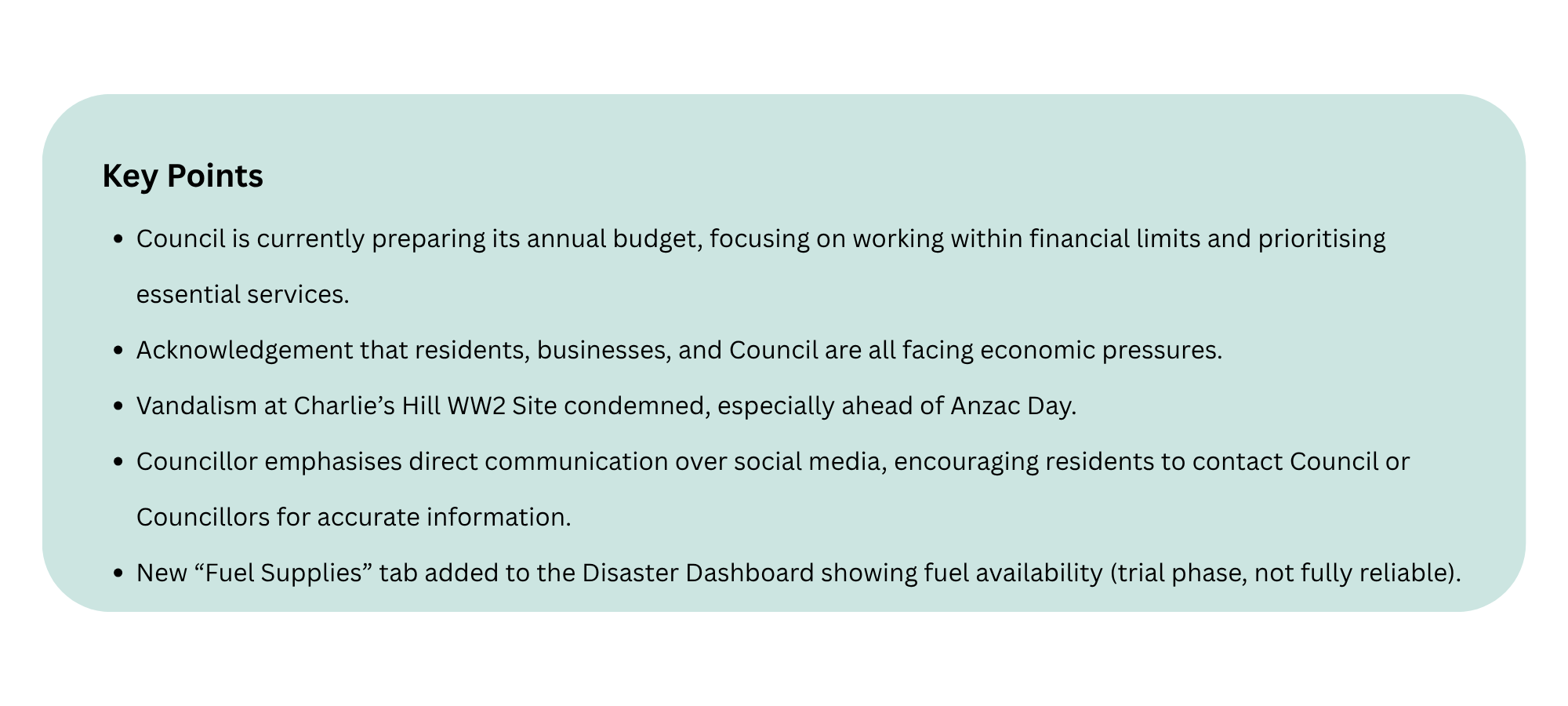
As Councillor Furnell mentioned in his column last week, Council is currently forming its budget for the coming year. I want to assure you that as Councillors, I think for once we are all on the same page with regards to working within our means and delivering the absolute necessities to keep the Shire running smoothly. Farmers, contractors, businesses and ratepayers will be tightening their belts in the current economy and Council is no different.
The recent vandalism at Charlie’s Hill WW2 Site is particularly distressing ahead of Anzac Day. Honestly, what is wrong with people that they think it’s okay to destroy something commemorating our soldiers who fought and died so that we may live our lives in freedom? Or any vandalism for that matter!
Social media. I have a love/hate relationship with it. I don’t have a Councillor Facebook page and I don’t believe the other Councillors do either. We were elected because people trusted us to represent them. We wade through endless reports and information, attend Council, budget and many other meetings, attend on-site issues at rate-payers requests and take those phone calls (which are always important and welcomed). That is our job. My mobile is 0427827386 if you have any feedback, queries or issues and I am available anytime. In addition, we all have our own jobs and businesses to run which leaves little time for self-promotion. The Burdekin Shire Council Facebook page or web site is where information is provided to you and which you may share as you wish. If something needs clarification, please ring the Council or a Councillor. Don’t rely on random Facebook posts.
Recently Council added a “Fuel Supplies” tab on the Burdekin Shire Council Disaster Dashboard web page. When you click on the Fuel Supplies tab you are taken to a map indicating fuel availability, with green, orange and red indicating full, partial and no availability respectively. The fuel supply information is currently in a trial phase, is irregular and approximate only and should not be relied upon as the sole source for decision-making.
The Department of Customer Services, Open Data and Small and Family Business (CDSB) service team will be visiting the Burdekin region to provide information and hands-on training on how to access Queensland Government services online. The following services and support are available at each session: Queensland Government Grant Finder, Disaster Preparedness, Queensland Digital Licence, Apply Online and Online Payments.
The scheduled community assistance sessions are as follows and bookings are not required:
The Ayr Library recently hosted 3D design and printing workshops as part of their school holiday programs, featuring sessions for ages 9-15 years. The 3D printer is available for public use and anyone who has an interest in learning about or using this technology just needs to contact the Library. Why not give it a go? We’re never too old to learn new tricks.
Finally, please pay your respects and attend one of the many Anzac Day Services on Saturday 25th April if you are able. In honour of our fallen, those who have served and those who continue to serve, LEST WE FORGET.

Burdekin Shire Council is preparing for potential fuel supply disruptions linked to instability in the Middle East, with officials taking early steps to protect essential services across the region. Photo credit: Victoria Velton
Burdekin Shire Council is preparing for potential fuel supply disruptions linked to instability in the Middle East, with officials taking early steps to protect essential services across the region.
The council’s Crisis Management Team has met to assess risks and ensure the organisation is ready to respond if conditions worsen. At this stage, all council services are operating as normal.
Chief Executive Officer Matthew Magin said fuel was critical to maintaining everyday operations and key community services, including waste collection, water and sewerage, road maintenance and public facilities.
“Council is taking a measured and proactive approach to ensure we can continue delivering essential services responsibly,” he said.
Measures already underway include careful monitoring of fuel use and forward planning for possible short-term supply constraints. Mr Magin said this planning would help council remain both operationally and financially stable if fuel availability tightened.
To keep residents informed, council has introduced a new Fuel Supplies section on the Burdekin Disaster Dashboard. The online hub provides up-to-date, verified information on fuel availability and pricing, reducing the need for residents to search multiple sources.
Council is urging residents to check the dashboard regularly to stay informed as the situation develops.
Mr Magin said council would continue monitoring international developments and liaising with relevant agencies. Any changes affecting services or the broader community would be communicated promptly through official channels.
He said the early preparation was designed to ensure the Burdekin community remained supported and informed, even if global conditions began to impact local fuel supplies.

Home Hill’s focal point commemorating servicemen and women will receive further enhancement under the inaugural round of the Honouring our Veterans program. Photo supplied

Home Hill’s focal point commemorating servicemen and women will receive further enhancement under the inaugural round of the Honouring our Veterans program.
As Anzac Day approaches, Member for Burdekin Dale Last has welcomed a Crisafulli Government announcement of funding to support a new memorial garden at Home Hill.
“Our war memorials stand as a physical symbol, not just for today but for generations that follow, of our pride and eternal gratitude for our current and past servicemen and women,” Mr Last said.
“The Crisafulli Government is proud to support our community’s commemorative initiatives with a cenotaph garden enhancement project at Memorial Park Home Hill.”
“We’re honouring heroes who put their lives on the line for our nation – this is our way to give back.”
Grants are awarded for major projects such as building improvements, creating or refurbishing war memorials, avenues of honour and memorial gardens, and purchasing new equipment.
They can also be received for supporting special events, activities and initiatives commemorating our veterans.
The support has been funded in a record Veterans budget that is also delivering Queensland’s first Veterans and Veterans’ Families Strategy, a boost to commemorative initiatives and initiatives to support the wellbeing of veterans and their families.
“I was proud to see the work undertaken by the Home Hill Sub-Branch in 2018 which has seen the new location of Memorial Park become a focal point during our Anzac Day and Remembrance Day services,” Mr Last said.
“The addition of a memorial gardens only builds on the great work our local RSL have done so generations of Queenslanders can recognise the great sacrifices our servicemen and women have made.”
For more information, visit https://www.qld.gov.au/community/getting-support-health-social-issue/veterans/grants-and-commemoration/honouring-our-veterans-grants-program.
Contributed with thanks to Member for Burdekin Dale Last’s Office

NQ Wildlife Care urges the community to report struggling animals to 0414 717 374. Photo source: NQ Wildlife Care
A quick response from local volunteers has given four struggling birds a second chance after they were found in distress in a cluster of thick mangroves.
North Queensland Wildlife Care (NQ Wildlife Care) responded early on 17 April following reports of sick birds in the area. Upon arrival, rescuers located three ibis and one cattle egret, all grounded and unable to stand or fly.
One of the birds was in particularly poor condition.
“One was so weak he couldn’t even hold his head up, although he was very much still alive,” the organisation said.
A rescuer attended promptly, safely containing the birds before transporting them for urgent veterinary assessment.
The organisation has since urged the community to remain vigilant, particularly around waterways where wildlife may be at risk. Residents are encouraged to report any unusual behaviour in birds or sightings of injured or deceased wildlife to help ensure a timely response.
“If you notice birds behaving unusually, or come across any deceased birds, please call us on 0414 717 374 or send us a message on Facebook,” NQ Wildlife Care said.
The rescue highlights the vital role local volunteers play in protecting native wildlife, with community awareness continuing to be key in ensuring animals in distress receive the help they need.
-2.jpg)
“I chose Tec-NQ for the opportunities after school,” said Donzel. Photo supplied
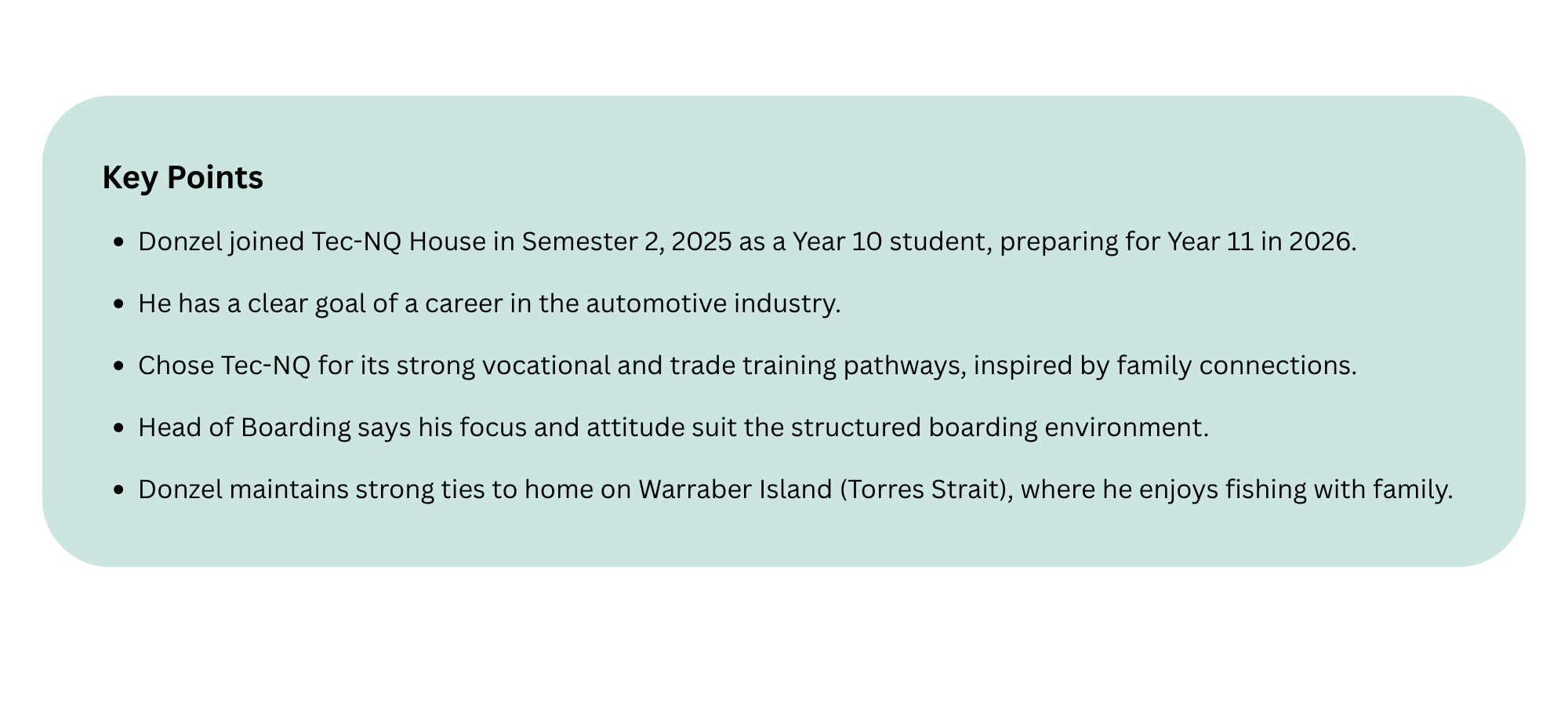
Donzel began his Tec-NQ House journey in Semester 2, 2025, bringing fresh energy to the boarding community. As a year 10 student, preparing for year 11 in 2026, he already has his future mapped out: a career in the automotive industry.
“I chose Tec-NQ for the opportunities after school,” said Donzel.
“I heard about this school from family members.”
It’s the strength of Tec-NQ’s vocational pathway options that attracted him, and he is keen to take every chance to learn.
“So far, it’s been good,” he added with a smile.
Head of Boarding, Dominic Stower, says Donzel’s attitude is a great fit for Tec-NQ House.
“When new students arrive with a clear goal, it sets them up to make the most of the opportunities here,” Dominic said.
“Donzel has come in focused on automotive, and we’re already seeing his commitment.”
Life outside of the classroom keeps Donzel busy. At home on Warraber Island in the Torres Strait, he spends spare time fishing with family and friends. In Townsville, he’s quick to make use of the boarding house facilities, enjoying games of pool and keeping up with basketball. A loyal Chicago Bulls supporter, his favourite number is 23, a tribute to Michael Jordan. On the rugby league field, he follows the Roosters.
For Dominic, this balance of vocational focus, sport and recreation is exactly what Tec-NQ House was designed to provide.
“Boarding gives young people independence with a safety net,” he explained.
“We set expectations around learning, wellbeing and behaviour, and then we support them with structure and routine. That’s where they thrive.”
Tec-NQ House itself is a purpose-built boys-only residence located in Rosslea. Opened in 2022, it provides accommodation for up to forty senior school students from regional and remote Queensland, giving them access to Tec-NQ’s trade-focused senior school program.
The facility blends structure with comfort. Students have air-conditioned double-occupancy rooms, communal lounges with streaming services and computer access, and a secure outdoor recreation area with BBQ facilities and a basketball court. An on-site professional chef prepares nutritious meals every day, fuelling the boys for school, sport and work placements.
Transport is provided to the Tec-NQ Douglas co-educational campus, and staff also drive students to and from workplaces when required. This removes barriers and lets students focus on their learning, hobbies and friendships. After-hours, the boys enjoy organised sport, social activities and excursions, all designed to build a sense of community.
Dominic says that for students like Donzel, these routines help them settle quickly.
“First-year boarders do well when there is a clear rhythm to the week,” he said.
“They learn to manage their time, connect with mates and build confidence. Those skills will serve them in school, in apprenticeships and in life.”
With his career pathway in mind, his hobbies from home, and a willingness to get involved in boarding life, Donzel is making a strong start. We look forward to seeing his journey continue into year 11 and 12.
Contributed with thanks to Tec-NQ
Publishers Indemnity. Any individual or entity that places advertising, supplies copy material, or submits editorial content to Core Life Publishing agrees and undertakes to ensure that all such material:- Does not infringe upon any copyright, trademark, or other intellectual property rights;- Is free from any content that could be considered defamatory, libelous, or slanderous;- Does not infringe upon any rights related to privacy or breach of confidence;- Contains no obscene, indecent, or otherwise unlawful material;- Complies fully with the Trade Practices Act and all other applicable laws, regulations, or statutes.Furthermore, by submitting or placing such material, these individuals or entities agree to indemnify and hold harmless the publisher, Core Publishing and Events Pty Ltd, and/or its agents from and against any and all investigations, claims, demands, liabilities, damages, costs, or judgments arising out of or in connection with the material provided. All material is believed to be accurate at the time of printing and remains the copyright of Core Publishing and Events Pty Ltd.
© 2026 Life Publishing Group Pty Ltd.
