Independently Owned, Locally Grown, Community Loved


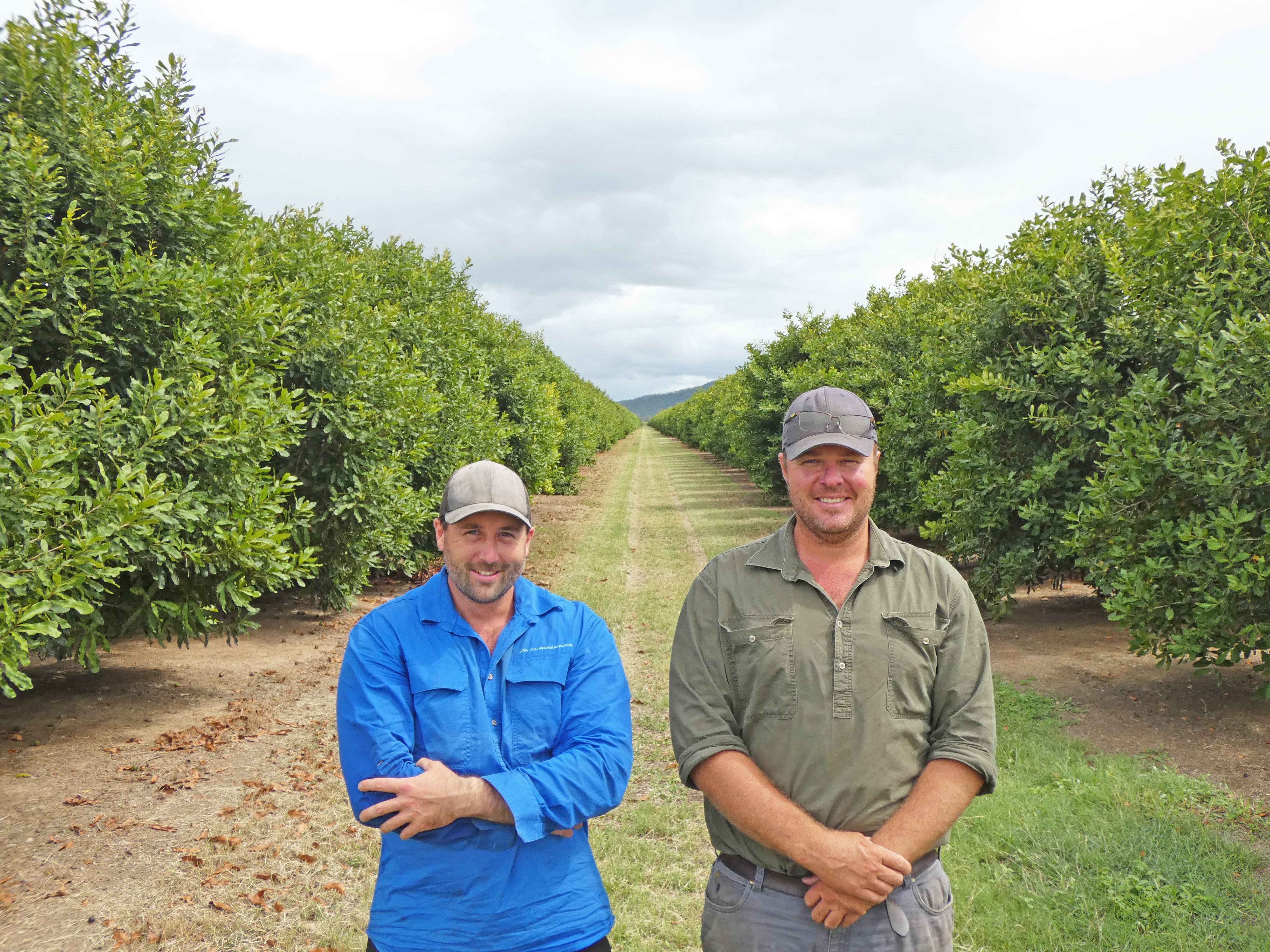
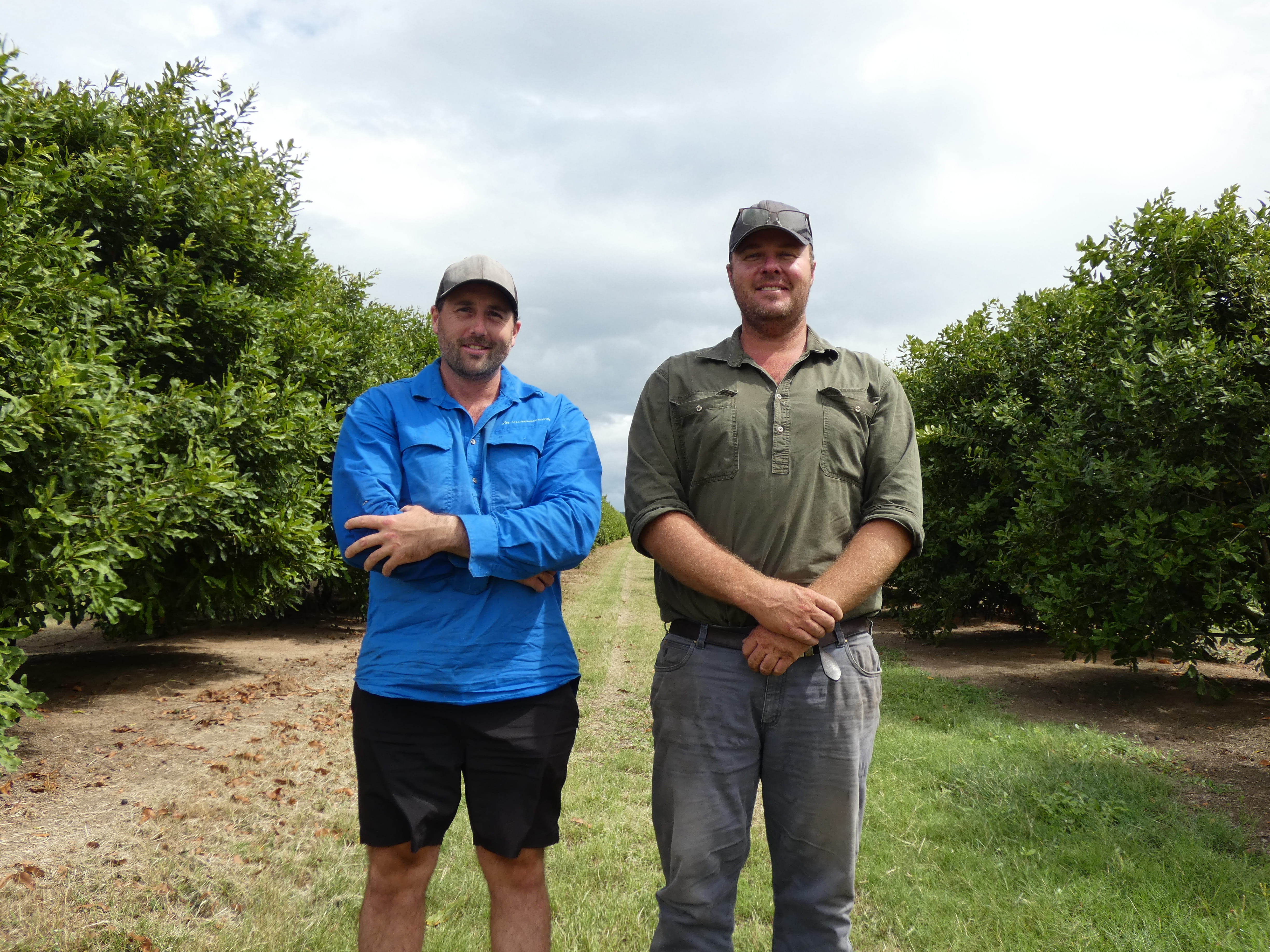
Operations manager Brandon Blakelock (left) and Burdekin area manager Andrew Cross (right) at the region’s first large-scale macadamia orchard in Horseshoe Lagoon. Photo credit: Jacob Casha
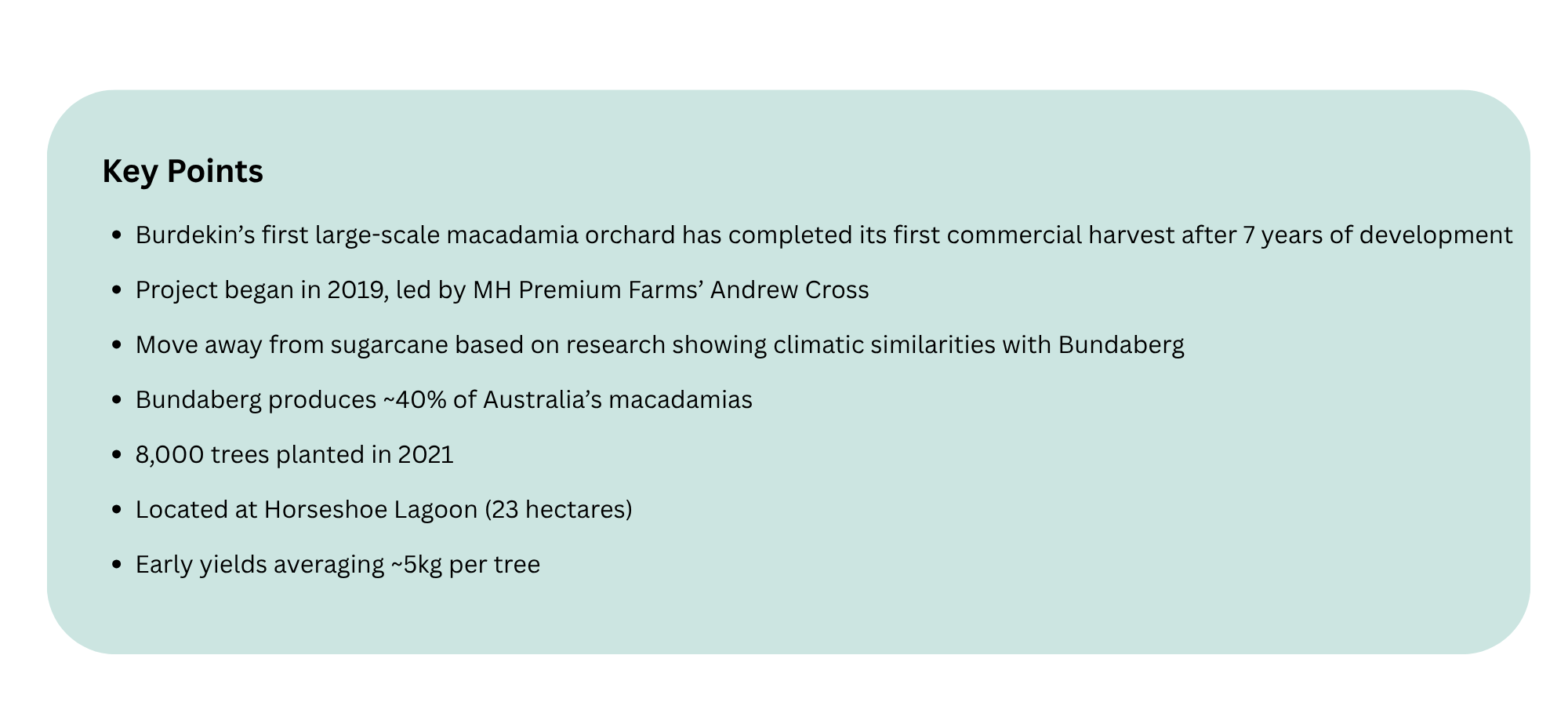
The Burdekin’s first large-scale macadamia orchard has delivered its first commercial harvest seven years after a bold break from cane, signalling a new path for local growers.
The switch, spearheaded in 2019 by Burdekin Area Manager of MH Premium Farms Andrew Cross, followed research identifying climatic similarities between the Burdekin and Bundaberg regions—the latter accounting for roughly 40 per cent of Australia’s macadamia production.
“We were trying a lot of alternatives to sugarcane to realise a bit of capital growth, and looked at macadamias for a while,” Cross said.
“We looked at Bundaberg and after a couple years of due diligence on environmental research, we realised the climates are just about a mirror-image.”
Planting began in 2021, with 8,000 macadamia trees spread across a 23-hectare orchard in Horseshoe Lagoon. After five years of negative cash flow, the current harvest has seen early yields average around five kilograms per tree.
Cross said early results had exceeded expectations, with the orchard now moving into full commercial production as yields increase across plantings in Horseshoe Lagoon and Brandon.
“I think it could definitely open the door to a new local industry, complementary to sugar,” he said.
“The existing (macadamia) land values in Bundaberg would be fourfold of what cane land is here in the Burdekin. We don't expect to realise that out here just yet… but any uptake in land valuation is certainly a big cherry.”
Cross said the seven-year process has been mostly smooth sailing, despite the switch being met with much local skepticism.
Macadamia trees have a known susceptibility to cyclones, making the Burdekin a historically risky location for mass investment in the crop.
Despite a few “sleepless nights” around this year’s Cyclone Koji scare, Cross said the team is “not worried.”
“Everyone obviously jumps straight to cyclone risks. We spent years in Bundaberg understanding the climatic and growing risks—we’re not worried,” he said.
“The cyclones the Burdekin’s had historically wouldn’t have been good, but wouldn’t have been devastating either. Even after Yasi and Larry up at Innisfail, there’s still macadamia orchards retaining there now.
“But if we get a severe cyclone, it’s going to be a mess. There’s no two ways about it.”
Cross said the project still had room for expansion, with further plantings underway as the operation scales across the Burdekin.
Publishers Indemnity. Any individual or entity that places advertising, supplies copy material, or submits editorial content to Core Life Publishing agrees and undertakes to ensure that all such material:- Does not infringe upon any copyright, trademark, or other intellectual property rights;- Is free from any content that could be considered defamatory, libelous, or slanderous;- Does not infringe upon any rights related to privacy or breach of confidence;- Contains no obscene, indecent, or otherwise unlawful material;- Complies fully with the Trade Practices Act and all other applicable laws, regulations, or statutes.Furthermore, by submitting or placing such material, these individuals or entities agree to indemnify and hold harmless the publisher, Core Publishing and Events Pty Ltd, and/or its agents from and against any and all investigations, claims, demands, liabilities, damages, costs, or judgments arising out of or in connection with the material provided. All material is believed to be accurate at the time of printing and remains the copyright of Core Publishing and Events Pty Ltd.
© 2026 Life Publishing Group Pty Ltd.