
Independently Owned, Locally Grown, Community Loved

Local PhD researcher moves to Spain for pioneering computing research
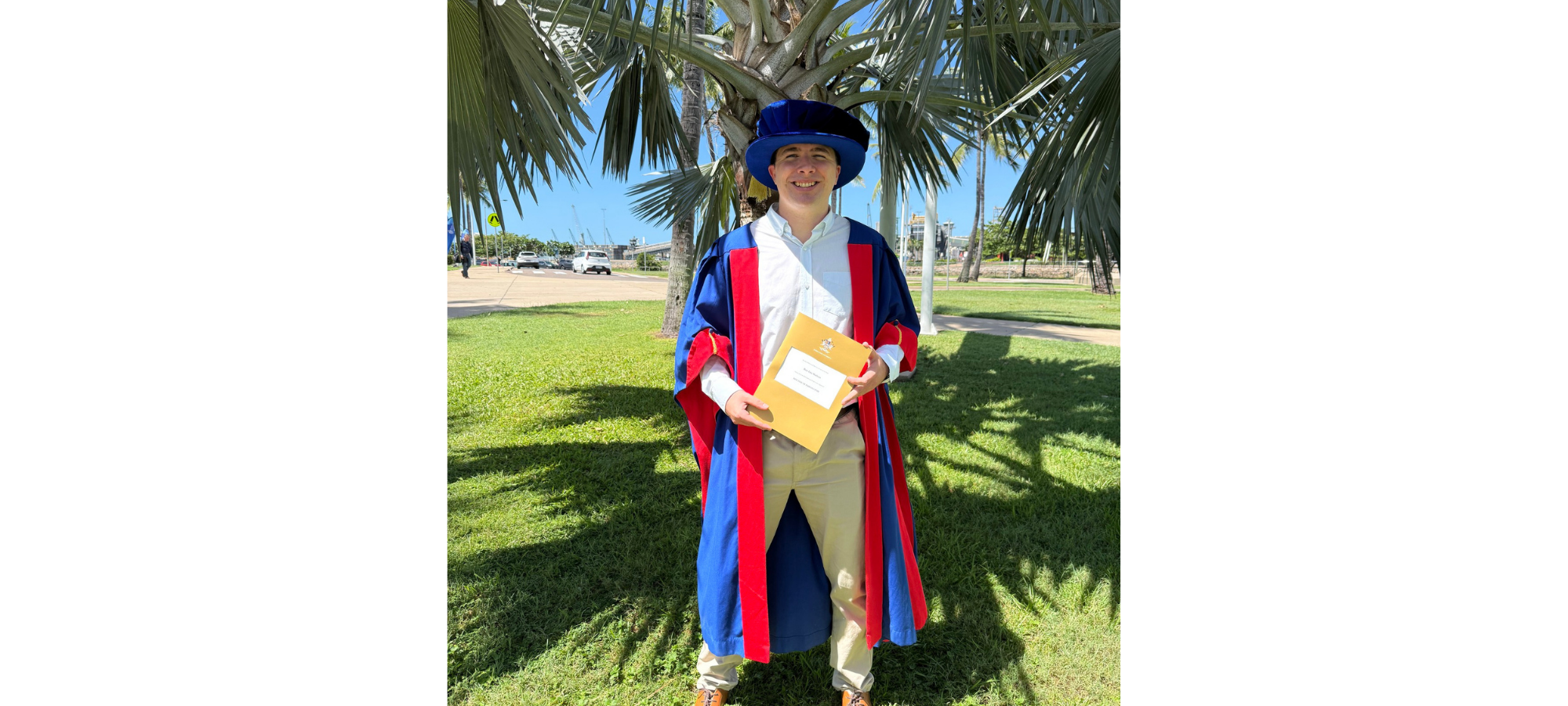
Burdekin-raised researcher Dr. Ben Walters is set to take his cutting-edge computing work to Europe this June, investigating spiking neural networks for predictive maintenance in Spain.
The former Home Hill High student is making the move following a successful PhD at James Cook University in Townsville. His new role will focus on spiking neural networks that can be utilised for real-time predictive maintenance of assets, with potential use in medical fields.
“I hope that I can continue to do this research and develop systems that prove to be beneficial such as systems for real-time detection of medical issues," Dr Walters said.
His research focuses on neuromorphic computing: an emerging field aimed at replicating the brain’s energy-efficient processes in computer hardware.
Dr. Walters’ work spans both hardware and software development; on the hardware side, he investigated graphene-based memristors—devices capable of mimicking neural behaviour—while his software research explores spiking autoencoders designed to reconstruct data using minimal energy.
“One of the key aspects is event-driven computing, where localised events such as voltage or current spikes are used to transmit information between areas of the brain, or in our case, computer architecture,” he said.
“In the absence of these spikes, the computer exists in a low-power state, drastically reducing energy consumption.”
The move follows growing international recognition for Dr. Walters, including the acceptance of his research into the International Symposium on Circuits and Systems in 2024, which opened the door to global collaborations.
His journey into the field began years earlier during undergraduate studies in Electrical Engineering and Physics, when he was introduced to neuromorphic research through a project supervised by Associate Professor Mostafa Rahimiazghadi.
“I enjoyed doing this research and decided to continue with this topic into my PhD,” he said.
Supported by a Research Training Program Scholarship, Dr. Walters was able to pursue his doctoral studies while also securing additional grants that allowed him to present his work at international conferences in Melbourne, Singapore, and London.
The process was far from linear, according to Dr. Walters.
“There were a lot of setbacks,” he said.
“Many experiments didn’t yield the results we were looking for, which was incredibly frustrating and required … a lot of persistence.”
Dr Walters believes neuromorphic computing could redefine how technology operates by reducing reliance on energy-intensive cloud computing platforms. He hopes to eventually deploy these systems locally to contribute to more efficient computing processes.
Despite his global ambitions, Dr. Walters said the Burdekin community he grew up in has played a key role in supporting his path into research.
“I’ve met so many wonderful people in the Burdekin that have allowed me to pursue these studies, and I'm very thankful for their support,” he said.
“The Burdekin is quite a unique place, and offers different perspectives on many issues, and I find that having multiple perspectives is useful for solving complex problems.”
Dr Ben Walters completed his PhD at James Cook University in June last year, with his thesis titled “Advancing Neuromorphic Computing with Novel Memristive Devices, Local Learning Algorithms, and a Hierarchical Dataset.” Photo source: Home Hill State High School/Facebook
Publishers Indemnity. Any individual or entity that places advertising, supplies copy material, or submits editorial content to Core Life Publishing agrees and undertakes to ensure that all such material:- Does not infringe upon any copyright, trademark, or other intellectual property rights;- Is free from any content that could be considered defamatory, libelous, or slanderous;- Does not infringe upon any rights related to privacy or breach of confidence;- Contains no obscene, indecent, or otherwise unlawful material;- Complies fully with the Trade Practices Act and all other applicable laws, regulations, or statutes.Furthermore, by submitting or placing such material, these individuals or entities agree to indemnify and hold harmless the publisher, Core Publishing and Events Pty Ltd, and/or its agents from and against any and all investigations, claims, demands, liabilities, damages, costs, or judgments arising out of or in connection with the material provided. All material is believed to be accurate at the time of printing and remains the copyright of Core Publishing and Events Pty Ltd.
© 2026 Life Publishing Group Pty Ltd.





.jpg)

.jpg)