
Independently Owned, Locally Grown, Community Loved
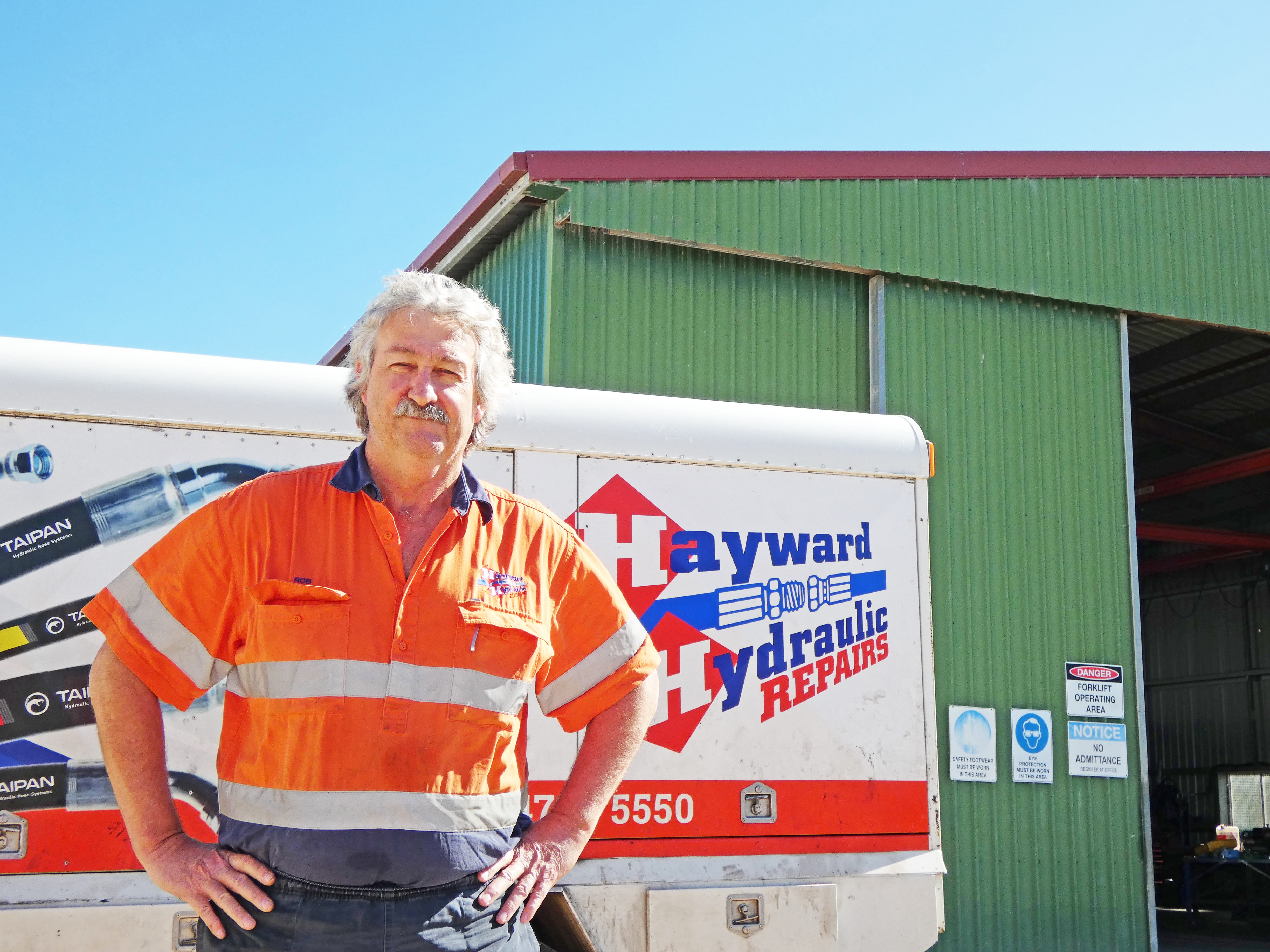
Not every business starts with a blueprint. For some, it begins as a calling… in more ways than one. Burdekin local Robert Hayward had been in the hydraulics industry since he was 18. A diligent worker who loved his job, he quickly built a reputation locally as one of the best in the business. But despite a mutual affinity with the industry that had formed over years, he stepped away in the early 1990s to help his father-in-law maintain a cane property in Clare. Until he received a call. Then another… and another. Rob quickly realised that, despite his brief hiatus, his reputation in hydraulics had not faded. With that, he was pulled back into the game, this time with nothing but a $2,000 ute, a toolbox, and work up to his neck. And the only way to keep himself from drowning in it was, ironically, to go in deeper. “As the Burdekin is, if you do a very good job, word travels quickly between the community. One farmer talked to another, he talked to another, he talked to another… “Until I sat down with my wife one day and said, ‘I think we can make a business out of this.’” His ute would eventually make way for a permanent space—a small sub-shed at Larry Hudson Engineering in the Ayr Industrial Estate that would serve as his headquarters for the following four years. He tackled the first year solo, before demand forced him to put an apprentice on in the second year, and a qualified tradesman in the third. By the end of the fourth, Rob’s work had outgrown its humble base, moving down the road into a new purpose-built shed that would become the home of Hayward Hydraulics. That shed would officially open in 1996, spurring a 30-year legacy sustained by three defining pillars. Growing with the industry “I had no idea how to use computers,” Rob said with a smirk. Admittedly, he hadn’t realised he signed himself up for a three-decade, three-fold evolution between an entire industry, his own business, and himself. What he did know was that he was ready to learn, and eager to grow. It started with the basics. For Rob, that meant wrapping his head around modern computers, attending TAFE courses on emerging welding techniques, and becoming a leader. “I went from being a very good tradesman to having to be an employer,” he said. “You have to be a people's person, you have to treat people the right way, treat your workers the right way. That part I never even thought of until we started getting into it.” Rob treated this evolution as a marathon rather than a sprint, dedicating the business's first decade cementing its reputation as a local leader. After striking up deals with major companies, including Queensland Rail and Wilmar Sugar in the mid-2000s, he decided to take the leap into the mining industry in the early 2010s as a safety net for the unpredictable sugar industry. With that growth, Hayward Hydraulics’ shed would undergo its third structural expansion to accommodate its continuously increasing popularity and modernised technology. He built a habit of gleaning ideas from various online hydraulic magazines, and then building on them to not only keep up with the industry, but to will it into the future himself. “I eventually built a reputation for thinking outside of the square. If somebody's been doing something for 20 years, I'll look at a better way of doing it,” he said. Albeit, he admits he and the business are still evolving today. “I've seen harvesters and planters go from chain and sprocket to hydraulic motors, to hydraulic motors being linked to satellite GPS,” he said. “The industry has changed in leaps and bounds, and you have to keep finding ways to move with it.” Doing it the right way Hayward Hydraulics’ evolution was founded on something Rob didn’t need to be taught. Care. And he makes sure his staff do, too. “I didn't come from a real wealthy family, so we were brought up to work; you work, you do the job right, you get paid,” he said. “So if I'm not happy with something, I'll ask my workers: ‘would you pay for that?’” When the mining industry began to boom in Queensland, Rob admits he had a difficult time retaining workers. To compete, he was forced into paying top-dollar for what he called “good quality workers,” causing financial tension. When asked if compromising staff quality for cost was ever an option, with the conviction of a true-blue purist, he said: “No.” “I've always maintained that a business is only as good as your employees. You can be the best boss in the world, but if you've got workers that people don't like, they don't come through the door,” he said. “My current staff are up there with the best that I've had. I just try to make sure they’re happy to come to work every day.” With quality and care as its engine, Hayward Hydraulics became known not just for technical know-how, but for doing things the right way. As its stature in the industry continued to grow, so did the scope of its customer base. Calls started coming in from as far north as Tully, all the way to Mackay and Western Queensland, all saying the same thing: “We heard you were the guy to talk to about this problem.” Family and community at its heart For the last 10 years especially, the business has made a point of supporting local organisations and sports clubs, most notably the Burdekin Roosters Rugby League Club. Rob described it as a duty to a community that has given so much to him and the company. “The community has been so important to it all. I’ve got some customers that have been with me from day one, and with some, I’m onto the third generation of the same family,” he said. “The’ve given a lot to me. They've helped me grow and supported me, so it's about time I supported them back.” Beneath it all, though, he points to his family as the driving force. “I remember those early days when we were setting up the new workshop, building benches and all that, my two brothers-in-law and my father came out and gave me a hand,” he said. “But my biggest support is my wife. Especially in the early days when I wasn't home, and she solely looked after the kids and everything. “It got to the stage where I was working seven days a week, 12 hour days, and my wife would bring the kids on a Saturday and Sunday, and we'd sit on the shop floor and have lunch. “She's been with me through the lows and the highs, and that I thank her for.” Now, thirty years later, it’s his family pulling him out of the industry. Driven by the desire to make up for lost time with his wife and kids, Rob has loosened his grip on business operations, working four days a week with plans to eventually let his brainchild find its own footing. As for right now, he’s not yet ready to call time on a chapter that was, perhaps, never meant to last this many pages. “I still love what I do,” he said. “The early days come with sacrifices, but when I look back now, it was all worth it. “I remember when it all first started, looking on the ATO website and coming across that statistic that most businesses fail within five years. “When I read it, I said to myself, 'well, I'm gonna make sure I’m not that statistic.’” And that, he did. CAPTION: Rob and his current team. Back L-R: Chase Pearce, Stephan Du Plessis Front L-R: Kade Pearce, Renee Viero, Robert Hayward, Tina Dennis, Bryan Parison Absent: Sam Tomasetig Photo credit: Jacob Casha
Read the full story
The Burdekin has rallied behind a local family after a sudden medical diagnosis turned their life upside-down. Ryan and Holly Davenport dropped everything when their two-year-old son, Rowen, was diagnosed with a brain tumour last month, temporarily relocating to Brisbane for his ongoing treatment. In response, a GoFundMe fundraiser has since raised over $55,000 in support of the family. Created in late May by Shannon Malone, a close friend of the Davenports, the fundraiser has been shared all over Facebook and Instagram by local organisations, garnering comments of support on top of 271 individual donations. “Words can’t describe how much it means to us to have everyone’s support behind Rowen as he begins his journey,” Ryan said. “They have given us precious time to spend with Rowen without the everyday worries.” The money will help fund hospital stays, travel, time away from work, and ongoing treatment expenses as the Home Hill family navigates a medical journey that began in April. Already on edge after daughter, Ally, underwent brain surgery to have a cavernoma removed just before Easter, Ryan and Holly acted promptly when they noticed a twitch in Rowen’s eye. Following weeks of consultations with Townsville doctors and specialists—which included MRI scans and a Royal Flying Doctors flight—Rowen was eventually diagnosed with pilocytic astrocytoma, a slow-growing brain tumour. He has since been transferred to Queensland Children’s Hospital in Brisbane for chemotherapy, with the couple leaving their two young daughters with their grandparents in the Burdekin to be by his side. In their absence, locals have offered meals, helped on the family’s sugar cane farm, assisted around their home and helped look after their daughters, along with the generous donations. Ryan said the funds raised would not just help relieve the financial burden of Rowen’s treatment, but allow the flexibility to fly their daughters down and spend some time as a family. “(The toughest part has been) the unknown, not having our family together … and watching Rowen go through these traumatic times and … not being able to do anything,” Ryan said. “It has been a very emotional journey so far, and it is hard to believe we are only at the start.” Anyone wanting to support the Davenports is urged to donate using the following link: https://www.gofundme.com/f/supporting-the-davos-and-little-rowen?attribution_id=sl:75c20475-06e5-4752-8e11-d1b7a07c7728&lang=en_AU&ts=1779705595&utm_campaign=fp_sharesheet&utm_content=amp20_t1&utm_medium=customer&utm_source=copy_link CAPTION: Funding will allow the family to fly their daughters down and spend more time together during Rowen’s treatment. Photo supplied
Read the full story
The Federal Member for Dawson, Andrew Willcox, has slammed the Albanese Government for an unacceptable ambush on regional communities, accusing the Commonwealth of abandoning disaster-prone areas to balance its own budget. The Federal Minister for Emergency Management, Kristy McBain, used a late Friday afternoon media release to quietly flag sweeping alterations to the Disaster Recovery Funding Arrangements (DRFA). The proposed changes dismantle the long-standing, scalable framework, which historically provided an average of 64 per cent federal coverage and capped support at 75 per cent for catastrophic events. In its place, Canberra intends to implement a rigid 50-50 funding model. This policy shift arrives at the worst possible time for the state; it follows a volatile severe weather season that caused widespread damage across 71 of Queensland’s 77 local government areas. Federal Member for Dawson, Andrew Willcox, is warning that the sudden funding shortfall threatens the future viability of essential infrastructure, local water treatment facilities, and emergency evacuation operations. Mr Willcox, drawing on his extensive experience as the former Mayor of the Whitsunday Regional Council, stated that the Federal Government is completely detached from the realities of regional recovery. "This decision is a direct hit to the heart of North Queensland," Mr Willcox said. "Canberra is treating natural disasters like a corporate budgeting exercise; however, out here, it is a matter of community survival. To penalise the very regions that drive the nation’s agricultural wealth and mining export revenues is a profound betrayal. "During my time steering the Whitsunday community through the wreckage of Severe Tropical Cyclone Debbie in 2017, I learned exactly what it takes to rebuild. We relied heavily on scalable federal assistance to restore our shattered rural road networks. Under a flat 50-50 split, local councils across Dawson would be forced to find millions of dollars in matching revenue; that is a financial burden our regional ratepayer base simply cannot sustain." Mr Willcox emphasised that major historical recovery operations would have been completely unviable under the newly proposed guidelines. "The total reconstruction of the Shute Harbour marine terminal and the $5 million federal package required to replace the decimated Proserpine Entertainment Centre occurred because the previous framework allowed for exceptional circumstances," Mr Willcox said. "Small regional councils do not possess the independent asset base to fund multi-million-dollar rebuilds alone. Furthermore, the historical system guaranteed that funding flowed directly into local economies, ensuring that regional earthmoving businesses and contractors were awarded the repair work. By lowering the funding floor, the Commonwealth is forcing cash-strapped councils to delay vital resilience works; this leaves our communities dangerously exposed before successive wet seasons. "It is a coward’s tactic for the Minister to leave this announcement until the day after the parliamentary sitting concluded, ensuring they avoided any real scrutiny or accountability in Question Time. “This is yet another calculated deception from a government that knows exactly how damaging these cuts are; this is absolutely not what the Australian people voted for, and I truly hope this betrayal is remembered at the next election. "This is yet another chapter in the ongoing federal neglect of regional Australia. The government is hiding behind the cover of an independent review to justify cutting essential frontline services. I call on the Emergency Management Minister to reverse this decision immediately; regional Queenslanders refuse to be treated as second-class citizens.” Supplied by the office of Federal Member for Dawson, Andrew Willcox CAPTION: FIGHTING FOR THE NORTH: Federal Member for Dawson Andrew Willcox MP outside Parliament House in Canberra, condemning the Albanese Federal Government's plan to slash scalable disaster recovery funding for regional councils. Photo supplied
Read the full story
"As the final week approaches for public submissions into the Sugar Code of Conduct, Member for Burdekin Dale Last has renewed his calls for growers to unite and make their voices heard. Mr Last said the public submissions for the sunsetting review of the Sugar Code of Conduct should be an opportunity for sugarcane growers from across the Burdekin to outline the benefits of the code for both farmers and the wider community. “Over recent weeks I have taken the liberty of providing a submission on behalf of the community, because ultimately the flow-on impact from changes in our sugar industry stretch beyond the paddock and the mills,” Mr Last said. “I recently met with several grower representatives which provided the opportunity to bring key stakeholders together, reaffirm my support as the Member for Burdekin and emphasise the need to work collaboratively as the review period unfolds.” Mr Last said while it was important stakeholders took the time to make their voices heard during the public submissions there was no better way to understand the impact of the Sugar Code of Conduct than to visit the area and speak directly to representatives. “A decade ago this district played a central role in bringing this code of conduct to fruition so I would expect our stakeholders receive a seat at the table they deserve,” Mr Last said. “If the Federal Labor Government was serious about consulting with the industry, the responsible Assistant Minister would be looking for every opportunity to listen to those who are most impacted by the Sugar Code.” Anyone wishing to have their say in the review can visit https://haveyoursay.agriculture.gov.au/sugar-code-review"
Read the full story
.jpg)
May heralds the beginning of Small Business Month, a time to honour and celebrate the backbone of our local economies. The festivities kicked off at the Burdekin Industry Breakfast, signalling a month filled with recognition and support for small businesses. Central to this celebration is an exciting competition that is currently underway, ‘Snap for Small Business’. As you’re shopping around town, snap a photo in one of your favourite small businesses and upload it to socials, tag @supportlocalburdekin and #snapforsmallbusiness to go in the draw to win 1 of 4 $100 Burdekin Gift Cards. Don’t forget to tag the business!
Looking ahead, mark your calendars for the Marketing Mingle event in collaboration with the Burdekin Chamber tonight at 6:00pm at the Kalamia Hotel. This event is presented by Natasha Buttler, founder of Boost Marketing Services and JCU lecturer in marketing, and is a great opportunity for anyone wanting to gain more knowledge. You will walk away with effective tips that you can immediately implement into your business.
You will have also seen in last week’s paper the newly installed tourist frames located at Lynch’s Beach, Alva and one to be installed at Mt Inkerman. I encourage locals to visit these frames and snap some photos of our beautiful region.
For those who don’t know, Councillors have been going on air with our local Sweet FM every Wednesday at 2:00pm. Be sure to listen in for your weekly update on what is happening around the region.
%20(1).jpg)
Did you know that our kerbside recycling doesn't end up at Kirknie Landfill? Instead, the recycling truck takes our co-mingled recycling to the Townsville Material Recovery Facility (MRF), where it undergoes processing.
This facility isn't just about sorting recyclables; it's also equipped with an education facility! The Townsville MRF encourages locals to take charge and responsibility for their recycling practices. You can even book tours through Townsville City Council to learn more about the recycling process firsthand. Let's all do our part for a cleaner, greener future.
Knowing what items can go in your yellow lid bin will help make sure we’re recycling as much as we can and doing it right. Recycling helps reduce the amount of waste that goes to landfill, which benefits both the environment and our community.
If you would like to get in touch with me, please feel free to phone me on 0447 150 582 or email mayor@burdekin.qld.gov.au.

Giru State School, a cornerstone of the small but vibrant community of Giru, is marking a century of educational excellence with a grand celebration.
The milestone event, featuring a gala dinner and a lively fete, is set to honour the school’s rich history and its enduring legacy in the region.
Giru derives its name from a railway station named on 31 March 1916, based on "goru," a sugarcane variety from New Guinea grown locally.
The Invicta Sugar Mill, originally located on the Richmond River in New South Wales, moved to Bucca in 1906 and then to the Haughton River in 1919, around which the township of Giru developed.
The mill began operations there in 1921 and Giru State School opened three years later on in October 1, 1924.
Jenni Lund, the current principal of Giru State School, encapsulated the spirit of the occasion by reflecting on the school’s journey.
“We’ve grown and we’ve gone through those fluctuations of a small town that’s lost residents and built the residents back up,” Ms Lund said.
“There’s the country atmosphere of the school and the community, but we’re not that far away from Townsville or Ayr; it’s a great location.”
The school has seen significant growth in recent years, transitioning from a two-teacher to a three-teacher school, and currently boasts an enrollment of 74 students across three classes.
Corin Widderick, a teacher, parent, and former student, represents three generations of family ties to the school and emphasised the unique opportunities available at Giru State School.
“We’re proud of what we have to offer; it’s a great little school that offers so many different things,” she said.
“We have tennis courts, a school swimming pool, and we’re able to send our students to play in big sporting tournaments.
“Even though it is such a small, rural school, we still have those opportunities which is really special."
The gala dinner to be help on Friday, July 5 promises to be a highlight, featuring live entertainment, tours of the school, and speeches that reflect on its storied past.
One particularly poignant moment will be the unveiling of a time capsule buried 25 years ago, with plans to bury a new one to be opened by future generations.
The fete, a vibrant community affair, will kick off the next morning with a high tea.
Attendees can look forward to a range of activities including rides, stalls, and displays, as well as bus tours of the Invicta Mill conducted by Wilmar.
The event will also feature a “Giruvian” challenge, where participants can engage in local activities such as putting crab pots together, cutting cane, casting fishing rods, and moving hay bales.
Students have integrated the festivities into their Media and Arts curriculum, creating videos, documentaries, posters, and magazine covers about the school's history, which will be shared on social media and displayed during the event.
A colouring in competition has even been designed by year 2 and 3 students which has been distributed throughout the school and other schools in the area, with entries to be displayed on the weekend.
The fete will also feature a raffle and auction aimed at raising funds to upgrade the school's soundproofing.
The involvement of parents, former students, and community members in organising the event is a testament to the strong community spirit that has kept the school thriving for a hundred years.
“We’ve had so many sponsors help out with putting our event on, so we’re very appreciative of that,” Ms Widderick said.
“It’s really good to see our community getting involved and helping out.”
With people traveling from as far as Perth and Melbourne to join the celebrations, Giru State School’s centenary is set to be a memorable event, celebrating the past while looking forward to a bright future.
Visit the Giru State School Facebook page for more information.
WHAT: Giru State School 100 Years Gala Dinner
WHEN: Friday, July 5 from 5:00pm
WHERE: Giru State School
TICKETS: Giru State School Facebook page
WHAT: Giru State School 100 Years Fete
WHEN: Saturday, July 6 from 3:00pm
WHERE: Giru State School
ADMISSION: $5 for adults, $2 for children aged 5-12, 4 and under free
Giru State School’s 2024 cohort
Giru State School is celebrating 100 years in 2024
Photos supplied
.png)
The Tropical North Queensland Drought Resilience, Adoption and Innovation Hub (TNQ Drought Hub) has secured funding to extend its efforts in North Queensland for several more years following last week’s announcement of the Federal Government’s record commitment of over $500 million to the Future Drought Fund.
Led by James Cook University, the TNQ Drought Hub is one of eight national hubs tasked with implementing and supporting practices for drought preparedness.
The Hub has been collaborating with farmers, researchers and industry to spearhead drought-resilience initiatives across North Queensland since its establishment in 2022.
Hub Director Professor David Phelps said the funding will enable them to continue a range of programs designed to bolster and support drought preparedness for North Queensland’s agricultural communities.
“This funding extension is pivotal for our region,” said Professor Phelps.
“It ensures the continuation of key TNQ Drought Hub and partner initiatives, including governance, leadership and succession workshops to prepare the next generation, advanced ESG research for practical on-farm adoption, and scholarship programs for honours and PhD students to propel forward their innovative research in finding solutions for our communities.”
Professor Phelps noted that the commitment to long-term funding, as opposed to sporadic short-term allocations, will enable the Hub to implement longer-lasting projects.
“We know that farms and producers in North Queensland experience different challenges to our southern counterparts,” said Professor Phelps.
“With secure, long-term funding, we can now ensure our projects and activities will have more meaning and impact on our region. We will also be able to seek out additional opportunities to collaborate closely with more communities and industry partners to address regional priorities and opportunities for future sustainable solutions.
“We’ve had terrific success over the last three years and are looking forward to continuing to help our primary producers and their communities prepare for the impacts of drought and work with the other Hubs nationally to ensure there is collaboration across the country.”
TNQ Drought Hub Director Professor David Phelps. Photo supplied

445 construction and operational jobs are set to be created as a result of the State Government greenlighting a major phosphate mine in Northwest Queensland.
Located 130km northwest of Mount Isa, the North West Phosphate’s Paradise South complex has been granted $300 million in mining leases. The Resources and Critical Minerals Minister Scott Stewart believes the initiative will stand as a vote of confidence from the government and reputable mining companies.
“Paradise South will create 445 good local jobs for the region and confirms the North West Mineral Province will continue to be a key driver in Queensland’s economy,” said Mr. Stewart.
“Phosphorous is an important product not only in the agriculture sector but is also needed for the technologies the world will adopt as it moved to a net zero economy, that is why the Commonwealth Government has added phosphorous to its new Strategic Materials list.”
The mining leases will further prompt additional support and benefits to the northwest Queensland economy with North West Phosphate intending to use local services throughout construction and in future operations. Northwest Phosphate Executive Chairman, John Cotter believes this project will stands as a significant milestone for the Paradise South project and for the Mt Isa community.
“We know that the Mt Isa community is relying on us to deliver local jobs and local opportunities and we will continue to work with the Queensland Government to get this project off the ground as soon as possible,” explained Mr Cotter.
“As many in the North West region would know, this project was first talked about decades ago, but is the cutting edge project design underpinned by world class technology that has been put together by the North West Phosphate project team that will make sure this project becomes a reality.”

Opinion piece
The crossbench will block the Australian Government’s “disastrous” and “ill-thought-out” fresh food tax in the Senate with Federal Member for Dawson, Andrew Willcox, saying common sense has prevailed.
It comes after The Nationals spent the past year campaigning with farmers and industry against the tax, called a biosecurity protection levy, which would have hurt both families and farmers in Dawson amid a cost-of-living crisis.
“This is a win for families, a win for farmers and a win for regional Australia,” Mr Willcox said.
“I am proud to have been part of a campaign to stop Labor’s fresh food tax as soon as it was announced in Labor’s bad Budget last year.
“I would like to thank everyone who supported The Nationals and joined our efforts to scrap this tax, either by signing our petition, backing our media campaign or helping to highlight just how disgraceful Labor’s reckless new tax would be.
“Not only would this tax drive up the price of fresh food in Dawson, with farmers forced to pass on costs, it would also undermine the entire levy system, causing chaos and confusion across industry.
“Families need food that is more affordable and our farmers need support to get food from paddock to plate.
“While Labor tried to introduce the exact opposite, The Nationals will always fight for common sense and for fairness in the regions.”
Mr Willcox admonished Agriculture Minister Murray Watt for even contemplating the idea, let alone trying to push it through and introduce the tax on July 1.
“The fact Minister Watt refused to listen to concerns and instead doubled down, carrying out a rushed and confusing policy which lacked in detail, is either lazy or arrogant,” Mr Willcox added.
“It was senseless when better alternatives were offered by The Nationals, such as an importer container levy, which would charge importers, not our own farmers, to pay for biosecurity risks being created as produce comes into the country.
“In what parallel universe would a government charge its own farmers to pay for the biosecurity risks their competitors are creating, just to raise $150 million over three years for consolidated revenue?
“I want families and farmers to know The Nationals have your back.
“We stand shoulder-to-shoulder with Australian farmers today and welcome news the Senate will reject Labor’s fresh food tax.”
Federal Member for Dawson, Andrew Willcox, welcomes news the Senate will reject a fresh food tax. Photo supplied

Simon Hood
Wilmar Manager Grower Marketing
The ICE#11 sugar contract continues to be weighed down by the growing 24/25 forecast global trade surplus.
The early start to the Brazilian harvest, and clear weather, has resulted in record breaking production numbers being posted in the UNICA half monthly production reports for April. Seasonal cane tonnages are up and so is the ratio of sugar to ethanol production, particularly for this early in the season. This is forcing analysts to revise their sugar production numbers for Brazil.
Additionally, much needed rain in Thailand is improving the outlook for this year’s crop to climb back above 10M tonnes of sugar production. Combined with incremental increases in tonnage for Europe, China and Central America, there is a growing consensus around another surplus year in sugar production.
The speculative money has sensed that the path of least resistance has been down, and has consequently moved to net short position on the market to around 50,000 contracts.
The good news is that global stocks are low and demand remains strong. Even with the significant pullback in prices, the forward market still exhibits a slightly inverted structure in which nearby prices are higher than deferred.
Australian sugar is selling well into our traditional Asian markets and the solid physical premiums paid for the 23-season crop look likely to be repeated into this year’s pricing. While Brazilian ethanol parity is still well below current market levels, the import parity for raw sugar into Chinese refineries is resulting in some fresh business and plenty of price checking.
Following the close of the 24 season pricing nomination date (April 30), the grower’s GEI sugar pricing mix has shifted back to traditional pool pricing mechanisms for price management. After a couple of years of record returns for our Production Risk Pool, this is not a total surprise.
Further, the large volatility of prices over the last 18 months has left some growers who forward price feeling a bit whiplashed. As with all choices, there are trade-offs.
For those in the pools you can never be sure of your final price until well after harvest has been completed, whereas forward pricing gives you certainty and control of your own income.
AUD Sugar Swap Price: 2024 season
AUD Sugar Swap Price: 2024, 2025 and 2026 seasons

As the leaves turn and the weather cools, there's no better time to invest in top-quality water storage solutions. This autumn, Tanks Direct is excited to offer unbeatable deals on their premier water tanks: the 23,280L water tank for just $2,999 (including GST) and the 26,000L tank for $3,300 (including GST). For added convenience, an optional pump is available for only $250.
Tanks Direct is owned by National Poly Industries who has been a trusted name in the industry since 2011. They have built a reputation for delivering reliable, high-quality products that meet the diverse needs of their customers. Whether you're looking for water and industrial tanks, or water and feed troughs, Tanks Direct has you covered. Their service area spans far and wide, reaching as far north as Cooktown, out west to Mount Isa, and as far south as Clairview.
What sets Tanks Direct apart from the competition is their commitment to quality and durability. Each tank is crafted using a one-piece construction method, ensuring superior strength and longevity. Their round tanks come with an impressive 25-year warranty, giving you peace of mind with your purchase. Made locally, these tanks are designed to withstand the harsh Australian climate, featuring tapered walls that are thicker at the base for added strength.
The Tanks Direct team is small but mighty, comprising of dedicated office staff, skilled production workers, and reliable delivery drivers. This close-knit team works tirelessly to ensure every customer receives the best possible service and product. Their commitment to quality and customer satisfaction is evident in every tank they produce.
One of the standout features of Tanks Direct’s tanks is their robust design. Engineered using finite element analysis, these tanks promise long-term structural integrity. They are also made from 100% food-grade polyethylene, ensuring safe water storage with no BPA, corrosion, or rust. The tanks come with additional accessories, including a stainless steel mosquito-proof screen and overflow, an algae-free cover top, and a brass outlet and valve.
Customers like Leanne O'Sullivan from Bowen have raved about Tanks Direct’s products and service: "Tanks Direct have very neat and sturdy-looking tanks,” Ms O'Sullivan shared. “I appreciated the quick delivery. We found Tanks Direct pricing very competitive.”
Choosing a polyethylene tank from Tanks Direct means choosing a product that is competitively priced, easy to transport and install, and incredibly durable. These tanks require minimal maintenance and come in a variety of shapes and sizes to suit your specific needs. This autumn, take advantage of Tanks Direct’s special offers and invest in a tank that will provide reliable water storage for years to come.
Don't miss out on these fantastic autumn deals. Visit Tanks Direct today at 25 Bird Street, Ayr or contact the friendly team at 1800 642 055 or sales@tanksdirect.com.au to secure your high-quality water tank at an unbeatable price.
.jpg)
Aiden Contzonis, Corey Marchionie, Ben Perna, Mark Barbagallo, Jole Hanson and Cody Betteridge
Charli Campbell, Alanee Marsh, Gypsy O'Hearn, Maddie Royal, Chayse Barra, Hunter Blomfield and Bailey Pery
Christina Paul, Nikki Bowes, and Kellie Stephenson
Craig Mcgill, Bailey Stibbs, and Brayden Rowlins
Dylan Raitelli, Ryan Kaminski, Hayde Munro, Dustin Priddle, and Harvey Horan
Eliza McMullen and Lily Harris
Isabella Dowling, Maddy Jukes, Bridget Caskey, Logan Cox, Megan Fredrickson, and Shannen Zohn
Jaiden Thomasson and Xander Devow
Jake Healy, James Windsor, Danielle Rehbein, Kelsey Nugent, and Carissa Paske
Kalypso Karagkiozis, Adriana Higgsward, and Skye Plumley
Paige Griggs and Indee Everett
Rebecca Walker, Rosalie Kelly, Katrina French, Kristy Raitelli, Amy Cranitch, Donna Sunderland and Fiona Smith
Sasha and Alannah Previtera, Emmeson Cowan, Lilly Wilms, Holli Arthur and Chumane Botha
Shannon Musumeci, Cassy Bonanno and Chantel Michielin
Tracey Wells, Kristy Nielsen, and Sharni Armstrong
Amiee Gibson and Mark Carrara
Annelise Simpson, Emily Funk, and Abby Wetherell
Blake Jorgensen, Brock Wright and Sarah Booth
Breanna Benedetti and Isabella Russo
Brianna and Sam Whittred
Photo credit: Chelsea Ravizza

Ayr’s first electric lighting scheme took place at Pioneer and Kalamia Sugar Mills in the sugar rooms in 1894 and 1895. David Edwards, who owned the Delta Hotel in 1910, built the Delta Theatre virtually next door. He installed a DC Generator at the rear of the Theatre to run an electrical lighting system. This was so successful that David Edwards applied to the Ayr Shire Council to supply electric power for commercial use and town lighting in 1914. It took from 1914 to October 1915 before DC power was able to supply electricity to businesses along Queen Street.
A galvanized iron building or Power House on the corner of Bey (Young Street) and Omar (Graham Street) to supply electricity was built by Mr George Lear of Townsville to the satisfaction of a well-known architect of Ayr, Mr Fred Smith. Mr Pepper, consulting engineer of the firm Kay, MacNicoll and Co. had passed all the work in connection with the electrical department and expressed himself well pleased. As to the staff in general they did very well under the supervision of Mr C Holloway of Melbourne. The relations between employer, employees and Mr Holloway were most harmonious. This building site is now occupied by The Burdekin Singers.
The Power House has an outside measurement of 111 feet in length by 30 feet wide. The front is a handsome brick façade, and the entrance is through impressive silky oak doors under a large and imposing circular door head with fanlight. The first two rooms are the manager’s office and the showroom. The office has silky oak fittings with furniture to match and is well appointed. The showroom is well stocked and replete with all accessories in connection with the electrical plant. The windows to these two rooms are very large and of heavy plate glass. The ceiling is of Wunderlich metal and the height is fourteen feet.
From here we pass into the storage battery room which is 34 feet by 30 feet. The battery is of the latest Tudor plant of 240 cells and the capacity of 290 ampere hours with a nominal discharge rate of 29 ampere for ten hours or a maximum rate of discharge of 72 amperes. The battery itself is erected on the very latest principles, on varnished silky oak bearers, and all of these stands on glass insulators. This room is magnificently lighted, and is beautifully cool. The ceiling is cone shaped and of light corrugated iron and has a maximum height of 17 ft. The walls and ceiling are painted and the whole appearance suggests good taste and skill in the designing. After Mr Edwards had explained somewhat of the working of the batteries, we open the door and enter the engine room, which is 39 x 30 ft and is structurally almost the same as the battery room.
For some days past, the townspeople have heard the steady cough-cough of an engine which is working well. It is the latest type of Fielding and Platt suction gas engine and is of 70BHP. It is very solidly erected and runs perfectly. This main engine is coupled up to an ECC Generator (25Kilowatts) which gives a voltage of 440-450 on the outers. The booster is also an ECC construction and of BHP capacity, and this used in charging the batteries.
Turning round from the main engine we notice the switchboard, which is of fine workmanship, being a set of beautifully grained marble slabs. The whole has a length of 12 ft 6 ins by a height of 6 ft. On this are erected the mechanical devices for the simple operating of electric current. It is a very complete, and has all the latest style of circuit breakers, rheostats, ampere, hour and voltage meters.
In the corner at the back of the main engine is installed a motor air pump. This being to charge an iron reservoir with compressed air, up to 200lb to the square inch, and anyone who has had any experience of starting a refractory suction gas engine by hand power after compressed air was exhausted, would appreciate this motor pumping principle. There, beside this, is a motor fan for drawing the gas from the producer, direct to the engine, and which is switched off as soon as the engine is going. This again, is a cheap necessary and effective appliance, ensuring as it does a steady draught of gas which is often difficult to obtain by hand method.
That there shall be no mistake in business and results Mr Edwards has made arrangements to put down an auxiliary engine in the other end of the room. There will be his well-known Delta engine, and as he foundation bed is ready, it will be moved to its site as soon as other details are attended to in connection with the main plant. This auxiliary engine will be coupled up to an ECC generator, 12 kilowatts, and the erection of this plant will mean that Mr Edwards will have no fear and little risk of not being able to supply customers in the event of temporary disablement of his main plant.
I might here mention that the floors of the two front offices-the battery and engine rooms are a solid 6inch solid concrete foundation topped by 1/4 inch of cement, giving a perfectly smooth surface. All provision has been made for cables safety, engine piping etc. being in brickwork trenches and covered by heavy checkered boiler plates.
As I pass on to the producer rooms, I notice it is through a sliding iron fireproof door set into a heave brick wall which is the full width of the building (30ft). This acts as a guard against fire and should be quite effective. The Producer Room is 20ft by 30ft and herein is installed a 75hp Cambridge generator of the latest model, with dust catcher and scrubber etc. The motor power from this generator is gas derived from firewood burnt direct. The principle of the generator really being a retort which converts the wood into charcoal whilst making its own gas, and is worked on the down-draught principle. There is no necessity for closing the retort, as it works as well open as shut.
I was curious as to the results of Mr Edwards turned up his chart and the engine and fuel consumed and showed me that the engine running on full load for eight hours test used 820lb of wood averaging 3.7lb of wood for every kilowatt generated. For the BHP generated in the same time 2.46lb of wood: all this showed 0.04 below the firms guarantee. For 40 hours continuous run the average load was .37kilowatts with total consumption of 4450lb wood or 3352lb per unit or 2.38lb BHP.
The whole of the producing plant is on a solid concrete foundation and has all the necessary platforms to enable the staff to do their work. Mr Edwards has a very large amount of firewood handy, and it his intention to at once to install a circular saw bench and thus minimize the cost of wood cutting, as this requires to be of suitable length for the retort.
The distributing mains are of bare hand-drawn copper cable erected on poles varying from 30 to 40ft being well above the Government wires. These mains are conducted through Queen Street and various other streets, and at present the connection is made with many business houses and some private establishments. At the present time the council are arranging for some nine lights in the main street and intersections each 100 candle-power. There is no doubt many more will apply for the light.
In connection with the consumption of light this is checked by Kilowatt meter-Board of Control units-so that any leakage on lines can be located also the consumption of light ascertained. Each consumer will have a meter check on a switchboard showing the amount of energy used.
After going through the technical details, Mr Edwards explained that the plant would have been ready before, but naturally war conditions had a great deal hampered him, and he had felt some anxiety, as he had roughly £1000 at stake in the scheme. However, all was now right, and here would be 40 to 50 consumers of light at an early date and no doubt as soon as times improved, he would be taxed to the maximum. What number of lights can you carry under a full load? I asked – Well 3000 that is to do justice.
Just as I was leaving Mr Edwards showed me a very unique instrument - a Megger Evershed testing set. This is used to find out the slightest leakage in the cables or breakage in insulation, and is an instrument which has received the approval and sanction of the Underwriters’ Association. Briefly, a provision is made for connection by a wire from the cable to the “Megger” All up this enterprise cost around £22,000.
The writer of this article left the premises after thanking Mr Edwards for his courtesy. No doubt Dave Edwards deserves success. This is his own plant on his own premises, and businesses, not only for his own benefit but to the development of the town.
By 1922, a couple of consumers to David Edwards Electricity Enterprise, told a reporter that electricity costs were three pence a unit, and one householder had an electric iron which cost thirteen to fifteen shillings a month to run. At the beginning there were only 20 consumers which increased to 231 in the 1920’s. By 1934 three diesel engines had been added to the original suction gas engine, 470 consumers and there was a staff thirteen. In 1938 the consumers had increased to 697and power was extended to Brandon. By this time as the Ayr Power House had operated on DC Power and because of the greater area to cover with electricity, this DC-Direct Current power was converted to A/C Alternating Current. In January 1939, the Ayr Shire Council bought out the Edwards Electricity Supply at about £26,000. The Ayr Shire presented Mr David Ronald Edwards with a fishing Rod and Reel for his services to supplying Electricity to Ayr.
World War II came and there were shortages of power because The Ayr Power House could not tap into the grid of power supply between Home Hill and Townsville. It was not until 1946 that the Ayr Power House was incorporated into the Townsville Regional Electricity Board-TREB. It was not until 1956 that the Ayr Brandon District was fully converted from DC to AC Electricity. What a legacy of Electricity that David Edwards and his family gave to Ayr and district from 1910 to 1939. David Edwards first supplied electricity in 1910 to his newly built Delta Theatre and by October 1915 to the whole town until 1939 when The Ayr Shire Council took over 24 years.
This article was written with the aid “Partner in Progress” (A history of electricity supply in North Queensland from 1897 to 1987) by Christine Doran Studies in North Queensland History Department of History and Politics James Cook University Townsville 1990 pp46-49.
Contributed by Glenis Cislowski

In February 2017, eleven people climbed the steep stairs at the Burdekin Library in Ayr. Beginners and experienced writers alike, they dreamed of novels, family histories, memoirs, anthologies and children’s stories. They sought a group of like-minded individuals who would inspire and encourage their creativity. From that meeting, Scratchy Scribblers was formed. Over the next six years, the group changed names and meeting locations multiple times. Members and partnerships came and went, but, throughout it all, the goal of the group stayed the same.
Burdekin Creative Writers is a welcoming space for writers to share their words, find encouragement and advice, enhance their literary skills, and have fun creating new things with only a pen and their imagination.
Because of this group, members have entered short story competitions and been published in anthologies. They have created newsletters, judged writing competitions, and learned to interview notable people in the community. They have written dozens of stories and poems and challenged themselves to write things they never would’ve created on their own.
In 2023, the group published their own anthology, an assortment of stories and poems from the members of Burdekin Creative Writers and Burdekin Night Writers. Burdekin Life is proud to share some of the work from this anthology.
RISKY BUSINESS
By Margaret Giffard
Anna K Ragland obviously was blind to the risks of establishing a retail outlet in the middle 80s. A small country town was not the greatest location for an upmarket formal wear boutique. Was her ambition like walking a tight rope over the flooded Burdekin River with no safety harness in place while fighting off her competitors who would have gladly seen her fall off and go under?
Setting up her business was both fun and challenging. Anna K had to undertake researching and planning her new venture, finding a suitable building, registering a business name etc. She chooses FINE THREADS for her boutique name.
Flying to Brisbane to buy her stock from wholesalers, manufacturers and manufacturers’ agents was a little out of her comfort zone. Anna remembers one wholesaler owner saying, “I am taking my hat off to you”. I reckon he realised that the 1980s was a period of economic downturn that affect much of the world. At this time the sugar prices were low and North Queensland had been through many natural disasters that affected the economy. Anna K was ignorant to all this and all that mattered to her was her passion, vision and determination.
Many joys of managing her own business came to Anna K. Special measurement doing wedding parties were her specialty. She loved being her own boss plus, the creative side like designing the outlay of her shop, doing window displays, designing gowns, and presenting high to low scale fashion parades for many charities and her Church. Anna K evidently did the buying, retailing, consulting, cutting out of the garments and the quality control. An advertisement for a machinist in the local paper brought 73 applications for the job sadly Anna K could only choose one. Her business was registered as a clothing manufacturer hence; she designed garments and then had her machinist sew designs for clients to buy off the peg. Anna K met many interesting people as clients and suppliers.
When staging a fashion parade each section that the models strutted up the cat walk was called stories. Anna K may present around 10 stories at each of her parades with approximately 5 to 6 models in each story for example; “a black and white story, a red formal wears story and a bridal story.”
While Anna K was out of town one day in 1990 the Burdekin River came to her premises that housed the FINE THREADS BOUTIQUE in the way of an unexpected flood. There was no warning to the community of Home Hill. Three feet of water damaged a third of the stock plus, ruining fittings, furnishings and carpets.
With all the negatives and positives Anna K Ragland had no regrets that she established her own business.
To find out more about the Burdekin Creative Writers, contact George Venables 0407 105 950.
Writers From the Burdekin Creative Writers and Night Writers Groups will read a selection of their pieces from the Anthology at the Home Hill branch of the Burdekin Library on Wednesday, June 12 from 10:30am.

In the ever-competitive Queensland rental market, tenants are often finding it challenging to secure and maintain a suitable home. With vacancy rates remaining low across the state, here are some top tips for renters to stand out and succeed.
Prepare Thoroughly Before Applying
Before you start your search, gather all necessary documentation. This includes proof of income, references from previous landlords, and identification. Having these ready can speed up the application process and demonstrate your reliability to potential landlords.
Understand Your Budget
Know what you can afford. This means not only considering the monthly rent but also factoring in additional costs such as utilities, internet, and any commuting expenses. Overextending your budget can lead to financial stress, so it’s crucial to stay within your means.
Act Quickly
In hot markets, desirable properties can be snapped up within days or even hours. Monitor listings frequently and be ready to inspect properties and submit applications promptly. Set up alerts on property websites to get notifications of new listings that meet your criteria.
Know Your Rights and Responsibilities
Familiarise yourself with the Queensland rental laws. The Residential Tenancies Authority (RTA) provides resources on tenants' rights and responsibilities, including information on bond lodgement, rental increases, and maintenance requests. Understanding these can help you navigate disputes and protect your interests.
Be Flexible
While it's essential to have a list of must-haves, being flexible with your criteria can increase your chances of finding a suitable property. Consider expanding your search to include nearby suburbs or different types of properties.
Build a Good Relationship with Your Landlord
Once you’ve secured a rental, maintain a positive relationship with your landlord or property manager. Promptly report any maintenance issues and communicate openly about any concerns. A good rapport can lead to smoother tenancy and potential lease renewals.
Navigating the rental market in Queensland can be daunting, but with preparation, flexibility, and a proactive approach, you can increase your chances of securing a home that meets your needs.
%20(1).JPG)
More strike action is planned in the Burdekin and across north Queensland as pay negotiations continue between Wilmar Sugar and Renewables and its employees.
Workers represented by the Australian Workers’ Union (AWU), Electrical Trades Union (ETU) and Australian Manufacturing Workers’ Union (AMWU) held strikes near Wilmar’s Inkerman Mill in Home Hill on Thursday, May 9 and Monday, May 13, with the three unions giving notice of intention to engage in another 24-hour strike next Tuesday, May 21.
The sugar giant, which is a subsidiary of the Singapore-based company Wilmar International and operates four sugar mills in the Burdekin, has been in salary negotiations with the unions and their members for over 12 months.
Wilmar workers and unions recently held two strikes in Home Hill, attracting honking horns and waves of support from passersby, with a third planned for next week. Photo credit: Sam Gillespie
The start of the annual raw sugar production season is at risk of delay as Wilmar and its workers continue to clash in an ongoing pay dispute.
Despite what has been called a “productive” negotiation meeting on Monday, May 13, Wilmar employees will go on strike for the third time in two weeks next Tuesday, May 21.
The strike action comes after over 12 months of negotiations which, at Monday’s meeting, saw Wilmar table a revised offer of 14.25% in wage increases over 42 months, with the first-year increase of 5% paid from June 2024 and the next increase paid from December 2024.
The three unions then tabled a counter proposal of a 22% pay increase over three years, plus log items equivalent to an aggregate claim of 25%.
ETU State Organiser Liam Sharkey said the unions agreed to reduce the wage increase in the interest of “fair and good faith bargaining” but he “can’t say the same” for Wilmar.
“Predictably, they have asked that workers cease industrial action, which won’t be happening,” Mr Sharkey said.
He said workers voted overwhelmingly to take more strike action before the busy crush season began.
“By taking action before the crush, union members wanted to cause the least interruption to the sugar community and to the farmers as possible,” Mr Sharkey said.
“These workers care about their communities, but they’re sick of being underpaid, underappreciated, and overworked.”
A Wilmar spokesperson said strike action will not only mean striking workers lose another day’s pay, but that third parties may now be affected, including cane growers, harvesting contractors, works contractors, suppliers, employees not involved in the dispute and communities.
“It is disappointing the unions are planning more strike action, despite a productive negotiation meeting yesterday (Monday, May 13) and a commitment to continue talks next week,” the spokesperson said.
“Every stoppage or disruption from now on will further delay completion of the multi-million dollar works program under way to prepare Wilmar’s factories, plant and equipment ahead of the season start, scheduled for June.
“While we continue to be hopeful of a mutually acceptable outcome, we recognise that progress could be slow.”
AWU Northern District Secretary Jim Wilson said hundreds of workers have participated in strike action across multiple sites and “we are not slowing down”.
“Wilmar executives and their shareholders need to reflect on whether our members will settle for their next offer if they want these mills to keep operating,” Mr Wilson said.
“Wilmar can end this dispute whenever they want.
"Simply come to the bargaining table with a fair offer that reflects the worth of our workers and we’ll get back to work.
“We are hitting Wilmar where it hurts, we are not backing down – and the whole community is standing with us.”
Wilmar and the unions were required to report back to the Deputy President of the Fair Work Commission on Wednesday, May 15.
The three unions have given notice of intention to engage in another 24-hour strike next Tuesday, May 21, with a face-to-face meeting scheduled for next Wednesday, May 22 to progress enterprise agreement negotiations.
AWU Northern District Secretary Jim Wilson and ETU State Organiser Liam Sharkey. Photo credit: Sam Gillespie
.jpg)
Hi readers
What a big weekend we have coming up in the Burdekin!
For those eager to dress to the nines for a day at the races, the Burdekin Growers Race Day is the place to be on Saturday.
I have friends from Ingham who, before I moved to Home Hill, told me all about the iconic race day and I’ve certainly been feeling the excitement throughout town.
I’ll sadly miss the big day as I’ll be heading down to Mackay for my cousin’s engagement party (certainly not a sad alternative), but my trusty colleague Chelsea will be there with camera in hand capturing the fun and frocky moments.
Sunday will see a different kind of race, one that the whole family can enjoy: the Norm Perry Memorial Duck Race hosted by the Rotary Club of Ayr.
The morning will see family-friendly activities, live music from the Burdekin Brass Band and a sea of yellow racing down Plantation Creek.
If you’re looking for something to do, our Social Life section is the place to go to read all about it; head to pages 24-27.
Lastly, I must thank everyone for sharing their well wishes with me upon my bittersweet announcement last week.
In case you missed it, I’ll be leaving the Burdekin in June as I head back to southeast Queensland to be closer to family and friends.
The community’s response has been an excellent example of how friendly and welcoming the people of the Burdekin really are.

With the Burdekin Junior Eisteddfod well underway, students from Burdekin Christian College have been putting their hospitality skills to the test, preparing and providing food and beverages for the countless volunteers involved in the Eisteddfod.
The school took to social media to share their pride with their students.
“So proud of our Eisteddfod helpers today,” the post read.
“What an amazing job they have been doing to keep all the volunteers fed and watered!”
The school also urged the public to pay a visit to the lobby of the Burdekin Theatre, where the Junior Eisteddfod is being held, to peruse some of the students’ artwork on display.
“Make sure you check out the Burdekin Theatre lobby this week to see the fantastic art displays on site!”
Celebrating its 40th year in 2024, the Burdekin Junior Eisteddfod is held from May 8 to May 16, 2024.
The event is held each year and invites the youth of North Queensland, particularly those from the Burdekin, to showcase their talents, increase their self-esteem and further their life experiences.
Visit Burdekin Junior Eisteddfod Inc. on Facebook for results and more information.
Burdekin Christian College have assisted the Burdekin Junior Eisteddfod by preparing food and beverages for volunteers. Photo credit: Burdekin Christian College
Publishers Indemnity. Any individual or entity that places advertising, supplies copy material, or submits editorial content to Core Life Publishing agrees and undertakes to ensure that all such material:- Does not infringe upon any copyright, trademark, or other intellectual property rights;- Is free from any content that could be considered defamatory, libelous, or slanderous;- Does not infringe upon any rights related to privacy or breach of confidence;- Contains no obscene, indecent, or otherwise unlawful material;- Complies fully with the Trade Practices Act and all other applicable laws, regulations, or statutes.Furthermore, by submitting or placing such material, these individuals or entities agree to indemnify and hold harmless the publisher, Core Publishing and Events Pty Ltd, and/or its agents from and against any and all investigations, claims, demands, liabilities, damages, costs, or judgments arising out of or in connection with the material provided. All material is believed to be accurate at the time of printing and remains the copyright of Core Publishing and Events Pty Ltd.
© 2026 Life Publishing Group Pty Ltd.
