
Independently Owned, Locally Grown, Community Loved
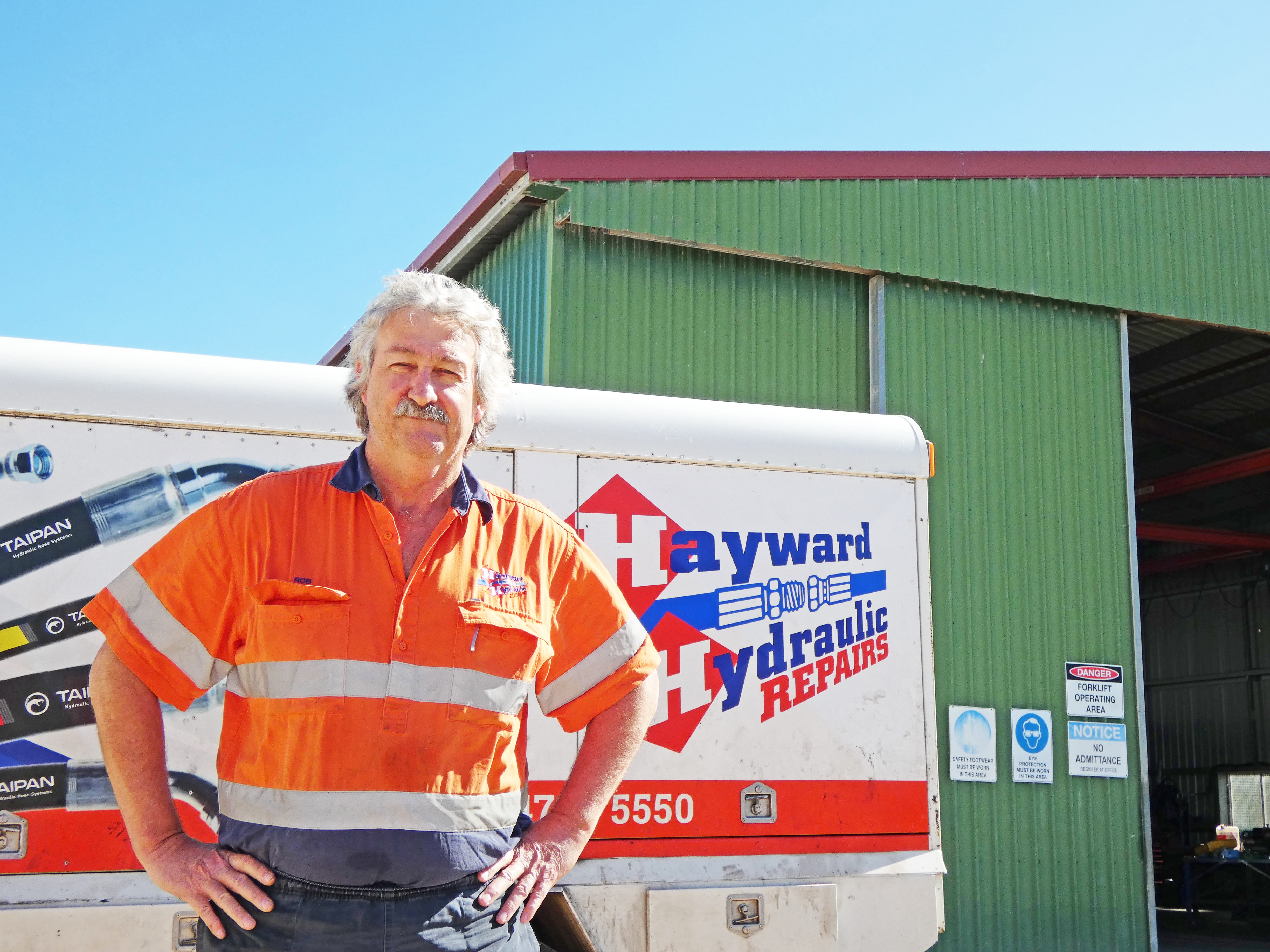
Not every business starts with a blueprint. For some, it begins as a calling… in more ways than one. Burdekin local Robert Hayward had been in the hydraulics industry since he was 18. A diligent worker who loved his job, he quickly built a reputation locally as one of the best in the business. But despite a mutual affinity with the industry that had formed over years, he stepped away in the early 1990s to help his father-in-law maintain a cane property in Clare. Until he received a call. Then another… and another. Rob quickly realised that, despite his brief hiatus, his reputation in hydraulics had not faded. With that, he was pulled back into the game, this time with nothing but a $2,000 ute, a toolbox, and work up to his neck. And the only way to keep himself from drowning in it was, ironically, to go in deeper. “As the Burdekin is, if you do a very good job, word travels quickly between the community. One farmer talked to another, he talked to another, he talked to another… “Until I sat down with my wife one day and said, ‘I think we can make a business out of this.’” His ute would eventually make way for a permanent space—a small sub-shed at Larry Hudson Engineering in the Ayr Industrial Estate that would serve as his headquarters for the following four years. He tackled the first year solo, before demand forced him to put an apprentice on in the second year, and a qualified tradesman in the third. By the end of the fourth, Rob’s work had outgrown its humble base, moving down the road into a new purpose-built shed that would become the home of Hayward Hydraulics. That shed would officially open in 1996, spurring a 30-year legacy sustained by three defining pillars. Growing with the industry “I had no idea how to use computers,” Rob said with a smirk. Admittedly, he hadn’t realised he signed himself up for a three-decade, three-fold evolution between an entire industry, his own business, and himself. What he did know was that he was ready to learn, and eager to grow. It started with the basics. For Rob, that meant wrapping his head around modern computers, attending TAFE courses on emerging welding techniques, and becoming a leader. “I went from being a very good tradesman to having to be an employer,” he said. “You have to be a people's person, you have to treat people the right way, treat your workers the right way. That part I never even thought of until we started getting into it.” Rob treated this evolution as a marathon rather than a sprint, dedicating the business's first decade cementing its reputation as a local leader. After striking up deals with major companies, including Queensland Rail and Wilmar Sugar in the mid-2000s, he decided to take the leap into the mining industry in the early 2010s as a safety net for the unpredictable sugar industry. With that growth, Hayward Hydraulics’ shed would undergo its third structural expansion to accommodate its continuously increasing popularity and modernised technology. He built a habit of gleaning ideas from various online hydraulic magazines, and then building on them to not only keep up with the industry, but to will it into the future himself. “I eventually built a reputation for thinking outside of the square. If somebody's been doing something for 20 years, I'll look at a better way of doing it,” he said. Albeit, he admits he and the business are still evolving today. “I've seen harvesters and planters go from chain and sprocket to hydraulic motors, to hydraulic motors being linked to satellite GPS,” he said. “The industry has changed in leaps and bounds, and you have to keep finding ways to move with it.” Doing it the right way Hayward Hydraulics’ evolution was founded on something Rob didn’t need to be taught. Care. And he makes sure his staff do, too. “I didn't come from a real wealthy family, so we were brought up to work; you work, you do the job right, you get paid,” he said. “So if I'm not happy with something, I'll ask my workers: ‘would you pay for that?’” When the mining industry began to boom in Queensland, Rob admits he had a difficult time retaining workers. To compete, he was forced into paying top-dollar for what he called “good quality workers,” causing financial tension. When asked if compromising staff quality for cost was ever an option, with the conviction of a true-blue purist, he said: “No.” “I've always maintained that a business is only as good as your employees. You can be the best boss in the world, but if you've got workers that people don't like, they don't come through the door,” he said. “My current staff are up there with the best that I've had. I just try to make sure they’re happy to come to work every day.” With quality and care as its engine, Hayward Hydraulics became known not just for technical know-how, but for doing things the right way. As its stature in the industry continued to grow, so did the scope of its customer base. Calls started coming in from as far north as Tully, all the way to Mackay and Western Queensland, all saying the same thing: “We heard you were the guy to talk to about this problem.” Family and community at its heart For the last 10 years especially, the business has made a point of supporting local organisations and sports clubs, most notably the Burdekin Roosters Rugby League Club. Rob described it as a duty to a community that has given so much to him and the company. “The community has been so important to it all. I’ve got some customers that have been with me from day one, and with some, I’m onto the third generation of the same family,” he said. “The’ve given a lot to me. They've helped me grow and supported me, so it's about time I supported them back.” Beneath it all, though, he points to his family as the driving force. “I remember those early days when we were setting up the new workshop, building benches and all that, my two brothers-in-law and my father came out and gave me a hand,” he said. “But my biggest support is my wife. Especially in the early days when I wasn't home, and she solely looked after the kids and everything. “It got to the stage where I was working seven days a week, 12 hour days, and my wife would bring the kids on a Saturday and Sunday, and we'd sit on the shop floor and have lunch. “She's been with me through the lows and the highs, and that I thank her for.” Now, thirty years later, it’s his family pulling him out of the industry. Driven by the desire to make up for lost time with his wife and kids, Rob has loosened his grip on business operations, working four days a week with plans to eventually let his brainchild find its own footing. As for right now, he’s not yet ready to call time on a chapter that was, perhaps, never meant to last this many pages. “I still love what I do,” he said. “The early days come with sacrifices, but when I look back now, it was all worth it. “I remember when it all first started, looking on the ATO website and coming across that statistic that most businesses fail within five years. “When I read it, I said to myself, 'well, I'm gonna make sure I’m not that statistic.’” And that, he did. CAPTION: Rob and his current team. Back L-R: Chase Pearce, Stephan Du Plessis Front L-R: Kade Pearce, Renee Viero, Robert Hayward, Tina Dennis, Bryan Parison Absent: Sam Tomasetig Photo credit: Jacob Casha
Read the full story
The Burdekin has rallied behind a local family after a sudden medical diagnosis turned their life upside-down. Ryan and Holly Davenport dropped everything when their two-year-old son, Rowen, was diagnosed with a brain tumour last month, temporarily relocating to Brisbane for his ongoing treatment. In response, a GoFundMe fundraiser has since raised over $55,000 in support of the family. Created in late May by Shannon Malone, a close friend of the Davenports, the fundraiser has been shared all over Facebook and Instagram by local organisations, garnering comments of support on top of 271 individual donations. “Words can’t describe how much it means to us to have everyone’s support behind Rowen as he begins his journey,” Ryan said. “They have given us precious time to spend with Rowen without the everyday worries.” The money will help fund hospital stays, travel, time away from work, and ongoing treatment expenses as the Home Hill family navigates a medical journey that began in April. Already on edge after daughter, Ally, underwent brain surgery to have a cavernoma removed just before Easter, Ryan and Holly acted promptly when they noticed a twitch in Rowen’s eye. Following weeks of consultations with Townsville doctors and specialists—which included MRI scans and a Royal Flying Doctors flight—Rowen was eventually diagnosed with pilocytic astrocytoma, a slow-growing brain tumour. He has since been transferred to Queensland Children’s Hospital in Brisbane for chemotherapy, with the couple leaving their two young daughters with their grandparents in the Burdekin to be by his side. In their absence, locals have offered meals, helped on the family’s sugar cane farm, assisted around their home and helped look after their daughters, along with the generous donations. Ryan said the funds raised would not just help relieve the financial burden of Rowen’s treatment, but allow the flexibility to fly their daughters down and spend some time as a family. “(The toughest part has been) the unknown, not having our family together … and watching Rowen go through these traumatic times and … not being able to do anything,” Ryan said. “It has been a very emotional journey so far, and it is hard to believe we are only at the start.” Anyone wanting to support the Davenports is urged to donate using the following link: https://www.gofundme.com/f/supporting-the-davos-and-little-rowen?attribution_id=sl:75c20475-06e5-4752-8e11-d1b7a07c7728&lang=en_AU&ts=1779705595&utm_campaign=fp_sharesheet&utm_content=amp20_t1&utm_medium=customer&utm_source=copy_link CAPTION: Funding will allow the family to fly their daughters down and spend more time together during Rowen’s treatment. Photo supplied
Read the full story
The Federal Member for Dawson, Andrew Willcox, has slammed the Albanese Government for an unacceptable ambush on regional communities, accusing the Commonwealth of abandoning disaster-prone areas to balance its own budget. The Federal Minister for Emergency Management, Kristy McBain, used a late Friday afternoon media release to quietly flag sweeping alterations to the Disaster Recovery Funding Arrangements (DRFA). The proposed changes dismantle the long-standing, scalable framework, which historically provided an average of 64 per cent federal coverage and capped support at 75 per cent for catastrophic events. In its place, Canberra intends to implement a rigid 50-50 funding model. This policy shift arrives at the worst possible time for the state; it follows a volatile severe weather season that caused widespread damage across 71 of Queensland’s 77 local government areas. Federal Member for Dawson, Andrew Willcox, is warning that the sudden funding shortfall threatens the future viability of essential infrastructure, local water treatment facilities, and emergency evacuation operations. Mr Willcox, drawing on his extensive experience as the former Mayor of the Whitsunday Regional Council, stated that the Federal Government is completely detached from the realities of regional recovery. "This decision is a direct hit to the heart of North Queensland," Mr Willcox said. "Canberra is treating natural disasters like a corporate budgeting exercise; however, out here, it is a matter of community survival. To penalise the very regions that drive the nation’s agricultural wealth and mining export revenues is a profound betrayal. "During my time steering the Whitsunday community through the wreckage of Severe Tropical Cyclone Debbie in 2017, I learned exactly what it takes to rebuild. We relied heavily on scalable federal assistance to restore our shattered rural road networks. Under a flat 50-50 split, local councils across Dawson would be forced to find millions of dollars in matching revenue; that is a financial burden our regional ratepayer base simply cannot sustain." Mr Willcox emphasised that major historical recovery operations would have been completely unviable under the newly proposed guidelines. "The total reconstruction of the Shute Harbour marine terminal and the $5 million federal package required to replace the decimated Proserpine Entertainment Centre occurred because the previous framework allowed for exceptional circumstances," Mr Willcox said. "Small regional councils do not possess the independent asset base to fund multi-million-dollar rebuilds alone. Furthermore, the historical system guaranteed that funding flowed directly into local economies, ensuring that regional earthmoving businesses and contractors were awarded the repair work. By lowering the funding floor, the Commonwealth is forcing cash-strapped councils to delay vital resilience works; this leaves our communities dangerously exposed before successive wet seasons. "It is a coward’s tactic for the Minister to leave this announcement until the day after the parliamentary sitting concluded, ensuring they avoided any real scrutiny or accountability in Question Time. “This is yet another calculated deception from a government that knows exactly how damaging these cuts are; this is absolutely not what the Australian people voted for, and I truly hope this betrayal is remembered at the next election. "This is yet another chapter in the ongoing federal neglect of regional Australia. The government is hiding behind the cover of an independent review to justify cutting essential frontline services. I call on the Emergency Management Minister to reverse this decision immediately; regional Queenslanders refuse to be treated as second-class citizens.” Supplied by the office of Federal Member for Dawson, Andrew Willcox CAPTION: FIGHTING FOR THE NORTH: Federal Member for Dawson Andrew Willcox MP outside Parliament House in Canberra, condemning the Albanese Federal Government's plan to slash scalable disaster recovery funding for regional councils. Photo supplied
Read the full story
"As the final week approaches for public submissions into the Sugar Code of Conduct, Member for Burdekin Dale Last has renewed his calls for growers to unite and make their voices heard. Mr Last said the public submissions for the sunsetting review of the Sugar Code of Conduct should be an opportunity for sugarcane growers from across the Burdekin to outline the benefits of the code for both farmers and the wider community. “Over recent weeks I have taken the liberty of providing a submission on behalf of the community, because ultimately the flow-on impact from changes in our sugar industry stretch beyond the paddock and the mills,” Mr Last said. “I recently met with several grower representatives which provided the opportunity to bring key stakeholders together, reaffirm my support as the Member for Burdekin and emphasise the need to work collaboratively as the review period unfolds.” Mr Last said while it was important stakeholders took the time to make their voices heard during the public submissions there was no better way to understand the impact of the Sugar Code of Conduct than to visit the area and speak directly to representatives. “A decade ago this district played a central role in bringing this code of conduct to fruition so I would expect our stakeholders receive a seat at the table they deserve,” Mr Last said. “If the Federal Labor Government was serious about consulting with the industry, the responsible Assistant Minister would be looking for every opportunity to listen to those who are most impacted by the Sugar Code.” Anyone wishing to have their say in the review can visit https://haveyoursay.agriculture.gov.au/sugar-code-review"
Read the full story
%20(1).jpg)
Did you know approval is required to set up a street stall or raffle on Council roads, footpaths or other areas?
Council has a number of locations, mainly on Queen Street, Ayr and Eighth Avenue, Home Hill, where raffles and street stalls may be held.
For information on availability of dates and locations and to receive approval, please contact Council's Customer Service Centre.
If approved a copy of your current public liability insurance to the value of $10,000,000 is to be provided to Council.
When approving the request, consideration will be made of adjacent businesses for example a stall selling cakes may not be approved near a bakery.
If you're looking to set up a street stall in the Burdekin, there's a straightforward process to follow. Street stalls, perfect for fundraising or promoting community events, require a permit from the Burdekin Shire Council. Here’s how it works:
• Application Form: Complete the street stall application form available on the Council's website.
• Submission: Submit the form at least ten days prior to the proposed date.
• Approval: The Council reviews the application, ensuring compliance with local regulations.
• Permit Issuance: Once approved, you’ll receive a permit detailing the conditions for your stall.
Street stalls are a great way to engage with the community and promote your cause. By following the proper steps, you ensure a smooth and successful event.
For detailed guidelines and to access the application form, visit Council's Street Stalls webpage.
If you would like to get in touch with me, please feel free to phone me on 0447 150 582 or email mayor@burdekin.qld.gov.au.
.jpg)
The Home Hill Chamber of Commerce has stood proudly in the Burdekin community since the early 1930s. Committed to addressing local issues and fostering community spirit, the chamber boasts a diverse membership of 43, encompassing not only business leaders but also dedicated individuals passionate about the region’s prosperity.
The Chamber includes five Executive Committee members who, alongside its members, drive forward initiatives and outreach efforts.
Recently, the Home Hill Chamber of Commerce was honoured to receive a Bendigo Bank Community Grant amounting to $1,000, a testament to the organisation’s shared vision with Bendigo Bank in supporting local endeavours. This grant will directly fund the upcoming Ephemera Art Competition, alleviating financial strain and enabling the chamber to expand its reach within the community.
“We run the Ephemera Art Competition as part of the Home Hill Harvest Festival, and it was very exciting to receive the grant as it will lighten the load for the Festival Committee,” explained Home Hill Chamber of Commerce Secretary, Robert Antoniazzi.
The involvement of local schools in past editions has not only enriched the event but also inspired young artists to explore their talents further.
“The grants are a wonderful initiative and mean that events involving local schools can continue,” said Mr. Antoniazzi.
“Students realise that there is something for them to give their artistic side an opportunity to develop and encourage them to continue their work.”
Beyond financial services, the Bendigo Bank’s commitment to community grants empowers organisations like the Home Hill Chamber of Commerce to cultivate local talent, foster community bonds, and drive positive change. The chamber expresses immense gratitude towards Bendigo Bank for their continued support and look forward to further collaborations.
The Home Hill Chamber of Commerce extends a warm invitation to Bendigo Bank board members to attend the chamber’s social events within the community, and see first-hand the work of the dedicated team. Both the Bendigo Bank board members and members of the local community are invited to attend the chamber’s meetings held every third Wednesday at the Home Hill Community Sports Club, Ninth Avenue, Home Hill at 5:30pm.

Inkerman Lime and Gypsum stands as a celebrated business which has been operating in the region since 1932. In 2006, couple Joe and Rosetta Tama took ownership of Inkerman Lime and Gypsum, which has since become a family business with their son, Robert Tama now the manager, following in his parents’ footsteps.
“My father has always been interested in investing in projects that he believed had great potential,” explained Robert.
“When he saw the possibilities and benefits of Inkerman Lime and Gypsum in improving soil quality using natural-based products, he recognised the opportunity to help not only farming land but also soils in general in the district and surrounding areas.”
Robert began working alongside his father in 2018, whilst continuing to manage his family’s farm. A couple of years later, Robert assumed full control of Inkerman Lime and Gypsum, and continues to balance both the business and the farm.
“One of the best highlights over the years has been the opportunity to communicate with customers and build friendships, and interacting with customers who have years of experience and local knowledge has been a great way to learn and provide assistance,” expressed Robert.
“I believe that no matter how old we get, there is always something new to learn, and interacting with others allows us to gain new knowledge over time.”
Robert manages the business with a focus on delivering exceptional customer service and finds great fulfilment in witnessing the long-term results of improving their customer’s soil quality and yield.
Moving forward in his management position, Robert envisions Inkerman Lime and Gypsum entering a new era of growth and innovation over the next decade and believes the upcoming changes will honour their continued dedication towards enhancing soil health and maximising crop yields for their customers.
“We plan to upgrade our equipment, introduce innovative product blends, provide comprehensive staff training and will collaborate with local agronomists and our growers to elevate and upgrade our services further,” explained Robert.
“We invite everyone to join us on this journey towards better soil health and increased productivity.”

The scheduled return for the Burdekin Water Festival has been celebrated across the region, with the festival set to ignite Queen Street on Saturday 7 September with the nostalgic theme, Bring it Back.
The theme, Bring it Back was decided at the Burdekin Water Festival Committee’s Annual General Meeting (AGM) held on Monday 10 June where a group of dedicated members of the community put plans into motion for the 2024 event.
Drawing from Water Festivals of the past, the theme, Bring it Back aims to take locals on a trip down memory lane, and the committee encourages all businesses to decorate their shop fronts to capture their most treasured memories of the annual festival. In discussions with the Water Festival Committee, common memories amongst the group included extravagant floats and costumes, Angie Baby, candy being thrown from the floats, various local organisation’s mascots participating in the parade, Queen Street festivities, delicious food stalls, and awesome entertainment throughout the day and into the night.
The committee has begun calling for your support to ensure this much-loved event returns with a bang, and needs organisations, sporting clubs, dance and performance schools, community groups, businesses, primary, high schools and kindergartens, and ultimately everyone in the community to become involved in some way.
“We have a short time frame to get this underway, and we need as much support as we can, financially, and with volunteers, so if you can help in any way, please contact us,” expressed the Burdekin Water Festival Committee’s Media Advisor, Kari Ravizza.
Both junior and senior ambassadors from any organisation, businesses, groups and / or schools in the region are also strongly encouraged to come forward.
On the evening of last Monday’s AGM, the Burdekin Water Festival Executive Committee was announced, receiving extremely positive feedback from the community, acknowledge the event will be in safe hands. The esteemed president, Eusebio Aguirre will be joined by Vice President Frank Nucifora, Treasurer Debbie Szendry, Secretary Bruna Pearson, and Secretary Support, Colleen Harris.
With updates and calls for support being published on the Burdekin Water Festival’s Facebook page, Wednesday 12 June saw the committee excitingly secure Queensland Country Credit Union as one of their major sponsors.
The committee expresses its gratitude to the region for their support of their efforts to date and looks forward to organising an extraordinary comeback event for the much-loved Burdekin Water Festival.
%20(1).jpg)
A visit to the Australian Institute of Marine Science (AIMS) has given a group of Burdekin cattle producers an opportunity to learn more about the science behind water quality research.
It was organised by natural resource management group NQ Dry Tropics, working with Burdekin graziers on changed grazing practices to manage riparian zones and maintain end-of-dry season groundcover to improve water quality and farm production.
NQ Dry Tropics Paddock to Reef project officer Jade Fraser said the tour of the facilities was an opportunity to provide graziers with additional knowledge about how improved farming practices could benefit the Great Barrier Reef lagoon.
“We’re trying to merge best-practice science with best-practice land management and come up with solutions that work for landholders, the government, and the Great Barrier Reef,” Jade said.
“If farmers are to be part of the water quality solution, they need access and communication lines to government, policymakers and scientists to help come up with solutions that complement their farm enterprise.
“Graziers had an opportunity to share how practices they’re putting in place are reducing their environmental footprint while also improving the viability of their farms, and scientists were able to talk about the research they’re doing and why it mattered.
“Scientists explained the implementation of the Paddock to Reef (P2R) Integrated Monitoring, Modelling and Reporting program in the Burdekin region, and how results provided evidence of links between land management activities, water quality and reef health.
“Monitoring is used to measure the on-ground change in land management practices and water quality at the paddock scale. This feeds into catchment models that track progress towards water quality targets through the Great Barrier Reef Report Card.”
Burdekin grazier Glen Duncombe said he found the visit informative.
“It was good to hear how scientists carry out monitoring to show impacts of environmental changes on marine ecosystems, and what corals can tell us about the occurrence and intensity of freshwater flood and cyclone events on the reef,” Glen said.
“Water quality going into the reef is, if not getting better, at least stabilising, and hopefully that’s got a bit to do with what we’re doing at home. If we’re all doing our bit, collectively it helps.
“We’re keeping cattle out of the rivers which means we don’t have the cattle pads into the river to cause erosion.
“We’re also improving groundcover and diversity of pastures, and that’s definitely making a difference in reducing run-off during the wet season.
“Hopefully that’ll make a difference to water quality in the long term.”
Grazier Jo Murphy said the visit highlighted the multitude and complexity of human and natural factors impacting the health of coastal waters.
“I live at the top of the Burdekin catchment and the country on our eastern side flows into the Burdekin, so it was interesting to hear about the sediment analysis,” Jo said.
“The data shows that if there’s a great rainfall event or big cyclone, or multiple cyclones in a season, the reef is going to get affected.
“It highlighted that those who manage large areas of agricultural land, need to do their best to control erosion and improve groundcover because it’s better for the country, the environment, grazing animals and livelihoods.
“This is also the case for other industries, coastal developments, and other disturbances. Improving water quality is a complicated and complex undertaking, and many graziers are committed to adopting practices to help with that.”
The Paddock to Reef program provides the framework for evaluating and reporting progress towards Reef 2050 water quality targets through the Great Barrier Reef Report Card. The program is jointly funded by the Australian and Queensland governments.
The AIMS visit was part of NQ Dry Tropics’ Herding Change Through Grassroots Recovery project funded by the partnership between the Australian Government’s Reef Trust and the Great Barrier Reef Foundation.
Zoe O’Neill, left, with Laureen and Glen Duncombe. Photos supplied
Mandy Flintham inspects coral core samples at the AIMS Coral Core Archive Facility
A tour of the National Sea Simulator, the world’s most advanced aquarium facility, provided an opportunity for cattle producers to learn more about the science behind water quality research
Graziers Glen Duncombe, Eric Le Feuvre and Jo Murphy inspected SeaSim’s large seawater tanks
Graziers Lauren Duncombe, left, and Jo Murphy

The last of Wilmar Sugar and Renewables’ four Burdekin mills were on track to start crushing earlier this week, on Tuesday.
General Manager Operations Mike McLeod said he expected the first bin to be tipped at Pioneer Mill near Brandon just after lunchtime on Tuesday, and the first raw sugar to be produced by Wednesday.
This means half of Wilmar’s mills will be in full swing by Wednesday, making sugar, molasses and renewable energy.
Inkerman Mill in Home Hill was first to begin the crushing season for the Wilmar group on Monday, 10 June. Despite an unexpected shutdown because of industrial action, Inkerman has already crushed 66,000 tonnes of cane and produced about 8,100 tonnes of sugar.
Kalamia and Invicta mills started crushing on Thursday, 13 June – a week later than originally planned because of industrial action.
Mr McLeod said Wilmar’s other four mills – Victoria and Macknade near Ingham, Proserpine on the Whitsunday coast, and Plane Creek south of Mackay – are all expected to be in production early next week.
The Sarina Distillery has been operating since 1 June, producing bioethanol for fuel and industrial products.
Mr McLeod said crews had worked hard to maintain throughput at the sugar mills that are operating, so growers could continue harvesting while fine weather prevailed.
“Everyone in the industry has an eye on the weather at this time every year, so we can’t afford to lose any time,” he said.
“Our people have worked hard to recover from the earlier stoppages and delays and, with everything going our way, everyone will have a good season.”
Wilmar’s eight mills are expected to process 15.59 million tonnes of sugarcane this year, to produce more than 2 million tonnes of raw sugar.
Representatives from Wilmar and union bargaining agents will meet for another round of bargaining for a new Enterprise Agreement on Thursday (20 June).
The parties will report back to the Fair Work Commission on Friday (21 June).
Wilmar’s Invicta Mill kicked off last on 13 June. This week, Pioneer Mill got underway, meaning half of Wilmar’s factories are now in production, despite hold-ups from industrial action
Manager Operations Harrison Slogrove on the first day of production at Invicta Mill, on 13 June
Pioneer Mill Operations Manager Matt Norton on the first day of production

The Australian Idol country singing treasure, Trent Richardson, will ignite the Burdekin Showgrounds on Wednesday 26 June.
From growing up on an Emu Park camel farm to having his name up in lights, Trent’s musical talents have been broadcast across the nation as part of the 2024 season of Australian Idol earlier this year.
Since concluding his time on the talent series, Trent has continued singing and working on his talents with bigger and better plans in mind for the future.
“She’s been a wild ride, but it’s definitely where the heart wants to be and I’m just so grateful that I did it and gave it a chance to find out once and for all if I had something,” explained Trent.
“I threw myself in the deep end and the feedback that I got back from the Aussies was great, so I’ll definitely stick with it, and keep doing my hard bit of yacka!”
When Trent stages his tunes in the region next Wednesday, this won’t be his first Burdekin Show rodeo! In fact, Trent has been an avid showgoer since he was young, accompanying his father in managing the infamous Burdekin Show Camel Rides!
“I’ve been there helping Dad with the camel rides since I was a little fella, and it’s funny that after all these years everyone has found out I can sing, so instead of walking the camels with Dad this year, I’ll be up there singing,” explained Trent.
Trent’s performance will have audiences dancing and singing along, and in an exclusive interview with Burdekin Life newspaper he shared his setlist plans!
“There will be a bit of Luke Combs, Morgan Wallan, and a few big country artists that everyone knows, a few classics too, and a couple of my originals but I won’t give too much away,” explained Trent.
“I’ll go up there, sing a few tunes, and hopefully everyone has a great time, and it’s good to be there getting paid to sing instead of walking camels!”

Cecillia Cason has been honourably selected to attend the Pacific Honors Ensemble Program in November; a prestigious program held in the United States of America.
The program, as hosted by the Young Conservatorium (the pre-tertiary program for Griffith University) and the Western International Band Clinic, is held in Seattle, Washington annually with a small group of highly skilled honor band students selected to attend. Candidates are to audition for a position by performing a piece from a selection of music provided, and although Cecillia’s instrument of choice is not the trumpet, her talents prevailed, and she was prestigiously granted a spot in the 2024 Pacific Honors Ensemble Program.
“I was so very happy and excited about getting in, and when I auditioned, the music was on an instrument I’m not the best at, but I was so excited to hear I was accepted,” expressed Cecillia.
Earlier this year, Griffith University reached out to Cecillia, advising her of the opportunity and encouraging her to apply.
“I couldn’t be prouder of Cecillia, and she hasn’t achieved this by herself, it’s due to the help of everyone around her, including her tutors, which have made everything she has achieved possible, and I’m just so proud,” expressed Cecillia’s mother, Maria Cason.
Cecillia’s musical talents and abilities have garnered much attention over the past couple of years and have led her to accumulate many awards and attendance at various celebrated musical enrichment opportunities. Earlier this year, Cecillia attended the Queensland Band Association’s Youth Band Camp, where she was awarded the Leonie Marshall Scholarship, a significant award in recognition of a student’s passion for their community band association and dedication to musical excellence.
Cecillia is also a celebrated member of the Burdekin Brass Band, performing at regular community events as well as the Concert Band where she is currently attending rehearsals in preparation for Ayr State High School’s upcoming musical at the Burdekin Theatre. Next month, Cecillia will attend the State Honors Ensemble Program in Brisbane where she will continue to build upon her skills surrounded by like-minded peers under the guidance of industry professionals.
Cecillia’s talents and dedication to her musical practice are outstanding, and she certainly has a bright future ahead of her in the instrumental sphere.

On the morning of Thursday 13 June, Ayr State High School hosted the Burdekin Chaplaincy Fundraising Breakfast.
Chaplains from each school in the region came together to celebrate the work these amazing people do for the community and its students, with all funds raised re-directed to support the youth of the Burdekin.
The event ran from 7am and encompassed school staff, principals, business owners, and community members from across the community, along with Mayor Dalle Cort. All attendees have supported the Burdekin’s Chaplains over the years, and the breakfast provided a heartwarming environment where their support was thanked.
Brooke Sorbello, the Scripture Union manager for North Queensland, was deeply touched seeing the community come together in support of the young people of the Burdekin at the Burdekin Chaplaincy Fundraising Breakfast and believes the chance to do so was beyond special.
“It was a chance to get these supporters together to say thank you as well as share stories around how their support is helping the young people of the community,” explained Brooke.
The event included guest speakers, one of which being Home Hill High School’s Chappy Jennie Dowie, who has been a celebrated chaplain in the Burdekin for over seventeen years. Chappy Jennie shared her experiences as a chaplain, explaining the important role chaplains have in student’s lives, from running programs in the areas of anger and anxiety management to simply being their friend.
"As a School Chaplain, I focus on prevention and support; helping students find a better way to deal with a range of issues from family breakdown, grief, peer pressure, loneliness, risk of disengagement, substance abuse, depression and anxiety - just to name a few,” expressed Chappy Jennie.
“I aim to provide a non-judgmental, accessible, listening ear and a caring presence for not only for our kids in crisis, but also for those who just need a friend.
“So today I want to thank you for your support of School Chaplaincy.
“I want to thank you because if it wasn’t for people like you, we wouldn’t have the opportunities that we have to support young people who often feel unseen, undervalued, misunderstood and powerless to change the life that they have been dealt with.”
Brooke would like to extend her gratitude to Ronda Williams, the Burdekin Chaplaincy Committee Chair, and for all her organisational efforts to fundraise for the chaplains in the community.
“In the chaplaincy structure, we’re given enough funding to support a chaplain for a day and half, whereas most of the Burdekin’s chaplains are in our schools for four, sometimes five days a week based on the community support,” explained Brooke.
“The presence of these chaplains is really powerful, and the continuity, and consistency makes a really big difference in the work that they can do for the students.”
The morning was emotional, powerful and inspirational, and stood as testament to the Burdekin community’s continued commitment to investing in and supporting the wellbeing and future of its youth.
%20(1).jpg)
Creating inviting outdoor living spaces through DIY projects can transform your backyard into a functional and aesthetically pleasing area for relaxation and entertainment.
Here are several creative ideas to inspire your outdoor makeover:
Cozy Outdoor Lounge: Begin with comfortable seating options like DIY pallet sofas or repurposed wooden benches with plush cushions. Add a handmade coffee table using a reclaimed crate or an old trunk topped with a custom-cut piece of glass.
DIY Hammock Corner: Create a cozy retreat with a hammock hung between two trees or posts. Customise it with handmade pillows and a small side table for books or drinks.
DIY Fire Pit: Build a fire pit using bricks or stones arranged in a circle. Line the bottom with gravel for drainage and safety. Enhance the ambiance with string lights hung overhead or solar-powered lanterns for eco-friendly illumination.
Vertical Garden Wall: Utilise a bare fence or wall by creating a vertical garden. Install wooden pallets horizontally and fill them with small potted plants or herbs. This not only adds greenery but also maximises space.
Outdoor Dining Area: Construct a sturdy dining table from reclaimed wood or pallets. Pair it with DIY benches or chairs made from old wooden crates or tree stumps - complete the setting with a handmade table runner, lanterns and outdoor dinnerware.
DIY Pathways and Walkways: Define pathways using materials like gravel, flagstones, or recycled bricks. Create a rustic look by embedding old railway sleepers or wooden planks for a natural, earthy feel.
Repurposed Outdoor Bar: Convert an old kitchen cart or dresser into an outdoor bar by adding shelves for storage and a countertop for serving. Use reclaimed wood or tiles for the bar surface and decorate with potted plants and hanging glassware.
Outdoor Movie Theatre: Hang a white sheet or use a blank wall as a projection screen. Set up seating with floor cushions, bean bags or homemade pallet sofas. Install outdoor speakers and a projector for movie nights under the stars.

Sunday 16 June hosted a celebratory milestone for Gumlu’s Biggest Morning Tea event, with community members flocking to the Molongle Creek Boat Club to attend the 10th anniversary of the fundraising gathering.
2024’s Biggest Morning Tea event raised an amazing total of $2,280 for the Cancer Council Queensland due to the outstanding generosity of the community, and Sunday’s fundraising efforts contributed to an overall decade total exceeding $10,000.
Regina Lequerica has been running and organising Gumlu’s Biggest Morning Tea events since 2014 and was blown away by the generosity of Sunday’s proceedings.
“The day went a lot better than anyone excepted, and we raised double the amount that we usually raise, and it was quite successful, people were very generous,” explained Regina.
After a decade of dedication, Regina looks forward to running the event each year, explaining this year went without a hitch.
“We’ve built up a little team with the four of us who get together to get the event all going, and this year I felt really relaxed planning the event,” said Regina.
Beginning at 9am sharp, over 50 attendees gathered to enjoy nibbles, trivia, an extensive cent sale, and raffles, with a large portion of the crowd being travellers staying at the Molongle Creek Caravan Park.
Along with regular fundraising initiatives, Regina and her team organised money boards, “first in best dressed” cent sales, guess the lollies jars, donation tins, and in a special decade celebration, Katrina Land made personalised T-shirts which were auctioned off to raise additional funds.
The event was highly successful in fundraising for the Cancer Council Queensland, and Regina thanks the community for their amazing support both for the 2024 event, and each event over the past 10 years.
“We’ve found that everyone enjoys what we do, and we’re so thankful for everyone’s support,” thanks Regina.
Regina Lequerica, Katrina Land, Summer Gurd from Bowen, Savannah Land, Amy and Susann Pfingst, Thomas Harrington, Ella and Nadine Land
Thomas Harrington, Tony Battiston, Katrina Land, Regina Lequerica, Nadine Land, Susann Pfingst

Congratulations to Tony Battiston, who celebrated his 70th birthday with family and close friends at the Bocce Club on Saturday.
All were encouraged to dress as a movie character, with Tony donning a Jedi costume. He entertained everyone by sharing a few of his favourite riddles and after lunch, a game of bocce was enjoyed by all.
Thank you to everyone who came, he had an awesome weekend, one not to forget.
Tony with nephews: Steven, David and Michael Lequerica

The latest victim of severe staff shortages in the medical industry is the Bowen Herbert Street Family Medical Centre which announced this week that it will close its doors at the end of June.
Over 200 GP clinics in Australia have closed down in the past year, many of them citing the same reason – they simply cannot get enough GPs.
Bowen Herbert Street Family Medical Centre is operated by the Girudala Community Cooperative Society, which is a non-for-profit organisation which predominantly overseas the welfare of Indigenous and South Sea Islander community members.
Since 2010, Girudala has been operating the Medical Centre and they welcome all patients, with more than 2,000 people registered on their books.
When they close their doors on June 30, there will only be two other medical centres in Bowen, servicing a population of over 10,000 people.
Bowen Herbert Street Family Medical Centre was also the last service to offer Bulkbilling to all patients.
The other Bowen GP clinics offer Bulkbilling to pensioners and children under 16, but there was a huge demand to fill the gap for vulnerable people that did not fit that age-bracket.
Bowen Herbert Street Family Medical Centre filled that gap.
The closure of this much-needed medical Centre will put immense pressure not only on the other GP clinics but also Bowen Hospital.
A spokesperson for Bowen Herbert Street Family Medical Centre, Jean Andersen, said they are appealing for help.
“It’s been a really hard decision to close the doors and we’ve been trying to reach out to the government for some kind of support,” she explained.
“We’ve gone through everything we can think of and now we’ve made the decision, our primary focus is to refer our patients onto other health services.
“I’m sure every rural and remote community is crying out for GPs as well; we are asking the government to help us in any way they can – is there any funding to attract doctors here?
“We need a resolution soon and I really hope we can find one.”
For several years, the Bowen Herbert Street Family Medical Centre has been surviving with locum GPs who work at the clinic for short periods.
A few years ago, they had two permanent doctors, but there are now no regular GPs to fill the huge demand and the service simply cannot cope anymore.
“This is a national crisis and governments are failing remote communities like Bowen, who simply cannot afford to pay for doctors,” stated Ms Andersen.
“The closure of Herbert Street will place extreme pressure on health services in the area and we’re calling on local governments, namely local, state and commonwealth to work together with us and with the community to develop a sustainable long-term and viable medical health solution.”
%20(1).JPG)
After six weeks of hard work, artist Glen Gillard is thrilled to have finished the latest of Bowen’s murals and is extremely happy with it.
“It is probably the longest that I have ever spent on a mural,” said Glen.
“I am glad to see the end of it, and I’m happy and think the results are pretty good.
“Everybody's saying how wonderful it is and magnificent, but most of the comments I get is that it’s beautiful and that's what I'm really happy about.”
Glen joked that his favourite part to paint was the end, adding his signature at the end.
Secretary of the Mural Society Heather Skinner, President Josie Tons and Treasurer Marcia Land are over the moon with it and describe it as “Fan-bloody-tastic!”
This mural is of Herbert Street and the Mural Society have plans to extend it, adding additional buildings from Herbert Street on the blank spaces next to the newly finished mural.
This mural would not be possible without Bowen Hire, supplying scaffolding and the Mural Society express a huge thank you to them.
Glen would also like to add that he loves green tree frogs, and he likes to add them into his murals – see if you can spot one!
“This mural here has three Green Tree Frogs which people have to find before they go home,” Glen laughed.
Glen Gillard in front of his finished mural
Treasurer Marcia Land, Secretary Heather Skinner, President Josie Tons and Artist Glen Gillard
Photo credit: Daniel Heggie
.png)
By Amanda Wright
Production at Wilmar Sugar and Renewables’ Inkerman Mill in the Burdekin region, which kicked off the 2024 season on Monday, June 10, was abruptly halted on Wednesday due to industrial action.
The shutdown was prompted by union delegates informing the company of a planned one-hour work stoppage at Inkerman Mill and at least two other sites at midday on Wednesday.
While a one-hour stoppage might not typically force a shutdown, the delegates declined to confirm whether this would be the only stoppage at Inkerman on Wednesday. This lack of certainty left Wilmar Sugar and Renewables with no choice but to halt operations.
Mike McLeod, General Manager of Operations, expressed Wilmar’s concerns.
“A safe shutdown usually takes about 12 hours and must be carried out with care and precision. The uncertainty about stoppages presented both operational and safety concerns, leaving us no option but to shut down the mill.”
Members of the local cane growing community along with QCAR representatives. Photo credit: Melanie Napier Photography
McLeod acknowledged the impact on local growers,
“We feel for the growers who had harvested cane and those expecting to harvest in the morning. We have 6,000 tonnes of burnt cane in the Inkerman yard now, and we are told there is another 7,000 tonnes in the paddock,” Mr McLeod said.
“We had planned to be crushing at Inkerman until at least 7:30 Wednesday morning, but without certainty, we are better to stop than risk damage or injury and possibly have the mill out of commission for an extended period,” he added.
The industrial action has sparked significant concern among growers and the local community, who are feeling the brunt of the disruption. Charles Quagliata, QCAR Chair, emphasised the dire consequences.
“It’s the growers and the community who are hurting the most with this industrial action. The growers are being held for ransom and used as collateral in this dispute.”
Christian Lago, QCAR Burdekin District Committee Chairman, highlighted the immediate impact on growers, saying, “The thousands of tonnes of burnt cane in paddocks, rail bins, and on sidings without the prospect of crushing at this time is disastrous for the sugar industry as a whole.
“This shutdown was premature and hurts the growers more than anyone else.”
QCAR also said that at this stage, there has been no indication from Wilmar on whether the growers will be compensated for the loss of sugar concentration in the cane while it sits stagnant.
Stephen Ryan, CEO of QCAR, outlined the broader implications for the industry.
“Our members are directly impacted by the current industrial action, which is causing impaired cash flows across all stakeholders. The local economy is already feeling the pinch, and the Burdekin community will continue to suffer if an agreement isn't reached swiftly.”
Panikos Spyrou, QCAR's Executive Director, expressed concerns about the sustainability of the industry.
“There is a legitimate fear of a repeat of the dark and disastrous 2010 season, where industrial action prevented a timely start during fine weather, leading to a season of supply collapse when untimely wet weather set in.
“For every week lost in perfect weather, the season could be dragged out for an additional month towards the end, potentially meaning cane could stay in fields unharvested.
“The ongoing dispute is unacceptable, and the community is being held to ransom.”
The union action comes within hours of all three unions requesting a resumption of negotiations on a new enterprise agreement. This request follows the recent rejection by a majority of company employees of the company’s latest offer, which included a 14.25 per cent increase over 3.5 years, a $1,500 sign-on bonus, and 50 permanent positions for seasonal and term contract workers.
At the time of print, Wilmar was working to resume crushing cane as soon as possible at its Inkerman Mill in the Burdekin on Wednesday afternoon, and to begin production on Thursday at Invicta and Kalamia mills, despite the threat of continuing industrial action.
The company will make application to the Fair Work Commission for an urgent hearing of its argument for orders to immediately suspend protected action to allow the annual crush to proceed while enterprise agreement (EA) negotiations continue. To date the company has not exercised its right under the Fair Work Act to lock out workers participating in protected industrial action.
Mr McLeod, said that the company welcomed, and shared, the views expressed by union officials that everything possible should be done to avoid harming the interests of cane growers and the community during negotiation of an enterprise agreement.
“We need to get that cane through the mill as soon as we can,” he said.
Publishers Indemnity. Any individual or entity that places advertising, supplies copy material, or submits editorial content to Core Life Publishing agrees and undertakes to ensure that all such material:- Does not infringe upon any copyright, trademark, or other intellectual property rights;- Is free from any content that could be considered defamatory, libelous, or slanderous;- Does not infringe upon any rights related to privacy or breach of confidence;- Contains no obscene, indecent, or otherwise unlawful material;- Complies fully with the Trade Practices Act and all other applicable laws, regulations, or statutes.Furthermore, by submitting or placing such material, these individuals or entities agree to indemnify and hold harmless the publisher, Core Publishing and Events Pty Ltd, and/or its agents from and against any and all investigations, claims, demands, liabilities, damages, costs, or judgments arising out of or in connection with the material provided. All material is believed to be accurate at the time of printing and remains the copyright of Core Publishing and Events Pty Ltd.
© 2026 Life Publishing Group Pty Ltd.
