
Independently Owned, Locally Grown, Community Loved
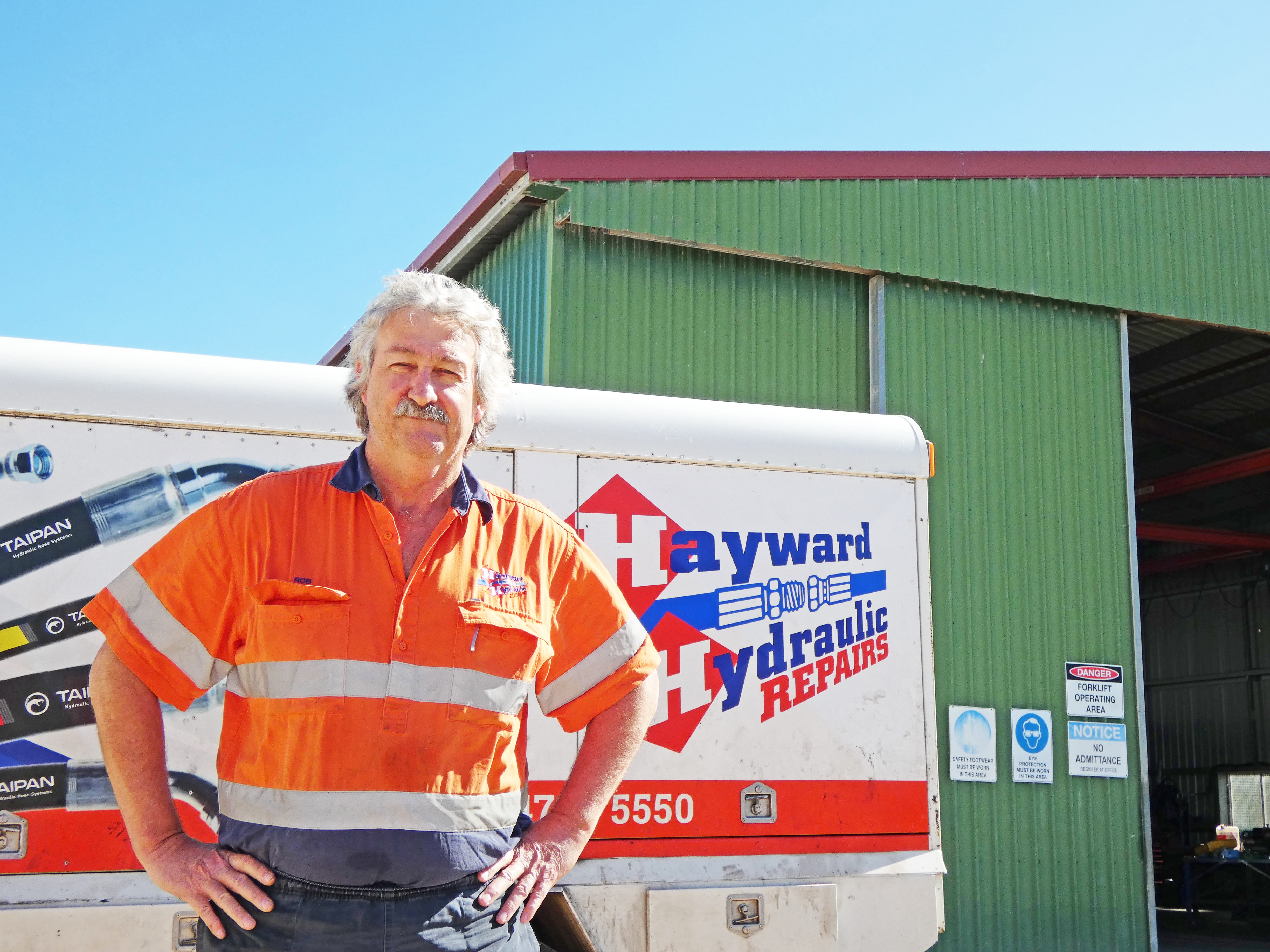
Not every business starts with a blueprint. For some, it begins as a calling… in more ways than one. Burdekin local Robert Hayward had been in the hydraulics industry since he was 18. A diligent worker who loved his job, he quickly built a reputation locally as one of the best in the business. But despite a mutual affinity with the industry that had formed over years, he stepped away in the early 1990s to help his father-in-law maintain a cane property in Clare. Until he received a call. Then another… and another. Rob quickly realised that, despite his brief hiatus, his reputation in hydraulics had not faded. With that, he was pulled back into the game, this time with nothing but a $2,000 ute, a toolbox, and work up to his neck. And the only way to keep himself from drowning in it was, ironically, to go in deeper. “As the Burdekin is, if you do a very good job, word travels quickly between the community. One farmer talked to another, he talked to another, he talked to another… “Until I sat down with my wife one day and said, ‘I think we can make a business out of this.’” His ute would eventually make way for a permanent space—a small sub-shed at Larry Hudson Engineering in the Ayr Industrial Estate that would serve as his headquarters for the following four years. He tackled the first year solo, before demand forced him to put an apprentice on in the second year, and a qualified tradesman in the third. By the end of the fourth, Rob’s work had outgrown its humble base, moving down the road into a new purpose-built shed that would become the home of Hayward Hydraulics. That shed would officially open in 1996, spurring a 30-year legacy sustained by three defining pillars. Growing with the industry “I had no idea how to use computers,” Rob said with a smirk. Admittedly, he hadn’t realised he signed himself up for a three-decade, three-fold evolution between an entire industry, his own business, and himself. What he did know was that he was ready to learn, and eager to grow. It started with the basics. For Rob, that meant wrapping his head around modern computers, attending TAFE courses on emerging welding techniques, and becoming a leader. “I went from being a very good tradesman to having to be an employer,” he said. “You have to be a people's person, you have to treat people the right way, treat your workers the right way. That part I never even thought of until we started getting into it.” Rob treated this evolution as a marathon rather than a sprint, dedicating the business's first decade cementing its reputation as a local leader. After striking up deals with major companies, including Queensland Rail and Wilmar Sugar in the mid-2000s, he decided to take the leap into the mining industry in the early 2010s as a safety net for the unpredictable sugar industry. With that growth, Hayward Hydraulics’ shed would undergo its third structural expansion to accommodate its continuously increasing popularity and modernised technology. He built a habit of gleaning ideas from various online hydraulic magazines, and then building on them to not only keep up with the industry, but to will it into the future himself. “I eventually built a reputation for thinking outside of the square. If somebody's been doing something for 20 years, I'll look at a better way of doing it,” he said. Albeit, he admits he and the business are still evolving today. “I've seen harvesters and planters go from chain and sprocket to hydraulic motors, to hydraulic motors being linked to satellite GPS,” he said. “The industry has changed in leaps and bounds, and you have to keep finding ways to move with it.” Doing it the right way Hayward Hydraulics’ evolution was founded on something Rob didn’t need to be taught. Care. And he makes sure his staff do, too. “I didn't come from a real wealthy family, so we were brought up to work; you work, you do the job right, you get paid,” he said. “So if I'm not happy with something, I'll ask my workers: ‘would you pay for that?’” When the mining industry began to boom in Queensland, Rob admits he had a difficult time retaining workers. To compete, he was forced into paying top-dollar for what he called “good quality workers,” causing financial tension. When asked if compromising staff quality for cost was ever an option, with the conviction of a true-blue purist, he said: “No.” “I've always maintained that a business is only as good as your employees. You can be the best boss in the world, but if you've got workers that people don't like, they don't come through the door,” he said. “My current staff are up there with the best that I've had. I just try to make sure they’re happy to come to work every day.” With quality and care as its engine, Hayward Hydraulics became known not just for technical know-how, but for doing things the right way. As its stature in the industry continued to grow, so did the scope of its customer base. Calls started coming in from as far north as Tully, all the way to Mackay and Western Queensland, all saying the same thing: “We heard you were the guy to talk to about this problem.” Family and community at its heart For the last 10 years especially, the business has made a point of supporting local organisations and sports clubs, most notably the Burdekin Roosters Rugby League Club. Rob described it as a duty to a community that has given so much to him and the company. “The community has been so important to it all. I’ve got some customers that have been with me from day one, and with some, I’m onto the third generation of the same family,” he said. “The’ve given a lot to me. They've helped me grow and supported me, so it's about time I supported them back.” Beneath it all, though, he points to his family as the driving force. “I remember those early days when we were setting up the new workshop, building benches and all that, my two brothers-in-law and my father came out and gave me a hand,” he said. “But my biggest support is my wife. Especially in the early days when I wasn't home, and she solely looked after the kids and everything. “It got to the stage where I was working seven days a week, 12 hour days, and my wife would bring the kids on a Saturday and Sunday, and we'd sit on the shop floor and have lunch. “She's been with me through the lows and the highs, and that I thank her for.” Now, thirty years later, it’s his family pulling him out of the industry. Driven by the desire to make up for lost time with his wife and kids, Rob has loosened his grip on business operations, working four days a week with plans to eventually let his brainchild find its own footing. As for right now, he’s not yet ready to call time on a chapter that was, perhaps, never meant to last this many pages. “I still love what I do,” he said. “The early days come with sacrifices, but when I look back now, it was all worth it. “I remember when it all first started, looking on the ATO website and coming across that statistic that most businesses fail within five years. “When I read it, I said to myself, 'well, I'm gonna make sure I’m not that statistic.’” And that, he did. CAPTION: Rob and his current team. Back L-R: Chase Pearce, Stephan Du Plessis Front L-R: Kade Pearce, Renee Viero, Robert Hayward, Tina Dennis, Bryan Parison Absent: Sam Tomasetig Photo credit: Jacob Casha
Read the full story
The Burdekin has rallied behind a local family after a sudden medical diagnosis turned their life upside-down. Ryan and Holly Davenport dropped everything when their two-year-old son, Rowen, was diagnosed with a brain tumour last month, temporarily relocating to Brisbane for his ongoing treatment. In response, a GoFundMe fundraiser has since raised over $55,000 in support of the family. Created in late May by Shannon Malone, a close friend of the Davenports, the fundraiser has been shared all over Facebook and Instagram by local organisations, garnering comments of support on top of 271 individual donations. “Words can’t describe how much it means to us to have everyone’s support behind Rowen as he begins his journey,” Ryan said. “They have given us precious time to spend with Rowen without the everyday worries.” The money will help fund hospital stays, travel, time away from work, and ongoing treatment expenses as the Home Hill family navigates a medical journey that began in April. Already on edge after daughter, Ally, underwent brain surgery to have a cavernoma removed just before Easter, Ryan and Holly acted promptly when they noticed a twitch in Rowen’s eye. Following weeks of consultations with Townsville doctors and specialists—which included MRI scans and a Royal Flying Doctors flight—Rowen was eventually diagnosed with pilocytic astrocytoma, a slow-growing brain tumour. He has since been transferred to Queensland Children’s Hospital in Brisbane for chemotherapy, with the couple leaving their two young daughters with their grandparents in the Burdekin to be by his side. In their absence, locals have offered meals, helped on the family’s sugar cane farm, assisted around their home and helped look after their daughters, along with the generous donations. Ryan said the funds raised would not just help relieve the financial burden of Rowen’s treatment, but allow the flexibility to fly their daughters down and spend some time as a family. “(The toughest part has been) the unknown, not having our family together … and watching Rowen go through these traumatic times and … not being able to do anything,” Ryan said. “It has been a very emotional journey so far, and it is hard to believe we are only at the start.” Anyone wanting to support the Davenports is urged to donate using the following link: https://www.gofundme.com/f/supporting-the-davos-and-little-rowen?attribution_id=sl:75c20475-06e5-4752-8e11-d1b7a07c7728&lang=en_AU&ts=1779705595&utm_campaign=fp_sharesheet&utm_content=amp20_t1&utm_medium=customer&utm_source=copy_link CAPTION: Funding will allow the family to fly their daughters down and spend more time together during Rowen’s treatment. Photo supplied
Read the full story
The Federal Member for Dawson, Andrew Willcox, has slammed the Albanese Government for an unacceptable ambush on regional communities, accusing the Commonwealth of abandoning disaster-prone areas to balance its own budget. The Federal Minister for Emergency Management, Kristy McBain, used a late Friday afternoon media release to quietly flag sweeping alterations to the Disaster Recovery Funding Arrangements (DRFA). The proposed changes dismantle the long-standing, scalable framework, which historically provided an average of 64 per cent federal coverage and capped support at 75 per cent for catastrophic events. In its place, Canberra intends to implement a rigid 50-50 funding model. This policy shift arrives at the worst possible time for the state; it follows a volatile severe weather season that caused widespread damage across 71 of Queensland’s 77 local government areas. Federal Member for Dawson, Andrew Willcox, is warning that the sudden funding shortfall threatens the future viability of essential infrastructure, local water treatment facilities, and emergency evacuation operations. Mr Willcox, drawing on his extensive experience as the former Mayor of the Whitsunday Regional Council, stated that the Federal Government is completely detached from the realities of regional recovery. "This decision is a direct hit to the heart of North Queensland," Mr Willcox said. "Canberra is treating natural disasters like a corporate budgeting exercise; however, out here, it is a matter of community survival. To penalise the very regions that drive the nation’s agricultural wealth and mining export revenues is a profound betrayal. "During my time steering the Whitsunday community through the wreckage of Severe Tropical Cyclone Debbie in 2017, I learned exactly what it takes to rebuild. We relied heavily on scalable federal assistance to restore our shattered rural road networks. Under a flat 50-50 split, local councils across Dawson would be forced to find millions of dollars in matching revenue; that is a financial burden our regional ratepayer base simply cannot sustain." Mr Willcox emphasised that major historical recovery operations would have been completely unviable under the newly proposed guidelines. "The total reconstruction of the Shute Harbour marine terminal and the $5 million federal package required to replace the decimated Proserpine Entertainment Centre occurred because the previous framework allowed for exceptional circumstances," Mr Willcox said. "Small regional councils do not possess the independent asset base to fund multi-million-dollar rebuilds alone. Furthermore, the historical system guaranteed that funding flowed directly into local economies, ensuring that regional earthmoving businesses and contractors were awarded the repair work. By lowering the funding floor, the Commonwealth is forcing cash-strapped councils to delay vital resilience works; this leaves our communities dangerously exposed before successive wet seasons. "It is a coward’s tactic for the Minister to leave this announcement until the day after the parliamentary sitting concluded, ensuring they avoided any real scrutiny or accountability in Question Time. “This is yet another calculated deception from a government that knows exactly how damaging these cuts are; this is absolutely not what the Australian people voted for, and I truly hope this betrayal is remembered at the next election. "This is yet another chapter in the ongoing federal neglect of regional Australia. The government is hiding behind the cover of an independent review to justify cutting essential frontline services. I call on the Emergency Management Minister to reverse this decision immediately; regional Queenslanders refuse to be treated as second-class citizens.” Supplied by the office of Federal Member for Dawson, Andrew Willcox CAPTION: FIGHTING FOR THE NORTH: Federal Member for Dawson Andrew Willcox MP outside Parliament House in Canberra, condemning the Albanese Federal Government's plan to slash scalable disaster recovery funding for regional councils. Photo supplied
Read the full story
"As the final week approaches for public submissions into the Sugar Code of Conduct, Member for Burdekin Dale Last has renewed his calls for growers to unite and make their voices heard. Mr Last said the public submissions for the sunsetting review of the Sugar Code of Conduct should be an opportunity for sugarcane growers from across the Burdekin to outline the benefits of the code for both farmers and the wider community. “Over recent weeks I have taken the liberty of providing a submission on behalf of the community, because ultimately the flow-on impact from changes in our sugar industry stretch beyond the paddock and the mills,” Mr Last said. “I recently met with several grower representatives which provided the opportunity to bring key stakeholders together, reaffirm my support as the Member for Burdekin and emphasise the need to work collaboratively as the review period unfolds.” Mr Last said while it was important stakeholders took the time to make their voices heard during the public submissions there was no better way to understand the impact of the Sugar Code of Conduct than to visit the area and speak directly to representatives. “A decade ago this district played a central role in bringing this code of conduct to fruition so I would expect our stakeholders receive a seat at the table they deserve,” Mr Last said. “If the Federal Labor Government was serious about consulting with the industry, the responsible Assistant Minister would be looking for every opportunity to listen to those who are most impacted by the Sugar Code.” Anyone wishing to have their say in the review can visit https://haveyoursay.agriculture.gov.au/sugar-code-review"
Read the full story

Worrying about falling is common. Falls are one of the main reasons older people are admitted to hospital or need to move to a higher level of care.
Whilst looking after your health and staying active is important to reduce your risks of falling, there are ways you can help reduce your risk of falling by adopting the following measures:
• Ensure your bed is the right height for you and your mattress is firm as this may aide getting in and out of bed easier and safer.
• Non-slip floorings/mats, especially in wet areas of the house like the shower or bath, can make areas less slippery. Clean up set spills as soon as possible.
• Use a bath seat or shower chair and a hand-held shower hose to help with unsteadiness.
• In areas you need additional support, install grab rails.
• Go to the toilet before going to bed and have a commode or urinal next to your bed.
• Leave a night light on to aide your vision in the dark.
• Have fluid and your phone beside your bed, especially at night within easy reach to limit the need to walk around in the dark.
• Sit on chairs with armrests and that are at right height to assist making getting in and out of easier.
• Have household items, for example toiletries and food, within easy reach to avoid bending and stretching.
• A well charged cordless or mobile phone will assist in elimination of some cords and will make using the phone easier.
• Eliminate trip hazards by removing clutter on the floor, checking for curled edges on mats/rugs.
• Don’t wear unsafe clothes. For example, clothes that drag on the ground, socks without shoes, or shoes with poor grip.
• Prepare food while seated to prevent loss of balance.
Contributed with thanks to Debra Cochran, Chief Executive Officer
Burdekin Community Association

In our busy lives, it's easy to overlook the importance of getting to know the people around us. Whether it's our colleagues, neighbours, or community members, each person has a unique story and set of experiences that can add depth and meaning to our lives if we take the time to connect.
One of the most important reasons to get to know the people around you is to build a sense of community and belonging. When we take the time to learn about our neighbours and coworkers, we’re creating a bond that can make everyone feel more at home. By understanding each other's backgrounds, interests, and challenges, we can find common ground and work together to create a more inclusive and supportive environment.
Learning about others also broadens our perspective and empathy. When we hear about someone else's experiences and challenges, it helps us see the world from different angles and appreciate the diversity of human experiences. This can lead to increased empathy and understanding, reducing misunderstandings and conflicts while fostering a more harmonious community.
Furthermore, taking the time to learn about the people around us can uncover opportunities for collaboration and support. Whether it's helping a neighbour in need, finding a mentor in the workplace, or simply making new friends, the connections we build through understanding and empathy can lead to mutually beneficial relationships.
So, in a nutshell, it's really important to take the time to learn about the people around us. When we do, we create a warmer, friendlier, and more connected community where everyone feels valued and appreciated. Let's all make an effort to reach out, listen, and learn from those around us.
Until next time,
The Team
Burdekin Neighbourhood Centre
.jpg)
Is it just me, or as we get older, do the days seem to meld into one? Time passes too quickly and sometimes I think we all need to slow down and take stock of what really matters to us. There is a Whitney Huston song called “The Greatest Love of All” and part of the lyrics are: … “I believe the children are our future, teach them well and let them lead the way. Show them all the beauty they possess inside. Give them a sense of pride to make it easier. Let the children's laughter remind us how we used to be.”
On Tuesday night, Councillor Fina Vasta and I had the privilege and honour of attending Ayr State High School’s “Voices of the Future” where students delivered an 6-8 minute speech on a particular topic. It is not an easy task to speak in public and these young people did so with both confidence and verve. They spoke on topics that were informative and interesting, at times making those in attendance question themselves. At least that’s how I felt.
To think that this form of public speaking competition was very nearly lost due to Covid. In 2021, in lieu of cancelled Rostrum Voice of Youth statewide events and thanks to an incredibly determined English teacher, Mrs Linda Attard, Ayr State High School hosted their own public speaking competition. It is a testament to the teachers at Ayr State High School through their dedication and care for their students that this event continues today. Congratulations to all students and teachers involved. Overall winners were:
Junior Runner Up: Parker
Junior Winner: Chloe
Senior Runner Up: Mahala
Senior Winner: Sophie
Special Awards:
Public Speaking Achievement Award: Layla
Stan Simpson Encouragement Award: Lee
To those students who competed and to all our young people, I say ”Stand tall, stand proud. Know who you are, know your worth and you will achieve great things”. Until next time.
%20(1).jpg)
My first 100 days as Burdekin Shire Council Mayor have been a busy start.
It has been such an honour to represent the Burdekin, to advocate to all levels of government and attended over 30 community events.
I have participated in numerous media interviews, ranging from television to radio, attended various school events, spoken at several community gatherings, and met with local businesses and organisations. These interactions have been invaluable in understanding the diverse needs and aspirations of our residents.
Delivering the 2024-25 Budget was a significant achievement not only for myself but for the new team of Councillors. This Budget was all about stretching dollars and strengthening communities. Council has been mindful of the cost-of-living pressures faced by residents and local businesses while committing to a range of initiatives in infrastructure developments, economic growth, and community projects that will benefit the Burdekin now and in the future.
It has been a jam packed 100 days but with much more work to do.
If you would like to get in touch with me, please feel free to phone me on 0447 150 582 or email mayor@burdekin.qld.gov.au

The school holidays hosted a memorable ski trip for the Year 10 and 11 students of the Burdekin Christian College.
The students began their adventure way before sunrise, gathering at the school in the chilly hours of the morning. The group of travellers boarded the bus to the Townsville Airport where they departed on a flight to New South Wales to embark on their frosty holiday.
With the dedicated professional supervision and support of Megan Diamond, David Nourdine and Madolyn Gabiola, the students spent their time enjoying the magical atmosphere of the slopes, with some seeing snow for the first time. Together, the students crafted spectacular snow angles, built impressive snowmen and engaged in the occasional snowball fight in between hitting the slopes.
The students began their Perisher mornings with two-hour long ski and snowboarding lessons, followed by free time to put their new skills into action by practising on the slopes. Many enjoyed the warmth of hot chocolates and concluded their action-packed days winding down in the cosy atmosphere of the Ski Rider Hotel with boardgames, arcade games, billiards, card games and movies. After three days at Perisher, the crew boarded a bus to Canberra to enjoy the remainder of their adventure exploring various local sites, enjoying the magnificent views the capital city had to offer.
A selection of the student’s many highlights from their Canberra travels included their trip to the Old Parliament House, which now operates as the Museum of Australian Democracy, and engaging in the heavily interactive Questacon activities at the Science Museum. The staff members of the Burdekin Christian College have expressed their sighting of future politicians, scientists, and engineers following the trip, noting the inspirations encompassed throughout the visit.
“This unforgettable trip has also taught the students many lessons such as responsibility of looking after one’s plane ticket, an appreciation for the cost of a bottle of soft drink back home and the trials and tribulations that come with sharing close quarters with multiple other teenagers (along with the various odours and sounds that also accompany),” shared accompanying staff member Mr Lequerica.
The students are already reminiscing on their time spent on the slopes and thank Miss Megan Diamond for organising the trip, Mr Tony Shaul for driving the students to and from the school, and David and Madolyn for accompanying the students on their travels.
Year 10 and 11 Burdekin Christian College students enjoyed their frosty journey to NSW for their 2024 Ski Trip.
One of the students’ highlights of their travels was their trip to Canberra.

The Lower Burdekin Scout Group attended an educational and enriching LEAP Camp led by Scouts Queensland over the second week of the school holidays.
Scouts Queensland organised two camps, one at Bluewater, north of Townsville, and the other south towards Brisbane. The week from 30 June until 6 July, the Lower Burdekin Scout Group attended the LEAP Camp at Bluewater, along with 100 scouts, and 40 leaders originating from places as far as Rockhampton to Cairns. Together, the scouts and leaders enjoyed a week of camping, fun, and challenging team activities.
LEAP stands for Leadership, Empowerment, Adventure, Patrol. A patrol encompasses a group of 4 to 6 scouts aged between 11 and 18 years old who hold the responsibilities of organising everything camping entails from cooking and eating to participating in games and challenging activities. The week works to develop and empower the leadership abilities amongst the attendees whilst fostering opportunities for adventure within their patrols.
Each of the patrols engaged in a range of outdoor activities including abseiling at Castle Hill, archery, rafting and other water-based activities, STEM challenges, camp cooking challenges, numerous games, and the older patrol groups camped on Magnetic Island. Together, the scouts additionally crafted campfires, organised Night Market stalls, and engaged in an activity called the Townsville Ramble where each patrol was to complete a range of challenges in and around Townsville.
Many of the scouts and leaders will utilise the skills, and knowledge gained over this camp in their preparations for the upcoming 12-day Jamboree which will be held in Maryborough in January of 2025.
Each of the leaders and scouts thoroughly enjoyed the week, with many heading home quite tired, and thankful to all those who had a hand in organising the event.
Scouts and leaders attending the opening and closing ceremonies
The scouts and leaders abseiling at Castle Hill
The scouts and leaders canoeing at Loam Island
One of the patrol tents and the dining shelters all set up
Preparing for offsite activities in Townsville
STEM activity of building a device to transport a potato along a racetrack
The scouts in Townsville for their activities near Jezzine Barracks
The scouts engaging in archery activities

It’s all about school spirit at Ayr State High School with each of the athletic and swimming carnivals preceded by a special Spirit Stick event where each House Group vies for the prestigious title.
This week the Spirit Stick competition took the theme of a dance-off and students were tasked with creating a performance around ‘Battle of the Decades’ where each House Group was given a specific decade to use as inspiration.
Groups of performers were made up of every age-group from Year 7 right through to Year 12 and they each took to the stage to dance and lip-sync from their chosen decade.
The event culminated in each group chanting their war cry and gearing up some good-natured competition ahead of the carnival at the end of the week.
Deputy Principal Courtney Carrigan said she loved the event and appreciated everyone participating.
“It was great to see everyone get involved and showcase their spirits,” she said.
There are almost 560 students at Ayr State High School and there are four house groups - Banks, Cook, MacQuarrie and Phillip.
The Spirit Stick will be awarded this Friday at the Athletics Carnival to the House Group that showed the most spirit.

The future of farming is steering towards a revolution driven by autonomous machines, poised to transform crop cultivation worldwide.
In a recent report titled "Global Agtech in Focus," Rabobank explores the evolving landscape of agricultural technology, emphasising the potential of autonomous machines to enhance productivity, precision, and operational ease.
According to Rabobank's analysis, while autonomous machines represent a significant advancement in crop farming, their integration into mainstream agriculture will unfold gradually. The report underscores these machines, equipped with capabilities ranging from autonomous steering to more complex decision-making processes, are set to revolutionise various stages of crop production.
Doriana Milenkova, a farm inputs analyst at RaboResearch, highlights that current agricultural practices are already benefiting from automation, which enables faster and more precise operations while reducing resource consumption.
“These machines must be capable of stand-alone diagnosis, decision-making, or task performance in changing environments, without a human operator or on-site supervisor,” explained Ms Milenkova.
However, she notes that achieving full autonomy across all farming tasks will require successive technological advancements and widespread market acceptance.
Vitor Pistoia, an ag tech analyst at Rabobank Australia, has highlighted that Australian farmers are leveraging technology to enhance efficiency, lower input costs, and simplify farm operations.
"Australia is a nation known to be early adopters of technology and this is no different in the ag tech space where our innovative farmers, supported by the large scale of their farms and paddocks, are well-advanced users of technology in their farm machinery which helps to increase efficiency, lower the use of farm inputs, save costs and simplify tasks for operators,” said Mr Pistoia.
“Australia is an important market for most global farm machinery companies and new technology releases or even trials of technology are taking place on Australian farms.
Those technologies range from traditional machinery that is enhanced by technology like sensors, all the way to more recently introduced innovative technologies, like drones and the use of artificial intelligence, to help convert a vast amount of data collected on farm into insights for the operator or for use by the machine itself for innovative weed control.”
The journey towards autonomous farming is marked by incremental advancements and collaborative efforts within the agtech industry. While the journey towards fully autonomous farming may be gradual, Rabobank's report highlights the future of agriculture is increasingly intertwined with advanced technologies that promise to redefine the industry's landscape.
RaboResearch analyst Vitor Pistoia.

Since 2005, Dave, Alissa, and their dedicated team at Burdekin Motorcycles have been proudly serving the Burdekin community as the local dealer for Yamaha motorcycles, Yamaha golf buggies, Yamaha WaveRunners, Toro, Bushranger, and now Landini tractors. Together, the team offers their customers a diverse range of products to suit every need and passion.
Over the past 19 years, Burdekin Motorcycles has garnered multiple awards for both sales and service excellence from Yamaha, underscoring their commitment to delivering top-notch customer satisfaction. Their reputation for aftersales service is unmatched, ensuring that every customer not only finds the perfect product but also enjoys ongoing support and maintenance.
As true locals, Dave, Alissa, and their team take pride in having nurtured talent by training numerous apprentices over the years. The pair are dedicated to supporting local events and initiatives whenever possible, contributing to the vibrancy and growth of the Burdekin community.
Whether you're looking to hit the open road with a Yamaha motorcycle, explore the waters with a Yamaha WaveRunner, manage your property with a Landini tractor, or enhance your leisure time with a Yamaha golf buggy, Burdekin Motorcycles is your go-to destination. Top of Form

A rural charity is encouraging farmers to reach out for assistance this Farm Safety Week.
“This year’s Farm Safety Week theme is 'in safe hands',” Rural Aid CEO John Warlters said.
“Rural Aid’s mission is to stand with farmers when they need it most.”
“We’re encouraging farmers to register with Rural Aid, so that our organisation and its passionate donors, can support farmers’ wellbeing and safety with a hand-up.”
Rural Aid’s range of assistance measures help farmers improve their lives and businesses before, during and after disaster events – be it drought, bushfire or flood.
“Rural Aid’s mental health and wellbeing team do a fantastic job of heading on-farm to chat with primary producers, at no cost to the farmer," Mr Warlters said.
“Our financial, water and fodder assistance provides urgent relief for farmers in need.
“And our Farm Recovery Events supply farmers with a team of volunteers, ready to tackle farming jobs post-disaster,” Mr Warlters said.
Rural Aid’s Mental Health and Wellbeing Manager, Myf Pitcher, said it takes strength to reach out for help.
“We want farmers to treat themselves as their most precious business asset and be open to receiving help with their busy workload,” Ms Pitcher said.
“One conversation at the right time with the right person can change everything”.
“More than 18,000 primary producers are “in safe hands”, already registered with Rural Aid,” Ms Pitcher said.
“Registering with Rural Aid means we can support farmers when they need it, now or in the future, and it helps us support rural communities as well.”
“Please don’t hesitate to get in touch with us to see how we can help.”
To register with Rural Aid, visit www.ruralaid.org.au or call 1300 327 624.
.JPG)
Since its inception in 1982, Rural Quip has stood as a pillar in the community, renowned for its steadfast commitment to the steel industry. Nestled within the Burdekin, their business stands as a beacon for customers seeking both bulk steel solutions and meticulous 'cut to length' orders, with Robert Oar and his celebrated team catering to diverse project requirements with unparalleled expertise.
Rural Quip distinguishes itself with a comprehensive range of steel products and services designed to meet every need. The skilled team excels in shaping steel plates and bending reinforcing rods, ensuring precise specifications for construction applications. Additionally, operating with precision, Rural Quip ensures that each piece of steel meets exacting standards, from intricate hole punching to advanced processing capabilities and paired with the experienced and knowledgeable staff, the business provides its customers with expert guidance throughout both quoting and ordering processes.
In addition to the business’ robust steel offerings, Rural Quip provides an extensive selection of building materials essential for diverse projects in the areas of roofing, concreating, fencing and more. Going the extra mile, the dedicated team offers dependable delivery options, utilising a crane truck and a 45-foot semi-trailer to ensure prompt and secure transportation of materials to the job site.
Overall, from embarking on a major construction project or a simple renovation, Rural Quip stands ready to deliver superior steel solutions and building materials tailored to your specifications. Visit Robert, and the team to experience firsthand their commitment to quality and customer satisfaction.
_lowres.jpg)
Unions negotiating a new enterprise agreement with Wilmar Sugar and Renewables are consulting with members on a company suggestion that the parties accept an invitation from the Fair Work Commission for the assistance of a Commissioner in resolving issues remaining in dispute.
The invitation for assistance was extended by a Commission Vice President after a hearing of the Full Bench in Sydney earlier this month (5 July).
During last week’s talks between the company and union representatives, the company put forward the suggestion of taking up the Commission’s offer in order to move on from the continuing stalemate.
A company spokesman said: “We have been willing from the beginning to explore all options to reach a fair and reasonable outcome acceptable to all parties, and we have welcomed the Commission’s assistance in the past.
“We hope that union members agree with us that the Commission’s invitation is an opportunity to move forward.”
Company and unions representatives discussed a number of options to close the gap between their positions. However, progress was limited to log items and not the key issue of the increase in wages employees might receive.
The discussion between the company and union representatives had been proposed by Wilmar before the Full Bench hearing.
Meanwhile, Wilmar Sugar and Renewables’ mills reportedly hit a sweet spot on the weekend, with strong factory performance and improved cane supply.
Group Manager Operations (Sugar) James Wallace said Wilmar’s eight sugar factories averaged above 85 per cent crush time over the weekend, following a challenging start to the season.
“Our factories have settled in and we’re seeing some good daily totals,” Mr Wallace said.
“The Burdekin region recorded above-budget throughput last week.”
Mr Wallace said the Wilmar group had now processed about 10 per cent of the estimated 15.59M tonne crop.
“Despite the interruptions to the crush thus far, we are only a week behind our initial throughput targets. We remain optimistic that, with a continued good run, we will process this year’s crop in a timely manner.”
Mr Wallace said the factories had experienced some stops and starts in the first few weeks of the season due to industrial action and wet weather.
“Thankfully, we’ve now got dry conditions and good cane supply in most of our regions.
“The main cane supply gaps are in the Herbert region where there are still some wet paddocks, but conditions are improving every day.”
Mr Wallace acknowledged the efforts of employees across the business in maximising weekly throughputs and sugar production.
“Our people are pulling together and working hard to get this crop through the factories for the sake of local growers and communities.
“Unfortunately, we are faced with notices of industrial action from unions this Thursday, which will force us to shut down the boilers and stop production at all sites for up to 16 hours,” he said.
“Our Operations and Cane Supply teams are managing the impacts as best they can but this industrial action will hurt harvesting operators, growers and communities at a time when we need to maximise production.”
Latest production statistics:
Herbert region – 214,000 tonnes processed
Burdekin region – 1.2M tonnes processed
Proserpine Mill – 115,000 tonnes processed
Plane Creek Mill – 98,000 tonnes processed
Group Manager Operations (Sugar) James Wallace

Ayr State High School’s cultural fire was burning “Loud and Proud” at their annual NAIDOC day held last week on 11 July.
Led by Indigenous Captain Seanna Chapman, the event commenced with a traditional Welcome and Smoking Ceremony by Uncle Randal Ross. The day also saw Year 7 students engage in cultural games, craft Message Sticks, and immerse themselves in traditional Dreamtime stories with the guidance of Uncle Neal and Aunty Leah Tabo.
“It was a privilege to have Uncle Neal and Aunty Leah Tabo helping with the cultural games, along with other elders and families attending to support the day,” shared Ayr State High School.
During the afternoon lunch break, the entire school community and honoured guests came together for a Cultural Feast, where the aromas of coconut, curry, and freshly baked damper filled the air, tantalising everyone's senses and transporting them on a culinary journey.
The festivities culminated in a special NAIDOC assembly, where the school community and guests were treated to captivating performances of traditional dances by talented Aboriginal and Torres Strait Islander students.
The assembly provided an interactive and memorable conclusion to the cultural journey of NAIDOC 2024, with staff and students joining in on the dancing in a fitting way to end the school’s annual celebration.
Photos supplied
.png)
By August 1933, the Burdekin River had not had a flood since 1927 and the underground water level had diminished somewhat. The Shire Council along with the farmers and townsfolk were getting worried about the water supply. Mr R. E. Shaw, assistant engineer of the Irrigation branch of the government addressed the Council. The Plantation Creek, (a delta mouth of the Burdekin River) was selected to replenish the underground water supply.
The Burdekin River water would be diverted through a tunnel from the river into Plantation Creek. A survey was to be undertaken to include a pumping plant in the Delta, their capacity, distance to water and depth of drift at various points along the creek. It was ascertained from this survey that Plantation Creek was once the main channel for the Burdekin River to enter the sea.
The Burdekin River water would enter Plantation Creek through a pipe line that will be about 644 feet long and 5 feet above the bed of the river. From here Plantation Creek was a well watercourse (with high scrub covered banks) to Cameron’s Waterhole (at the junction of Giddy Road Plantation Creek and Maidavale Roads). At the entrance to Plantation Creek much dirt would have to be excavated. The water would then flow down to what was known as the Klondyke Lagoon, (once known as Gilmore’s Lagoon and now Hutching’s Lagoon). Klondyke means a very rich source of wealth - it can refer to a card game, mining such as gold, or in this case, untold water. Klondyke Lagoon is not only a part of Plantation Creek but it has beneath its bed a spring of water that bubbles away timelessly. There were to be 12 pumping plants between the river and Klondyke Lagoon.
Between March and April in 1934, the Plantation Scheme was established after the Council had voted for it to go ahead. The estimated cost was £19,000 with the Government paying subsidising half and the shire to pay the other half. It was depression years and 75% of the labourers were to be chosen among relief workers and the other 25% labourers to be chosen by the Ayr Shire Council. As usual the estimated cost to the scheme would run over the £19,000. Sometime in 1934-35 tenders were called for the construction of the pipe line and the successful tenderers were Super Pipe and Construction Companies of Brisbane and Sydney, the local manager of the firm was Mr E H Bishop. The pipe line was 644 feet long, 7 feet high and 7 feet wide. It was constructed of reinforced concrete the tops and bottoms being 11 inches in thickness and sides 6 inches. Some 240tons of cement was required and 43 tons of steel for the job and 700 cubic yard of concrete will comprise the pipe and conduit. The bottom will be 5 feet above the bed of the river, and when the flood water of the Burdekin is level with the rails at Inkerman Rail Bridge, the conduit will be running full bore.
As a safe guard against erosion of the river bank, the first 120 feet of the conduit will be laid after tunnel laid for that distance. This work was well in hand by October-November 1935. The remainder of the conduit was laid in an open cut approximately 24 feet in depth. For the work of excavating this huge trench, a Bucyrus Excavator was employed, working three shifts of eight hours each. The soil removed in a day of 24 hours is from 800 to 1000 cubic yards. The excavator steam shovel did an excellent work and had previously been used in the Theodore area during the irrigation works there. The conduit laid in the open cut will be covered after the completion with the soil which has been excavated. At one portion of the tunnel the floor will be approximately 27 feet underground.
As a further safeguard against erosion, the banks of the river from the bed to the top in vicinity of the intake was to be stone faced. To prevent large timber and other debris from entering the pipe, the face was provided with a grid consisting of three-inch trash bars 15inches apart. In order to ensure that the water flowing into the pipe will all find its way to the creek and not be lost when the river commences to recede, a flood gate was provided near the intake. This will result in impounding all the water in the pipe when a flood is at its peak. This flood gate was worked on a screw known as Archimedes Screw which is very simple to operate.
On account of the low level of pipes there will be 22,000 cubic yar of excavation between the outlet and the end of the conduit and Cameron’s Waterhole, a distance of eleven miles of open drain. This work was not completed until sometime in late 1936. This Plantation Replenishment Scheme was an experiment as authorities did not know if pumping water from the Burdekin River into Plantation Creek and into the underground would work. It has proved to be a success over the years as will be shown.
It is interesting to note the names of some of the road crossings along Plantation Creek to Cameron’s Waterhole. There is Gilligan’s Culvert near the river and Plantation Creek entrance. Gilligan was bailiff for North Queensland Pastural Co which had property from Inkerman Station to the Burdekin River on the Southern side and on the Northern side of the river, Jarvisfield and along Plantation Creek. The Clare Crossing on Clare Road, then we come to Old Clare Road, known as Laun’s Crossing. Laun’s had a farm there which previously had been in the Rossiter Family and now Bugeja’s. Burnett’s Crossing at Giddy Road and Maidavale Road and down to Craig’s Crossing at the junction of Robertson’s Road and Maidavale Road. Craig’s Farm was previously owned by Spelta, and after Craig it became Whitson’s Farm.
Sometime towards the end of 1938, a cutting in Plantation Creek between Cameron’s Waterhole and Klondyke Lagoon to remove debris and certain obstructions along the Creek give Plantation Creek uninterrupted flow were submitted to the Department of Irrigation and Water Supply. It was not until the floods of 1940, that the Plantation Replenishment Scheme proved to be a success.
For two or three days after the flood in the Burdekin River, the 7 by 7 feet conduit at the entrance to Plantation Creek from the river, the Creek ran full bore and the water reached the town boundary. During the water’s progress, the large lagoons and water courses were all filled and immense quantities have penetrated the sandy soil to the underground storage. The original scheme cost about £19,000 with the shire paying half on a 50-50 loan subsidy.
By 1945 the river ran into the creek for about 2weeks every year and growers using the irrigation plants along the bed of the creek noticed an improved supply of underground water since the installation of the diversion roughly ten years ago from 1935 onwards. One of the old hands that worked and irrigated along the creek gauged the depth of Hutchings Lagoon by the number of turtles sunning themselves on an old tree log in the creek. The depth being two turtles down to 4 turtles or maybe 5 turtles on the tree log.
This Replenishment Scheme which began in 1934-35 is noticed in the underground from the entrance to Plantation Creek down past Norham Road today. A fish ladder has been installed at the culvert on Cislowski Road, Ayr town water is pumped from Plantation between Hutchings Lagoon and Cislowski Road. Plantation Park and its recreation facilities benefit from the Scheme also. Down towards the mouth of Plantation Creek which once acted a port for the Ayr District, an embankment has been built to stop the Salt from the ocean penetrating to far up the creek. Yes, the Plantation Replenishment scheme has been a success.
Note: Much fishing has taken place along the banks of the Plantation Creek where Barramundi and other fish has been caught over the years. Crocodiles have been known to lurk in the creek between Robertson and Cislowski Roads. Swimming and kayaking have been another favourite pastime of the locals in the creek. Another pastime that was carried on by the young folk of the district was swimming through the culvert on Cislowski Road when the stream was flowing. Perhaps this was carried on at other crossings along Plantation Creek as well.

The sky again is overcast; it’s threatening to rain.
The farmer gazes at the clouds; He has to burn his cane
And “ Will it rain or clear away? What will the weather do?”
‘Tis Sunday afternoon and dull; The farmer’s in a stew.
“Perhaps another break I’ll push and burn a little less.
Then if I’m caught by lots of rain, there won’t be such a mess!”
The time of year that should be wet was very, very dry
And harvest time’s supposed to have a cloudless, sunny sky,
But round here in the Burdekin, the harvest’s been delayed.
The crushing’s held up by the wet, and farmers are afraid
The mill won’t have capacity to crush the sugar crop
Because that rain, unseasonal, has caused the mill to stop.
The farmers try their very best to cut the soggy cane,
The haul-outs bog, the harvester has skidded In a drain.
The farmer’s thoughts turn back a bit, he ponders once again
On seasons, crops and harvesting, as happens now and then.
The farmer’s thoughts swing back again, he’s in the present now,
Decisions must be made and soon; a frown is on his brow.
“It’s overcast again,” he says, “I’ll have a smaller burn
And hope that soon again I’ll see the sunny days return.
Publishers Indemnity. Any individual or entity that places advertising, supplies copy material, or submits editorial content to Core Life Publishing agrees and undertakes to ensure that all such material:- Does not infringe upon any copyright, trademark, or other intellectual property rights;- Is free from any content that could be considered defamatory, libelous, or slanderous;- Does not infringe upon any rights related to privacy or breach of confidence;- Contains no obscene, indecent, or otherwise unlawful material;- Complies fully with the Trade Practices Act and all other applicable laws, regulations, or statutes.Furthermore, by submitting or placing such material, these individuals or entities agree to indemnify and hold harmless the publisher, Core Publishing and Events Pty Ltd, and/or its agents from and against any and all investigations, claims, demands, liabilities, damages, costs, or judgments arising out of or in connection with the material provided. All material is believed to be accurate at the time of printing and remains the copyright of Core Publishing and Events Pty Ltd.
© 2026 Life Publishing Group Pty Ltd.
