
Independently Owned, Locally Grown, Community Loved
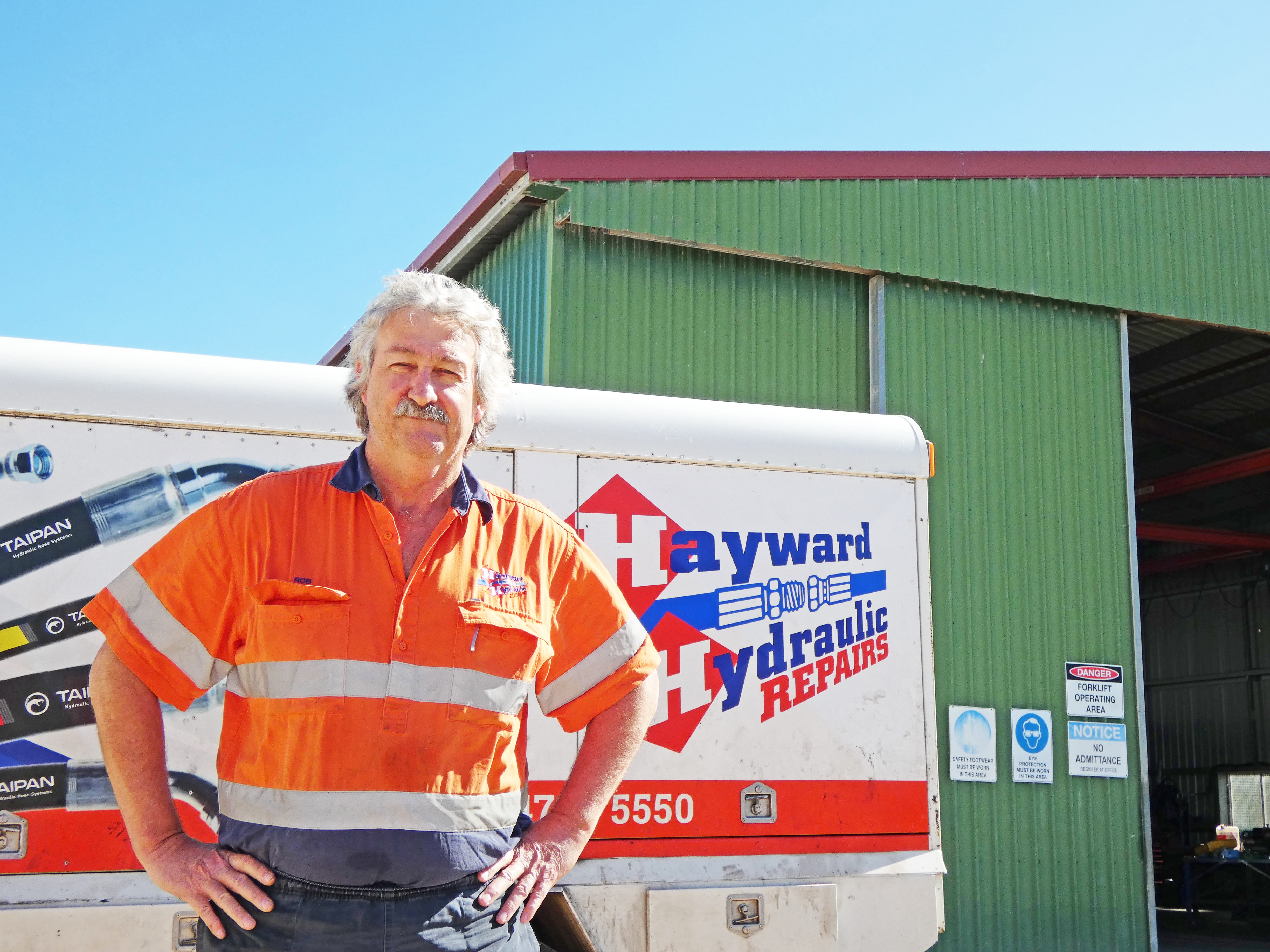
Not every business starts with a blueprint. For some, it begins as a calling… in more ways than one. Burdekin local Robert Hayward had been in the hydraulics industry since he was 18. A diligent worker who loved his job, he quickly built a reputation locally as one of the best in the business. But despite a mutual affinity with the industry that had formed over years, he stepped away in the early 1990s to help his father-in-law maintain a cane property in Clare. Until he received a call. Then another… and another. Rob quickly realised that, despite his brief hiatus, his reputation in hydraulics had not faded. With that, he was pulled back into the game, this time with nothing but a $2,000 ute, a toolbox, and work up to his neck. And the only way to keep himself from drowning in it was, ironically, to go in deeper. “As the Burdekin is, if you do a very good job, word travels quickly between the community. One farmer talked to another, he talked to another, he talked to another… “Until I sat down with my wife one day and said, ‘I think we can make a business out of this.’” His ute would eventually make way for a permanent space—a small sub-shed at Larry Hudson Engineering in the Ayr Industrial Estate that would serve as his headquarters for the following four years. He tackled the first year solo, before demand forced him to put an apprentice on in the second year, and a qualified tradesman in the third. By the end of the fourth, Rob’s work had outgrown its humble base, moving down the road into a new purpose-built shed that would become the home of Hayward Hydraulics. That shed would officially open in 1996, spurring a 30-year legacy sustained by three defining pillars. Growing with the industry “I had no idea how to use computers,” Rob said with a smirk. Admittedly, he hadn’t realised he signed himself up for a three-decade, three-fold evolution between an entire industry, his own business, and himself. What he did know was that he was ready to learn, and eager to grow. It started with the basics. For Rob, that meant wrapping his head around modern computers, attending TAFE courses on emerging welding techniques, and becoming a leader. “I went from being a very good tradesman to having to be an employer,” he said. “You have to be a people's person, you have to treat people the right way, treat your workers the right way. That part I never even thought of until we started getting into it.” Rob treated this evolution as a marathon rather than a sprint, dedicating the business's first decade cementing its reputation as a local leader. After striking up deals with major companies, including Queensland Rail and Wilmar Sugar in the mid-2000s, he decided to take the leap into the mining industry in the early 2010s as a safety net for the unpredictable sugar industry. With that growth, Hayward Hydraulics’ shed would undergo its third structural expansion to accommodate its continuously increasing popularity and modernised technology. He built a habit of gleaning ideas from various online hydraulic magazines, and then building on them to not only keep up with the industry, but to will it into the future himself. “I eventually built a reputation for thinking outside of the square. If somebody's been doing something for 20 years, I'll look at a better way of doing it,” he said. Albeit, he admits he and the business are still evolving today. “I've seen harvesters and planters go from chain and sprocket to hydraulic motors, to hydraulic motors being linked to satellite GPS,” he said. “The industry has changed in leaps and bounds, and you have to keep finding ways to move with it.” Doing it the right way Hayward Hydraulics’ evolution was founded on something Rob didn’t need to be taught. Care. And he makes sure his staff do, too. “I didn't come from a real wealthy family, so we were brought up to work; you work, you do the job right, you get paid,” he said. “So if I'm not happy with something, I'll ask my workers: ‘would you pay for that?’” When the mining industry began to boom in Queensland, Rob admits he had a difficult time retaining workers. To compete, he was forced into paying top-dollar for what he called “good quality workers,” causing financial tension. When asked if compromising staff quality for cost was ever an option, with the conviction of a true-blue purist, he said: “No.” “I've always maintained that a business is only as good as your employees. You can be the best boss in the world, but if you've got workers that people don't like, they don't come through the door,” he said. “My current staff are up there with the best that I've had. I just try to make sure they’re happy to come to work every day.” With quality and care as its engine, Hayward Hydraulics became known not just for technical know-how, but for doing things the right way. As its stature in the industry continued to grow, so did the scope of its customer base. Calls started coming in from as far north as Tully, all the way to Mackay and Western Queensland, all saying the same thing: “We heard you were the guy to talk to about this problem.” Family and community at its heart For the last 10 years especially, the business has made a point of supporting local organisations and sports clubs, most notably the Burdekin Roosters Rugby League Club. Rob described it as a duty to a community that has given so much to him and the company. “The community has been so important to it all. I’ve got some customers that have been with me from day one, and with some, I’m onto the third generation of the same family,” he said. “The’ve given a lot to me. They've helped me grow and supported me, so it's about time I supported them back.” Beneath it all, though, he points to his family as the driving force. “I remember those early days when we were setting up the new workshop, building benches and all that, my two brothers-in-law and my father came out and gave me a hand,” he said. “But my biggest support is my wife. Especially in the early days when I wasn't home, and she solely looked after the kids and everything. “It got to the stage where I was working seven days a week, 12 hour days, and my wife would bring the kids on a Saturday and Sunday, and we'd sit on the shop floor and have lunch. “She's been with me through the lows and the highs, and that I thank her for.” Now, thirty years later, it’s his family pulling him out of the industry. Driven by the desire to make up for lost time with his wife and kids, Rob has loosened his grip on business operations, working four days a week with plans to eventually let his brainchild find its own footing. As for right now, he’s not yet ready to call time on a chapter that was, perhaps, never meant to last this many pages. “I still love what I do,” he said. “The early days come with sacrifices, but when I look back now, it was all worth it. “I remember when it all first started, looking on the ATO website and coming across that statistic that most businesses fail within five years. “When I read it, I said to myself, 'well, I'm gonna make sure I’m not that statistic.’” And that, he did. CAPTION: Rob and his current team. Back L-R: Chase Pearce, Stephan Du Plessis Front L-R: Kade Pearce, Renee Viero, Robert Hayward, Tina Dennis, Bryan Parison Absent: Sam Tomasetig Photo credit: Jacob Casha
Read the full story
The Burdekin has rallied behind a local family after a sudden medical diagnosis turned their life upside-down. Ryan and Holly Davenport dropped everything when their two-year-old son, Rowen, was diagnosed with a brain tumour last month, temporarily relocating to Brisbane for his ongoing treatment. In response, a GoFundMe fundraiser has since raised over $55,000 in support of the family. Created in late May by Shannon Malone, a close friend of the Davenports, the fundraiser has been shared all over Facebook and Instagram by local organisations, garnering comments of support on top of 271 individual donations. “Words can’t describe how much it means to us to have everyone’s support behind Rowen as he begins his journey,” Ryan said. “They have given us precious time to spend with Rowen without the everyday worries.” The money will help fund hospital stays, travel, time away from work, and ongoing treatment expenses as the Home Hill family navigates a medical journey that began in April. Already on edge after daughter, Ally, underwent brain surgery to have a cavernoma removed just before Easter, Ryan and Holly acted promptly when they noticed a twitch in Rowen’s eye. Following weeks of consultations with Townsville doctors and specialists—which included MRI scans and a Royal Flying Doctors flight—Rowen was eventually diagnosed with pilocytic astrocytoma, a slow-growing brain tumour. He has since been transferred to Queensland Children’s Hospital in Brisbane for chemotherapy, with the couple leaving their two young daughters with their grandparents in the Burdekin to be by his side. In their absence, locals have offered meals, helped on the family’s sugar cane farm, assisted around their home and helped look after their daughters, along with the generous donations. Ryan said the funds raised would not just help relieve the financial burden of Rowen’s treatment, but allow the flexibility to fly their daughters down and spend some time as a family. “(The toughest part has been) the unknown, not having our family together … and watching Rowen go through these traumatic times and … not being able to do anything,” Ryan said. “It has been a very emotional journey so far, and it is hard to believe we are only at the start.” Anyone wanting to support the Davenports is urged to donate using the following link: https://www.gofundme.com/f/supporting-the-davos-and-little-rowen?attribution_id=sl:75c20475-06e5-4752-8e11-d1b7a07c7728&lang=en_AU&ts=1779705595&utm_campaign=fp_sharesheet&utm_content=amp20_t1&utm_medium=customer&utm_source=copy_link CAPTION: Funding will allow the family to fly their daughters down and spend more time together during Rowen’s treatment. Photo supplied
Read the full story
The Federal Member for Dawson, Andrew Willcox, has slammed the Albanese Government for an unacceptable ambush on regional communities, accusing the Commonwealth of abandoning disaster-prone areas to balance its own budget. The Federal Minister for Emergency Management, Kristy McBain, used a late Friday afternoon media release to quietly flag sweeping alterations to the Disaster Recovery Funding Arrangements (DRFA). The proposed changes dismantle the long-standing, scalable framework, which historically provided an average of 64 per cent federal coverage and capped support at 75 per cent for catastrophic events. In its place, Canberra intends to implement a rigid 50-50 funding model. This policy shift arrives at the worst possible time for the state; it follows a volatile severe weather season that caused widespread damage across 71 of Queensland’s 77 local government areas. Federal Member for Dawson, Andrew Willcox, is warning that the sudden funding shortfall threatens the future viability of essential infrastructure, local water treatment facilities, and emergency evacuation operations. Mr Willcox, drawing on his extensive experience as the former Mayor of the Whitsunday Regional Council, stated that the Federal Government is completely detached from the realities of regional recovery. "This decision is a direct hit to the heart of North Queensland," Mr Willcox said. "Canberra is treating natural disasters like a corporate budgeting exercise; however, out here, it is a matter of community survival. To penalise the very regions that drive the nation’s agricultural wealth and mining export revenues is a profound betrayal. "During my time steering the Whitsunday community through the wreckage of Severe Tropical Cyclone Debbie in 2017, I learned exactly what it takes to rebuild. We relied heavily on scalable federal assistance to restore our shattered rural road networks. Under a flat 50-50 split, local councils across Dawson would be forced to find millions of dollars in matching revenue; that is a financial burden our regional ratepayer base simply cannot sustain." Mr Willcox emphasised that major historical recovery operations would have been completely unviable under the newly proposed guidelines. "The total reconstruction of the Shute Harbour marine terminal and the $5 million federal package required to replace the decimated Proserpine Entertainment Centre occurred because the previous framework allowed for exceptional circumstances," Mr Willcox said. "Small regional councils do not possess the independent asset base to fund multi-million-dollar rebuilds alone. Furthermore, the historical system guaranteed that funding flowed directly into local economies, ensuring that regional earthmoving businesses and contractors were awarded the repair work. By lowering the funding floor, the Commonwealth is forcing cash-strapped councils to delay vital resilience works; this leaves our communities dangerously exposed before successive wet seasons. "It is a coward’s tactic for the Minister to leave this announcement until the day after the parliamentary sitting concluded, ensuring they avoided any real scrutiny or accountability in Question Time. “This is yet another calculated deception from a government that knows exactly how damaging these cuts are; this is absolutely not what the Australian people voted for, and I truly hope this betrayal is remembered at the next election. "This is yet another chapter in the ongoing federal neglect of regional Australia. The government is hiding behind the cover of an independent review to justify cutting essential frontline services. I call on the Emergency Management Minister to reverse this decision immediately; regional Queenslanders refuse to be treated as second-class citizens.” Supplied by the office of Federal Member for Dawson, Andrew Willcox CAPTION: FIGHTING FOR THE NORTH: Federal Member for Dawson Andrew Willcox MP outside Parliament House in Canberra, condemning the Albanese Federal Government's plan to slash scalable disaster recovery funding for regional councils. Photo supplied
Read the full story
"As the final week approaches for public submissions into the Sugar Code of Conduct, Member for Burdekin Dale Last has renewed his calls for growers to unite and make their voices heard. Mr Last said the public submissions for the sunsetting review of the Sugar Code of Conduct should be an opportunity for sugarcane growers from across the Burdekin to outline the benefits of the code for both farmers and the wider community. “Over recent weeks I have taken the liberty of providing a submission on behalf of the community, because ultimately the flow-on impact from changes in our sugar industry stretch beyond the paddock and the mills,” Mr Last said. “I recently met with several grower representatives which provided the opportunity to bring key stakeholders together, reaffirm my support as the Member for Burdekin and emphasise the need to work collaboratively as the review period unfolds.” Mr Last said while it was important stakeholders took the time to make their voices heard during the public submissions there was no better way to understand the impact of the Sugar Code of Conduct than to visit the area and speak directly to representatives. “A decade ago this district played a central role in bringing this code of conduct to fruition so I would expect our stakeholders receive a seat at the table they deserve,” Mr Last said. “If the Federal Labor Government was serious about consulting with the industry, the responsible Assistant Minister would be looking for every opportunity to listen to those who are most impacted by the Sugar Code.” Anyone wishing to have their say in the review can visit https://haveyoursay.agriculture.gov.au/sugar-code-review"
Read the full story
.jpg)
And so the new year begins. As this is my first Councillor column for 2025, I would like to reflect on the past year – and what a year it has been.
Having been overwhelmingly elected by people to represent them in Council, I have tried my best to do so, sometimes garnishing the ire of fellow Councillors and directors. So be it, I fight for what I believe in. It has been a steep learning curve, understanding correct protocol, local laws and Government legislation. It’s not as cut and dried as people may think, and you must work within the scope of it all.
Decisions have to be made. Sometimes coming to terms with those decisions and the backlash that ensues is cause for a headache. If people disagree with those decisions, I would encourage them to inform themselves as to why they have been made. Pick up the phone and ring a Councillor, our phone numbers are on the Council website. Attend a Council meeting. Become an involved community member.
Hopefully the district can dust itself off and recover from the debacle that was sugar cane harvesting season. Mill disruptions have had a devastating effect on those in the industry. Mill workers, contractors, and farmers, have all been impacted by the lengthy season through no fault of their own and this flows onto the economy of the Burdekin Shire. Government needs to recognise and understand this and act accordingly.
With that being said, I hope each and every one of us has had a happy Christmas with their family and friends. A new year brings new hope. A hope for positivity and kindness to our fellow man. A hope for change. God Bless.
%20(1).jpg)
I hope everyone had a wonderful Christmas and New Year, filled with relaxation, joy and time spent with loved ones. It’s great to see our businesses reopening after a well-deserved break and getting back into action.
As most of us return to work, it’s a good time to reflect on the year ahead. No doubt many of you set New Year’s resolutions, and perhaps a few have already been broken – we’ve all been there!
We are truly blessed that the holiday period was disaster-free, allowing us to enjoy the season in peace. Now, as we step into 2025, I’m excited and optimistic about what lies ahead. There’s much to look forward to, and I’m confident it’s going to be another fantastic year for the Burdekin.
Here’s to making 2025 a year of growth, success and community spirit. Let’s embrace the opportunities ahead and continue working together to make our region the best it can be.
Stay safe, stay positive, and let’s make this year a memorable one!
Should you wish to reach out, don’t hesitate to contact me directly by phone on 0447 150 582, or feel free to send an email to mayor@burdekin.qld.gov.au.

Introducing the one and only Tones and I – or as her friends call her, Toni! This beautiful tabby with striking markings and captivating green eyes is ready to find her forever home. Despite facing challenges in her young life, including being a young mum, Toni is a resilient little fighter who’s determined to find the love and security she deserves.
Toni is a social and affectionate cat who loves food, attention, and playtime. She’s especially fond of feather wands and will happily engage in a playful chase. Whether it’s getting scratches at the base of her tail, full-body pats, leg rubs, or being picked up and coddled, Toni is always up for some love. Plus, she’s quite the chatterbox and enjoys carrying on a conversation with her humans!
Currently living in a foster home with other cats, Toni has a bit of “sassy little sister” energy and may prefer to be the solo queen of her domain. However, with a slow introduction, she might be open to sharing her space with a confident, friendly feline companion.
If you’re looking for a loving, chatty companion who’s ready to bring joy and affection into your home, Toni could be the perfect fit. Could you offer this determined little lady the forever home she craves?
Adoption Details:
• Adoption Fee: $195
• Included in the Fee: Desexed, Microchipped, Up-to-date Vaccinations, Flea/Tick/Intestinal Worm Treatment
• DOB: 01/04/2023
• Breed: Domestic Shorthair (DSH)
• Sex: Female
• Kid-Friendly: Yes
• Cat-Friendly: Yes (with slow introduction)
• Dog-Friendly: Untested
• BIN: BIN0000268254643
If you’re interested in meeting Toni and offering her the loving forever home she deserves, please submit an adoption enquiry form at: https://www.angelpawsinc.com.au/forms.html.

Established in 2011, the Burdekin Men’s Shed Association (BMSA), is a not-for-profit organisation that has been a haven for men to keep up their skills in retirement, engage with others and learn about men’s health issues, while giving back to the community.
The BMSA meets every Monday, Wednesday, Friday, and Saturday from 8am-11.30, where they promote various activities that focus on recreation, skill building, and community projects such as making their popular kid’s toy boxes, and tables and chairs.
“We have five buildings and three workshops – one for woodworking, one for small items of craft, another for welding, metal fabrication and mechanics – and we have another front building where we run garage sales. We have a big stock of furniture and items up there. We also have our own chooks, so we can provide eggs for our members,” Charles Ford, Secretary of the BMSA says.
With monthly general meetings and committee meetings three times a year, the ‘Shed’ has felt like a home away from home for many men, making them feel part of something while offering a place to address health issues in a safe, supportive environment with other blokes.
“We get a guest speaker to come along who speaks about some form of men's health issue, which the guys find informative. After the meeting, we then have a sausage sizzle and drinks and a laugh. We also have monthly luncheons at six different venues within the Burdekin, which is for our members and friends to participate in, along with trips to other Men's Sheds in Far North Queensland,” Charles adds.
The BMSA is responsible for all their expenses, from council rates to site building maintenance and equipment repairs, insurance, electricity, printing and postage etc. However, that gets more difficult with the decline in membership numbers due to members passing on or moving. The BMSA once had 80+ members, today it’s dwindled to half that number.
“For the sustainability of the Men's Shed, we've got to look at trying to recruit younger members of the community, and members who will basically take a position on our management committee.
“It's a good place to be and we want them to come enjoy themselves, as so many do,” Charles adds.
A big selling point about the Men's Shed is that it offers a reprieve for men’s partners and family, instead of them being stuck at home looking up at the ceiling. Once families bring a man down to the Men's Shed, they can then do whatever they want for that short term the men are there.
“When a man comes, participates, and has enjoyed himself, he goes come home and talks about something new and exciting. We’ve seen a lot of benefits for men and their families,” Charles smiles.
Annual membership fees are only $50, but with all the incredible benefits for men’s overall health, well-being and their families, it’s hoped more men will join and contribute.
The Burdekin Men’s Shed Association, which relies on fundraising and grants to keep the lights on, welcome donations or sponsorships from businesses and companies, families, and individuals, who wish to support them in addressing men’s health (physical, mental, emotional, social well-being), within the greater Burdekin region.
For donations, sponsorship, or information, call: 0467 083 502, email: burdekinmensshed@outlook.com or better yet, go visit them at 155-157 Young St, Ayr.
Burdekin Men’s Shed Secretary, Charles Ford, and members, Antony, and carpenter, Steve Bridges. Photo: Mark T. Rasmussen
Burdekin Men’s Shed’s only carpenter (at present), Steve Bridges, and BMSA Secretary, Charles Ford, outside one of their sheds.

New and improved agricultural levies legislation will replace the existing framework next year, making the levy system more user friendly for participants and making it easier for them to understand their obligations.
More than 50 pieces of legislation governing over 110 levies and charges – across 75 commodities and 18 bodies that receive levies – are being streamlined into five Acts and subordinate legislation.
Deputy Secretary for Agriculture, Fisheries and Forestry Policy, Matt Lowe, said the new legislation would make life simpler for those interacting with it from 1 January.
“From the start of 2025, the new legislation will make obligations clearer for levy payers, collection agents and bodies that receive levies, and better support industries seeking to pursue new or change existing levies," Mr Lowe said.
“More flexible and consistent, it will benefit current and future levy system participants and help industry to get the most out of the levy system.”
“The streamlined legislation will allow primary industries to continue to invest collectively in research and development, marketing, biosecurity activities and responses, and residue testing.”
“Our agricultural levy system is a long-standing, successful partnership between industry and government to facilitate industry investment in strategic activities, and the new framework will make it stronger and more effective,” he said.
Levies are collected from farmers, producers, processors and exporters, with any proposal for new, or changes to existing, levies requiring majority agreement among levy payers.
In 2023-24, the Research and Development Corporations, Animal Health Australia, Plant Health Australia, and the National Residue Survey, received just over $600 million in levy payments.
The Australian Government contributed an additional $470 million in matching funding for research and development activities.

Sugar cane growers in North Queensland are grappling with the dual challenges of rising electricity costs and restricted access to peak-time energy. According to irrigation specialist, Chris Doblo, of Farmacist Pty Ltd, the solution lies in smarter, more efficient practices. Drawing on his extensive experience, Mr Doblo shares practical strategies for growers to future-proof their operations and adapt to these mounting pressures.
One of the most critical steps for growers, Mr Doblo advises, is to evaluate their current irrigation systems. With potential restrictions cutting irrigation time by 20 per cent, it is essential to optimise systems to deliver more water in less time.
Automating For Success
Automation offers significant opportunities for growers to optimise their irrigation processes. With limited irrigation hours and ongoing labour shortages, automated systems can provide precise control over water application, ensuring efficiency and consistency.
“Automation has become more accessible and affordable,” Mr Doblo explains. “It’s an effective option for growers to overcome resource and time constraints.”
Features like automated scheduling and real-time monitoring allow water to be applied during off-peak energy periods, maximising cost savings.
Harnessing Solar Power
Solar energy continues to be one of the most practical investments for sugar cane growers. For pumps of 18.5 kW or larger, installing a solar array can significantly reduce reliance on grid electricity, particularly during daylight hours when energy demand is highest.
Planning For Off-Peak Energy
Aligning irrigation schedules with off-peak energy tariffs, such as Tariff 34, offers growers immediate savings of up to 30 per cent. While these tariffs may face additional restrictions in the future, Mr Doblo emphasises their current value in reducing operational costs.
However, he warns growers to prepare for potential interruptions, as off-peak energy may eventually become a “switchable load” during peak demand periods. Diversifying energy sources and improving irrigation efficiency are essential to navigating these changes.
Adapting to rising electricity prices and shifting energy regulations is no easy task, but the solutions are within reach for North Queensland’s sugar cane growers. As Mr Doblo explains, “Investments in infrastructure, automation, and solar energy are not just beneficial—they are essential for the future of our industry.”
By adopting these strategies and embracing innovation, growers can overcome energy constraints and maintain sustainability.

Burdekin firefighters spent some time at Wilmar Sugar’s Pioneer Mill last month, to do a site familiarisation tour and begin planning a joint emergency exercise drill.
The site familiarisation was led by Operations Superintendent, Dean McNamara, and Safety Advisor, Ashley Corradi.
During the visit, new members of the Queensland Fire and Emergency Services (QFES) team were informed about site-specific risks and where fire safety equipment is located on-site.
They also met Manager Operations, Matt Norton, Emergency Response Team (ERT) Captain, Patrick Patterson, and ERT member, Ryan Taylor.
Ashley said the site famil was beneficial to both QFES and Wilmar Sugar and Renewables employees.
"It is important that new members of the QFES do these visits as it makes the site familiar to them, ensuring a quick response in the case of an incident,” she said.
QFES officers make site visits to our other factories on a regular basis. They also participate in mock emergencies with Wilmar's emergency response teams, Queensland Ambulance Service and Queensland Police Service.
Pictured during the familiarisation tour are, from left, Emergency Response Team Captain Patrick Patterson, Senior Firefighter Peter Felesina, Firefighter Lindsay Wilson, Firefighter Carter Dal Ponte, Station Officer Ash Ryder and Operations Superintendent Dean McNamara. Photo source: Wilmar Sugar and Renewables

Social media has transformed the way we explore and share the natural world, but it has also had unintended consequences. Studies show that the rise of social media has contributed to habitat disturbances, impacting native species. Popular wildlife spots often experience increased visitor numbers, which can lead to habitat abandonment, changes in usage patterns, reduced breeding success, and altered feeding behaviours.
If you’re planning to photograph wildlife and share it online, here are some tips to ensure your actions contribute positively to conservation efforts:
Respect Your Surroundings
Be mindful of your environment. Avoid trampling sensitive vegetation or disrupting animals in their natural habitats. Every small action matters when it comes to preserving delicate ecosystems.
Say No to Flash Photography
When photographing nocturnal animals, avoid using flash. The sudden burst of light can startle them, disrupt their behaviours, or even lead to stress, which can have long-term impacts.
Maintain a Safe Distance
Keeping an appropriate distance from wildlife is essential to prevent causing stress or prompting animals to abandon their habitat. Use zoom lenses or binoculars to observe and capture them without interference.
Avoid Playback of Animal Calls
While it might seem like a harmless way to attract wildlife for the perfect shot, playing recorded animal calls can confuse or distress creatures. This can cause them to leave their nests or aggressively defend territory, putting them at risk.
Follow Local Regulations
Abide by local rules, including restricted access areas and opening hours. These guidelines are in place to protect both visitors and wildlife, ensuring a safe coexistence.
Don’t Mark or Promote Hidden Gems
Sharing the location of a special wildlife spot might seem harmless, but it can lead to over-visitation and increased disturbances. Enjoy these places quietly and leave no trace.
Queensland’s unique flora and fauna are worth celebrating, but it’s crucial to do so responsibly.
By being mindful of our actions, we can help ensure these precious environments thrive for future generations to admire.
Queensland Department of Environment, Science and Innovation

Shay Linton, owner of Home Hill News & Coffee, is set for the back-to-school rush that invariably comes this time of year. With preparations in place, they cater for all the local Burdekin schools by providing book lists and stocking necessary school uniforms and supplies.
They anticipate serving many families in the coming weeks, all who are looking for school uniforms and other supplies. Additionally, they offer non-school related book items also.
“We've had Christmas, and now we're gearing up for the kids to go back to school. It will be a hectic couple of weeks for us, and for parents. We’ll easily have a couple of hundred parents and kids come into the shop for their return to school purchases but we’ve got them all covered.”
“We can do book lists for the schools, where all you need to do is to drop your book lists in and we'll prepare them for you. We also have school uniforms for Home Hill State High and Home Hill Primary, which they can try on or order here. We're also going to have striking new backpacks and lunch boxes coming and cool new book covers for them to cover their books with.”
“And for parents waiting for their kids to choose, with a coffee shop here means they can have a relaxing coffee or tea,” she smiles.
If that wasn’t enough, there’s also the extra incentive to pop in and visit Home Hills News & Coffee, because they’ll be holding a prize draw as Shay explains.
“Home Hill News & Coffee will be offering a ‘Shop local’ incentive, which includes a prize draw for everyone who purchases school supplies from us. We have a $200 gift voucher for 1st prize, $100 for second, and $50 for third. The draw will take place on the morning of the 28th of January, right in time for the first day of school.”
“We'd like everyone to think local, shop local, and support local,” Shay expresses.
With that in mind, visit Home Hill News & Coffee for all your back-to-school needs, enter their draw, and be sure to grab yourself a coffee.
Home Hill News & Coffee owners, Ken & Shay Linton and their daughter, Mackenzie, showcasing several of their back to school supplies. Photo: Mark T. Rasmussen

Sid Ruskin, an 83-years young scallywag, has been part of the Burdekin ever since he first moved here 22 years ago. Born in Paddington, Sydney, his family moved from Captain's Flat to Cobar, a copper mining town in western New South Wales. They then moved to Mount Morgan near Rockhampton, before later going to Collinsville.
Sid attended school in Collinsville, before receiving a teacher scholarship to Kelvin Grove in Brisbane, becoming a primary school teacher. From there he moved to Townsville and joined the Air Force.
“My next door neighbour was in the Air Force at the time. Now that to me, sounded pretty good, so I joined the Air Force, which was in 1964. Being in the Air Force, you got around all over Australia. After 22 years, I went to RMIT (Royal Melbourne Institute of Technology) and became a communications engineer, then became a radio officer in the Air Force. Eventually, after being a ‘baggy bum’, I worked my way up, before eventually retiring as a Squadron Leader in Darwin,” Sid states.
Retiring from the Air Force, Sid then worked at a TAFE College in Townsville, teaching electronics and management before moving to Home Hill to care for his in-laws.
“After leaving Darwin, I got out of the Air Force right around the time these airplanes flew into those big buildings in America, which was my 60th birthday. So, I said to the missus, ‘pack up we’re leaving’. We bought a caravan to go tour Australia, before my wife's mum and dad got sick. We came back to this region and bought a house in Home Hill to look after them. And would you believe it, they both turned their toes up,” Sid jokes.
In his time here, Sid’s been involved in the Burdekin Race Club as Secretary for 10 years, while also being radio announcer on Sweet FM.
“I was Secretary of the Race Club because they couldn't find anyone, so they said, ‘Look, can you look after it for 12 months?’ 10 years later, I was still there. But that's how things happen in the Burdekin. Then for 10 years I was a radio announcer on sweet FM. I still listen to it, he says.
In his time, Sid's known five Australian Prime Ministers including Arthur Calwell.
“Arthur Calwell is the only politician in Australia to have had an assassination attempt. He lived up the road from me in North Melbourne. We were trying to get a new school, because we're right next to a tannery. Anyway, old Arthur came over and he put his support behind us and helped get a new school. I've known five prime ministers,” Sid declares.
Sid has two sons, one who lives in Home Hill, the other in Sydney, who recently visited for a fishing trip.
“He came to visit the other day, and the first thing I got him to do was cut my toenails because I can't reach them,” Sid laughs. “Anyway, he came up and wanted to go fishing. We caught a couple of brim. It's the first time he's been here for 10 years.”
Sid’s content with his current lifestyle volunteering at the Home Hill Visitor Centre, while his wife still keeps him active around the kitchen.
“She still chases me around the kitchen but it doesn't do her any good,” he smiles.
Sid Ruskin (83), good for a yarn and a joke. Photo: Mark T. Rasmussen

Sophie Robertson has achieved another commendable milestone in her STEM journey, following her outstanding selection to attend the prestigious National Youth Science Forum this January.
The celebrated National Youth Science Forum provides students with a broader understanding of study and career options available in science, technology, engineering and mathematics (STEM), across a nine-day session. Sophie will travel to Canberra from the 6th to the 14th of January to live and study on the Australian National University campus to be fully immersed in a world of all things STEM. Along with fellow students from across the nation, Sophie will participate in tours of science and technology facilities, learn about cutting edge research, engage with industry partners, learn about university, training and STEM career pathways, and network with former NYSF participants.
“I am excited to connect with like-minded peers at the NYSF as I’ve made wonderful friends through STEM and have learnt so much from them,” shared Sophie.
“I absolutely love STEM – it encourages me to view our world through a different lens, and always ask why?”
“I became fascinated in STEM as a young girl, when my mother shared her passion for astronomy with me, therefore, my favourite branch of STEM is astrophysics!”
Sophie has participated in many STEM related programs throughout her schooling, including attending the SPARQ-ed Junior Research Immersion Program, the CyberTaipan Young Women’s Career Tour, and the six month long Curious Minds Program.
As the school year commences later this month, Sophie will begin her role as School Captain of Ayr State High School, and with her secondary education coming to a close this November, she plans to continue pursuing her passion for STEM.
“I definitely plan on pursuing a career in STEM,” Sophie says with excitement.
“I intend on studying a Bachelor of Aeronautical Engineering at the Australian Defence Force Academy in Canberra, where my dream is to work on rocket propulsion systems in the Defence Space Command.”
Sophie Robertson at work and play, applying her knowledge and skills. Photo supplied.

In a new (and hopefully continuing) segment here at Burdekin Life, we’re hitting the streets to meet you and ask the hard hitting questions. Well, not really, they’ll be easy. But we’re keen to hear your voice, and get your thoughts and opinions.
This week’s question: What New Year’s resolutions do you have, or are there any revelations you learned from last year that you hope to do better and/or grow from for this year?
Barbara: “I'd like to go swimming a lot more than what I have been. I usually go three or four times a week, but lately it’s only been twice as it’s been too hot. That sounds stupid, because the best place to cool off is the pool I know. But to get there, I have to walk to the pool, but once I get there it’s very invigorating. I also volunteer here at the Visitor Information centre twice a week and at the op shop once a month, so I’d like to find more time for myself to do the things I like to do, such as sewing and quilting. Yeah, in short, I want to swim more and find more time for my hobbies,” Barbara enthuses.
Sid: “My new year's resolution for 2025 is a really simple one – and that’s to just keep my toes pointed in the right direction I reckon. And how do I do that? What do I plan to ensure that happens? Easy, to just keep standing up right. Yep, that sounds pretty good for a bloke that’s 83. So that’s all I need or want from this year, is to keep being above ground,” Sid jokes.
Isaac: “My resolutions would be to not only be a better person to myself and my family and my kids, but everyone that I see throughout the day at work and in my home life. I am six months sober. I made some poor choices and mistakes through last year. I'd like to learn and continue to learn from them. I also want to point out to not just for blokes, but females out there too, it's not weak to speak. I went through a rough patch not too long ago last year and if you’ve got something going on, just reach out to family members, and health professionals. They've all been amazing support for me. With mental awareness for other people out there, you know, reach out to somebody before doing anything, radical. That's my resolution, to continue to be a better person,” Issac adds.
Pam: “I don't know how to put this into words, but probably just to do more for me, instead of anybody and everybody else. I've been putting myself kind of second for a while now, but in 2025 I plan to change all that. I want to focus on my own desires and interests for a change, rather than prioritising those of others. I have been neglecting my own needs and I’m ready to shift my attention to more of my own personal fulfilment. I am determined to make positive changes for me in 2025,” Pam declares.
Sage: “I plan to prioritise my family time in 2025, where I am aiming to allocate more time to them after managing multiple facilities for over a year now. The time that we all spend at work, it just consumes your whole life at times. We are now running just one facility here in Home Hill, and the workload is lighter and better. If I can allocate that little bit more time for the surf club and for my family that would be ideal, as I seek to improve my work-life balance by dedicating time to family. So, yeah, that's the main goal for me, to just have more family time,” Sage muses.
Anthony: “My New Year's resolutions are a focus on happiness, health, and prosperity. I think you can always go into a new year with the hope of happiness and health above all. And of course, you have to throw prosperity into that. Everybody needs a bit of prosperity to survive. But health is key, particularly as you get older because you have to really help your body stay healthy. I think a revelation for me for 2025 is to help those less fortunate. More people are less fortunate these days. The economy is straining people. The economy is bruising people. In this economy money is harder to get, and there's an imbalance. So if I can try and help those less fortunate than myself, whether in small amounts or another way, then that can be significant to some people,” Anthony concludes.
Barbara Sullivan (73). Photo: Mark T. Rasmussen
Sid Ruskin (83). Photo: Mark T. Rasmussen
Isaac Wilson (29). Photo: Mark T. Rasmussen
Pam Murray (70). Photo: Mark T. Rasmussen
Sage Hisatake (52). Photo: Mark T. Rasmussen

A new artistic talent has emerged in the Burdekin. Jane Baltzars, who hails from the small Welsh town Barry, has called this region home for the past 15 years. She’s now drawing up a storm and garnering praise for her real-life animal depictions.
For someone who recently re-picked up the pencils about 18 months ago despite creating art for 45-50 years, the results have been nothing short of outstanding! Specialising in pencil drawing, Jane uses brands like Faber Castell and Caran d'Ache.
“I always had an interest in art, especially pencils. When I was in school, I drew a detailed picture of a rock pool I was proud of. However, the student next to me splashed water on it and it became blurred. When the teacher saw it, she said it improved the art, but I was upset. They made me feel like my art wasn’t very good, so I concentrated on science subjects instead,” Jane explains.
“Over the years, however, I taught myself oil painting, while I studied watercolours in night classes I took. But I always had a soft spot for drawing in my spare time,” she smiles.
Seeing her talent rise, Jane’s partner John, bought an expensive coloured pencil set for Christmas a few years ago, before she plucked up the courage to join an art group that specialised in animal coloured pencil drawing.
She enjoys drawing wildlife, particularly cheetahs, which are inspired by her volunteer work in Namibia several years earlier.
“My passion is Africa. I've been a number of times. I want to do pictures of elephants and lions, but especially cheetahs because I spent about two- or three-weeks volunteering in Namibia with them. I find them the most fascinating animal.”
The Burdekin isn’t about to lose Jane to Africa, is it?
“No because in our garden we've got agile wallabies, possums, and plenty of bird life. And that's what I love, animals. I see myself drawing more wildlife here,” she enthuses.
Jane advises beginners to start simple, practice regularly, while emphasising having fun and not being too critical of one's own work.
“Start off simple. Do pictures that you can draw. Change it into a simple line art and then just colour, practice, and have fun with it. Just have a go,” she urges would be artists.
Jane Baltzarswith a small sample of her spectacular pencil drawings. Photo: MarkT. Rasmussen
Cheetah eye by Jane. Image: Supplied.
German Shepherd. Image: Supplied.
Wine been poured into a wine glass. Image: Supplied.

When Heather Jorgensen started her Sunday radio program with two colleagues at Sweet FM, the station was only five years old. Twenty years on, and both her and the station are still going strong.
Heather, who has lived in the Burdekin region for over 50 years after growing up on a cane farm, has been co-hosting the regular weekly Christian music program since 2005. She was initially inspired to start the program after a priest at her local church sought volunteers.
“We're in church one day, and our priest said they wanted to start a Christian program on the radio, is anybody interested? I just knew I had to do it. It was something I felt called to do,” Heather explains.
The ladies are on a roster, and play a mix of hymns and modern Christian music while incorporating prayers and Bible readings. After transitioning from CDs, they now use USB drives for all their music.
“I started with CDs on a very small console. Now we've got no CDs and a much larger console. That’s been the biggest change in my time here. When we switched over, I searched the internet for all the different artists and songs that I can now easily download onto a single USB stick,” she says.
“We find older listeners relate well to hymns that they would have sung growing up. I also like to find more modern Christian songs, for variety,” Heather states.
Despite not knowing the exact listenership, they have built a good following over the years, with Heather receiving positive feedback from the community who recognise her voice.
“Quite often you're walking down the street and someone will say, ‘Oh, I heard you on the radio on Sunday’, and you think, oh that’s nice. It's lovely to hear,” Heather says joyfully.
She plans to continue the program for some time to come, finding it fulfilling and varied. Heather encourages readers to tune in to the weekly Christian program, which airs from 7:30 to 9:00am every Sunday, which Heather hopes provides a relaxing and uplifting experience.
“It's only an hour and a half and so if people are looking for something relaxing, I find it makes them feel good. It seems to work,” she declares.
If you’re interested in becoming a presenter for Sweet FM, contact the radio station on: (07) 4782-8394 or email: admin@sweetfm.com.au.
Heather Jorgensen, one of Sweet FM’s Sunday Christian presenters, outside the radio station office. Photo: Mark T. Rasmussen

Home Hill State High School (HHSHS) are delighted to be the worthy recipients of a brand spanking new horticultural project initiative that’s set to be a massive boon for both the school and the Burdekin region.
The new horticultural protected cropping system is likely the first of its kind at a school in Queensland, offering unique educational opportunities. It’s also a significant investment, not just in cost, but also for the school and the students who will now be able to attain certificates in horticultural studies. The aim is to teach them the benefits of great horticulture which may encourage them to stay in the region to pursue career opportunities.
L-R: HHSHS students, Michael Finn, Eli Wilkie, Principal Sharon O’Neill, Kiarra Werde, Medea Burr, Agricultural teacher Louise Nicholas, Matilda Forbes, Angelina Curro, Teacher Aide Megan Barbagallo, Danny and Alex Kirkwood. Photo: Mark T. Rasmussen
Louise Nicholas, an agricultural science teacher at HHSHS, is passionate about agricultural education and loves seeing the joy in students learning about agriculture. The establishment of the protected cropping structure, also known as an ag precinct, is designed to grow vegetables in a controlled environment, while teaching students.
“The structure which came from Canada, was imported over to allow us to grow vegetables in a protected cropping situation so we can limit the amount of pests and diseases but also control the weather conditions,” Louise says proudly.
The huge complex, which took six months to build, began as a pre-Covid State electoral promise in 2020 before receiving additional funding to move forward. Funded by the Department of Education and Navarro Minerals, who both supplied significant funding, MP Dale Last, also got behind the initiative.
“Dale definitely helped us get it across the line. From there, we had further talks with builders and architects, and then in March, we got the area nice and clean and tidy, and the footings down. We had to wait for the building to be come across from Canada, but then it went up very quickly and was finished around the end of October,” Louise smiles.
The ag precinct is automated and based on weather conditions, adjusting humidity, temperature, and wind speed, and includes a nutrient film technique system and a potting up system for propagation activities.
“We plan to grow cucumbers, lettuce, and other crops, to allow students to experience the whole propagation activity to then see, distribute, cook, and eat their efforts,” she says.
Plants will be trellised to the ceiling, and the structure can grow 1500 lettuce using a nutrient film technique system. The produce will be harvested and stored in a cold room and packed by students for distribution via community outreach.
“We have a cold room and a little packing area for the students to pack up the produce and to keep it nice and fresh to the end point. Then it’s hoped we can supply the local community, such as Meals on Wheels or local retirement homes, like we have in the past, with fresh, clean, healthy produce.”
The school plans to start a Vocational Education Training (VET) course in Certificate II in production horticulture in early February, involving students from both Home Hill and Ayr High state schools. The course aims to teach students about propagation activities and other aspects of horticulture with the aim to inspire students and foster career pathways in agriculture, for them to stay in the Burdekin.
“We've got a partnership with Ayr High for 2025. They'll come here to HHSHS to do the practical side of things, and we'll go to their school to do the theory. Eventually we’ll expand that out to the other high schools in the Burdekin. The goal is to inspire students to pursue careers in agriculture and develop a deeper understanding of food and fibre production,” Louise comments.
“We'll have students from grade seven through to 12 next year engage in agriculture. To have this in the Burdekin is fantastic,” she smiles.
But it’s not just for students, with the local community as a whole getting behind it, it is hoped they will get more involved and help foster and support its growth.
“The community has been very supportive, providing sponsorship and intellectual support from local organisations. The Prawn Stop for example, has been fantastic in supporting our initiative here at school as well. We've also had people who have reached out and provided sponsorship, which we truly appreciate. We've also got the DPI Ayr Research Station, who have been very generous with offering their intellectual ideas and support there. It’s our hope other business and organisations also come on board.”
If you or your business is interested, contact the school’s principal, Sharon O’Neill, to discuss ways to support the program or contribute.
“The school appreciates the community's encouragement and any offers of support. Hopefully we can support the community that supports our school.” Louise concludes.
Back row L-R: students Danny Kirkwood, Eli Wilkie, Michael Finn, Medea Burr, HHSHS Principal, Sharon O’Neill. Front row L-R: Agricultural Science teacher, Louise Nicholas, students, Alex Kirkwood, Matilda Forbes, Angelina Curros, Kiarra Werda. Photo: Mark T. Rasmussen
Inside the impressive new horticultural protected cropping system. Photo: Mark T. Rasmussen
The cold room and packing area. Photo: Mark T. Rasmussen
The ag precinct’s two buildings. Photo: Mark T. Rasmussen
The horticultural protected cropping system is a huge structure. Photo: Mark T. Rasmussen
Publishers Indemnity. Any individual or entity that places advertising, supplies copy material, or submits editorial content to Core Life Publishing agrees and undertakes to ensure that all such material:- Does not infringe upon any copyright, trademark, or other intellectual property rights;- Is free from any content that could be considered defamatory, libelous, or slanderous;- Does not infringe upon any rights related to privacy or breach of confidence;- Contains no obscene, indecent, or otherwise unlawful material;- Complies fully with the Trade Practices Act and all other applicable laws, regulations, or statutes.Furthermore, by submitting or placing such material, these individuals or entities agree to indemnify and hold harmless the publisher, Core Publishing and Events Pty Ltd, and/or its agents from and against any and all investigations, claims, demands, liabilities, damages, costs, or judgments arising out of or in connection with the material provided. All material is believed to be accurate at the time of printing and remains the copyright of Core Publishing and Events Pty Ltd.
© 2026 Life Publishing Group Pty Ltd.
